Connect with us

Fertility

Why hormone testing shouldn’t be a one-off

Published

on

Progesterone is a key hormone in assessing ovulation. FemTech World speaks to Amy Beckley, founder of Proov, to find out how at-home testing could change the way infertility is diagnosed and treated.

Progesterone is a female sex hormone produced mainly in the ovaries following ovulation each month – a crucial part of the menstrual cycle and maintenance of pregnancy.

But when progesterone levels are low, women may have difficulty conceiving and experience uterine bleeding, irregular periods and spotting.

In the US, over six million women – 10 per cent of the female population – aged 15-44 have difficulty getting pregnant or staying pregnant.

“This happens because the US healthcare system is very reactive,” says Amy Beckley, scientist and founder of the home testing company Proov.

After seven miscarriages Beckley and her husband had to actively try conceiving for 12 months before they could see a fertility expert. She was diagnosed with unexplained infertility and the doctors recommended IVF.

“I have a PhD in pharmacology, so I’ve been studying hormone signalling for a long time,” she explains.

“I realised the only thing that was different between my IVF cycles and my natural pregnancies was the fact that after embryo transfer I was put on progesterone supplements to support my luteal phase. This actually matched my previous idea, that I must have a progesterone deficiency causing my short luteal phases.

“But since progesterone in blood fluctuates a lot, one single blood test can’t detect suboptimal levels throughout the implantation window. The research [on progesterone] was there, but nobody had actually come up with a diagnostic test.”

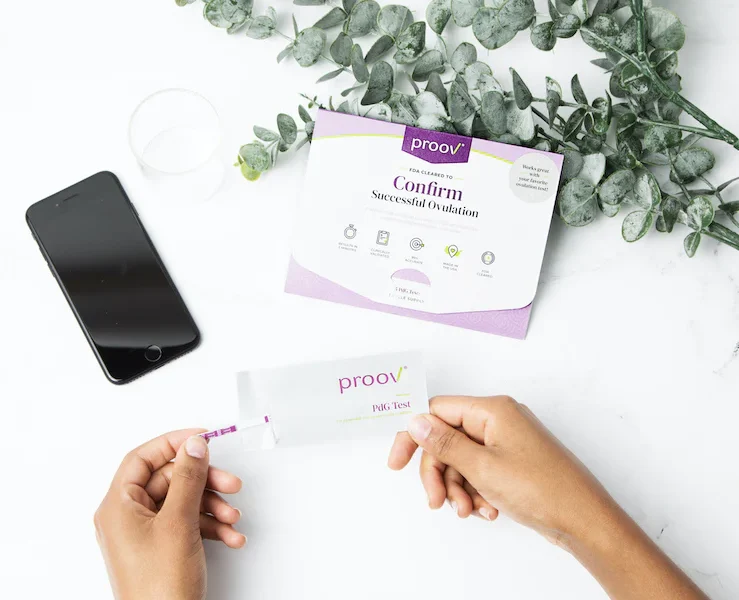
This is when Beckley decided to create Proov Confirm, a urine marker of progesterone and the first and only FDA-cleared PdG test kit to confirm successful ovulation at home.

Her company now offers a suite of diagnostics to provide fertility insights throughout the entire menstrual cycle by allowing women to measure all of the menstrual hormones daily.

Women can then snap a photo of each test within the Insight app and follow the in-app prompts to understand ovulation status, get daily insights and an ovulation insights score, along with a personalised action plan to maximise their wellness.

The idea behind Proov was to empower women with critical information about their ovulation and menstrual cycle, the founder says. “Most women don’t check their hormonal health because there’s no help available,” she adds.

“Women are very savvy and very data-driven. When they have a problem, they try to reach out and get help, but very often there’s nobody on the other end to help them.”

“But it’s very important to look at what your hormones are doing over time. Blood testing misses a lot of issues, so by simply giving women that insight and the actual hormone value we want to help them learn about their cycle and understand it.

“We do everything through our free app and women love this digital approach,” Beckley continues. “They love the idea of seeing numbers and having all the data they need. They love having it stored and having a notification to remind them to take a test the next day.

“It makes things a little bit easier and provides data in a format that’s easily digestible.”

While Proov is already working with a number of American clinics, Beckley hopes to expand their partnerships beyond the US and get approvals in other countries.

“Apart from expanding geographically, we also want to expand into hormonal health in general,” she adds.

“We’re really good at understanding the menstrual cycle to help women get pregnant and we realised that the menstrual cycle is not only important for getting women pregnant, but it’s also important for everyday life.

“Our goal is to support women through heavy, painful periods, PMS and menopause and help them thrive during those hard times.”

Tests are available on proovtest.com and amazon.com.

 

Insight

Covid vaccine not linked to decrease in childbirth, study finds

Published

on

The Covid vaccine is not behind a fall in childbirth, a Swedish study has shown.

Rumours on social media have alleged that the jab impairs chances of becoming pregnant.

In the later stages of the pandemic, some countries, including Sweden, saw fewer births, raising the question of whether vaccines were responsible.

The study analysed all women aged 18 to 45 years in Region Jönköping County, Sweden, a total of almost 60,000 women. Of these, 75 per cent were vaccinated once or more against Covid-19 from 2021 to 2024.

Researchers at Linköping University used healthcare records on childbirths, miscarriages and deaths.

Comparing vaccinated and unvaccinated groups, the researchers found no statistically significant differences in childbirths or miscarriages.

This aligns with previous studies finding no link between the Covid vaccine and fertility.

 Toomas Timpka is professor of social medicine at Linköping University.

Timpka said: “We see no difference in childbirth rates between those who have taken the vaccine and those who haven’t.

“We’ve also looked at all registered miscarriages among those who became pregnant, and we see no difference between the groups there either.

“Our conclusion is that it’s highly unlikely that the mRNA vaccine against COVID-19 was behind the decrease in childbirth during the pandemic.”

The researchers suggest other explanations for the dip in births.

People now in their 30s were born in the late 1990s, a period of economic strain and lower birth rates in Sweden, shrinking today’s cohort of potential parents.

Additional pandemic-related factors, such as health and economic concerns and changed behaviour during lockdown, may also have reduced childbirth.

A strength of the study is its large, nationally representative cohort.

The analysis adjusted for age to avoid masking any potential vaccine effect on childbirth.

Continue Reading

Insight

Parents sue IVF clinic after delivering someone else’s baby

Published

on

A Florida couple have sued an IVF clinic after giving birth to a baby who is not genetically related to either of them.

Tiffany Score and Steven Mills hired IVF Life, which operates as the Fertility Center of Orlando in Longwood to help them conceive about five years ago using in vitro fertilisation.

The couple had an embryo implanted in April and welcomed a baby girl nine months later, but soon suspected the clinic had made an error.

Both Score and Mills are white, but the baby had the appearance of a racially non-Caucasian child, according to the lawsuit.

Genetic testing confirmed that the baby is not biologically theirs. The couple filed the lawsuit on 22 January after allegedly trying to contact the clinic multiple times without getting a response.

Jack Scarola, one of the couple’s lawyers, told the Orlando Sentinel: “They have fallen in love with this child. They would be thrilled in the knowledge that they could raise this child.

“But their concern is that this is someone else’s child, and someone could show up at any time and claim the baby and take that baby away from them.”

Score and Mills are also concerned that one of the three fertilised eggs they had frozen at the clinic may have been mistakenly implanted into someone else.

They have demanded that the clinic share what happened with all other patients who had embryos stored at the facility during the year before Score gave birth. They also want IVF Life to pay for genetic testing of every child born as a result of its services over the last five years, and to account for their remaining embryos.

The couple said in a statement: “We love our little girl. We would hope to be able to continue to raise her ourselves with confidence that she won’t be taken away from us.

“At the same time, we are aware that we have a moral obligation to find and notify her biological parents, as it is in her best interest that her genetic parents are provided the option to raise her as their own.”

A family spokesperson said: “Based upon leads discovered to date, and despite the lack of help or cooperation from the clinic, there is hope that we will be able to introduce our daughter to her genetic parents and to find our own genetic child soon.”

The lawsuit names IVF Life LLC and Dr Milton McNichol, who runs the clinic.

The Fertility Center of Orlando had posted a notice on its website stating it is “actively cooperating with an investigation to support one of our patients in determining the source of an error that resulted in the birth of a child who is not genetically related to them.”

The notice was removed after a court hearing on Wednesday.

During the hearing, the judge ordered the clinic to submit a thorough plan for handling the situation by Friday.

McNichol was reprimanded by Florida’s Board of Medicine in May 2024 after an inspection of the clinic in June 2023 revealed several issues, including equipment that did not meet current performance standards, failure to comply with a risk-management plan and missing medication.

He was fined US$5,000.

Continue Reading

Fertility

Femtech World Awards to celebrate breakthrough fertility innovations

Published

on

Fertility innovation is to set to take centre stage at Femtech World’s third annual awards event.

The Femtech World Awards will celebrate some of the best examples of leadership, innovation and impact in key areas that affect women’s health and wellbeing.

The Fertility Innovation of the Year award celebrates a pioneering product, service or initiative that is transforming fertility care and support.

The winner will have demonstrated exceptional innovation in helping individuals or couples navigate fertility journeys, whether through technology, treatments, education, accessibility, or emotional support.

Consideration will be given to scientific advancement, inclusivity, user impact and the ability to break barriers in fertility health.

The award is sponsored by FinDBest IVF – a global B2B digital platform created to simplify and accelerate how IVF and ART manufacturers connect with trusted, pre-vetted distributors around the world.

Launched in 2024, the platform addresses a long-standing challenge in the MedTech sector—fragmented, costly, and inefficient market access—by offering a curated, country-specific directory of active partners, complete with key segmentation, certification indicators, and direct contact tools.

From consumables and lab equipment to AI-powered embryo selection and genetic testing solutions, FinDBest makes it faster and easier for companies to scale internationally—without relying on expensive congresses or cold outreach.

Juan A. Jiménez is founder and CEO of FinDBest IVF.

He said: “As part of its commitment to driving smarter access to reproductive innovation, FinDBest IVF is proudly supporting the Femtech World Fertility Innovation Awards for the second year in a row.

“This collaboration reflects two core beliefs at the heart of the platform.

“First, FinDBest IVF was created to accelerate not only the discovery of innovative fertility solutions but their global adoption.

“By supporting these awards, the platform helps amplify breakthrough technologies—from AI-based egg quality tools to next-gen IVF microdevices—and ensures they can reach the right partners and clinics faster.

“Second, the Awards align with FinDBest’s vision of building a 360-degree commercialisation ecosystem, where innovation is not just recognised, but connected to real-world opportunities.

“Many award nominees are pioneering startups and clinical researchers—exactly the kind of innovators who benefit from FinDBest’s support in navigating regulatory complexity, distributor validation, and go-to-market strategies across diverse regions.

“Together with Femtech World, FinDBest IVF is helping to spotlight, support, and scale the future of fertility care.”

Find out more about the Femtech World Awards and enter for free here.

Continue Reading

Trending

Copyright © 2025 Aspect Health Media Ltd. All Rights Reserved.