




Fertility
Future Fertility partners with Japan’s leading IVF provider, Kato Ladies Clinic

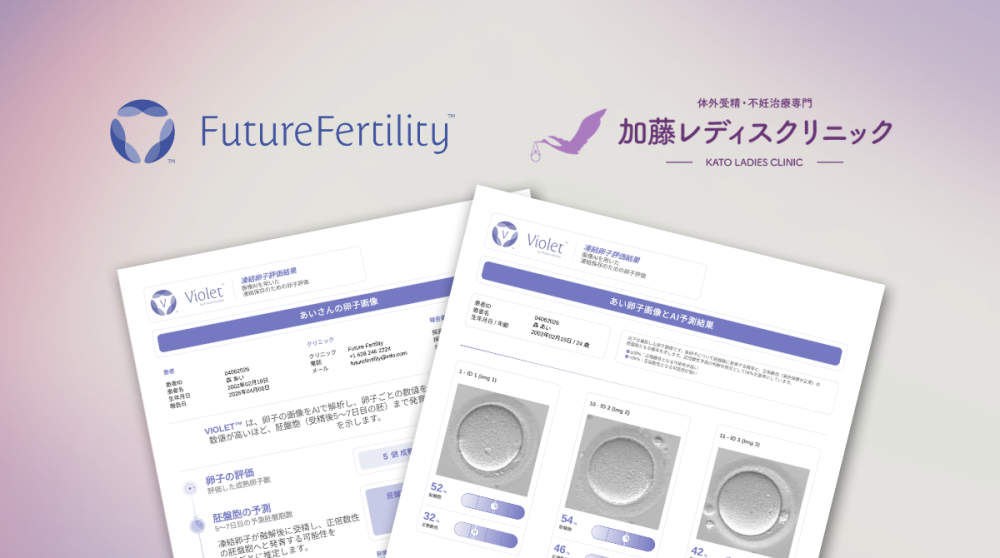
Future Fertility, a Toronto-based health technology company specialising in AI-powered fertility insights, has entered the Japanese market through a new commercial partnership with Kato Ladies Clinic — a globally recognised leader in IVF research and advancing clinical fertility care.
The collaboration marks Future Fertility’s first partnership in Japan and reflects growing global demand for technologies that bring greater objectivity and personalisation to fertility care.
Kato Ladies Clinic will integrate the company’s AI-powered oocyte (egg) quality assessment tools into its clinical workflows, with the aim of supporting more informed treatment planning and patient counselling across IVF and egg freezing cycles.
“At Kato Ladies Clinic, we are committed to advancing fertility care through innovation while maintaining a strong focus on individualised, patient-centred treatment,” said Keiichi Kato, chief executive officer.
“Partnering with Future Fertility enables us to integrate objective, data-driven insights into our clinical approach and better support our patients in making informed decisions.”
Future Fertility’s platform analyses images of oocytes using artificial intelligence trained and validated on a dataset of more than 650,000 unique oocyte images.
The technology is already in use at more than 300 clinics across more than 35 countries, helping clinicians better understand the developmental potential of individual eggs and provide patients with more personalised insight earlier in their treatment journey.
From Research Collaboration to Clinical Adoption
The partnership between Future Fertility and Kato Ladies Clinic began as a scientific research collaboration in 2024, marking the first use of AI-powered oocyte quality assessment in Japan.
The collaboration not only validated the technology in a new patient population and across diverse clinical protocols — including minimal stimulation cycles —but also resulted in a peer-reviewed publication in Reproductive BioMedicine Online (RBMO) and a poster abstract presentation at ESHRE 2025.
The joint research explored how AI-derived oocyte quality scores relate to early embryonic development and overall treatment outcomes. In a retrospective study conducted at Kato Ladies Clinic, researchers analysed nearly 2,800 mature oocytes across more than 1,300 ICSI cycles, linking image-based assessments of egg quality to key developmental milestones.
The study demonstrated that lower AI scores were associated with reduced fertilization rates, delays, and abnormalities in early embryo development, increased developmental errors, and lower-quality blastocyst formation.
Notably, the researchers also found that cumulative oocyte scores were a stronger predictor of live birth outcomes than the number of eggs retrieved — underscoring the importance of assessing egg quality alongside quantity.
“Our collaboration with Future Fertility has demonstrated how artificial intelligence can uncover meaningful biological differences between oocytes that were previously difficult to quantify,” said Kenji Ezoe, senior scientist.
“Bringing this technology into routine clinical use is an important step toward translating research into improved patient outcomes.”
Future Fertility’s VP of clinical embryology & scientific operations, Jullin Fjeldstad, noted that the findings provide important clinical validation.
“Our joint research with Kato Ladies Clinic has shown how AI-based oocyte assessment can be directly linked to numerous embryo development outcomes, from fertilization through early developmental milestones and blastocyst formation,” she said.
“We are excited to see this work translated into clinical practice.”
Growing Demand for Fertility Care in Japan
The partnership comes at a time when demand for fertility treatment in Japan continues to rise.
The country performs over 450,000 fertility treatment cycles annually, making it one of the largest markets globally. Delayed childbearing and evolving societal trends have also contributed to increasing interest in egg freezing.
As patients seek more clarity and personalization in their care, tools that provide earlier insight into reproductive potential are gaining traction.
“Entering the Japanese market with a partner like Kato Ladies Clinic is a significant step forward for our global commercial strategy,” said Rafael Gonzalez, Future Fertility’s VP of global sales & strategy.
“It reflects the growing demand for technologies that support more transparent, data-driven fertility care across diverse healthcare systems.”
Expanding a Global Footprint
Founded in 1993, Kato Ladies Clinic is known for its pioneering work in natural and minimal stimulation IVF and has long been a leader in clinical innovation in Japan.
For Future Fertility, the partnership represents both a geographic expansion and a continuation of its broader mission to bring AI-driven insights into routine fertility care.
“We are proud to partner with Kato Ladies Clinic, a globally respected leader in IVF and a pioneer in reproductive medicine in Japan,” said Future Fertility’s CEO, Christy Prada.
“This partnership represents an important milestone as we expand into Asia and continue our mission to bring objective, personalised insights into fertility care worldwide.”
Future Fertility develops AI-powered tools designed to generate personalised insights across the fertility journey.
Its flagship oocyte assessment technologies analyse egg images to provide objective, individualised measures of egg quality, supporting treatment planning, patient counselling, and clinical decision-making in egg freezing and IVF, while also enabling more data-driven approaches to donor egg distribution and quality assurance.
As fertility care continues to evolve, collaborations like this one are helping shape a new standard — one that emphasises earlier insight, greater transparency, and more personalised decision-making for patients navigating increasingly complex reproductive journeys.














Weight loss surgery was linked to more regular periods and fewer polyendocrine metabolic ovarian syndrome (PMOS) symptoms in women aged 18 to 45 living with obesity in a recent study.
The researchers recommend that women undergoing the procedure have access to preconception care and reproductive counselling to support their reproductive health.

Researchers at the University of Surrey analysed data over 24 months from 84 women who underwent bariatric surgery and 18 women living with obesity who did not have surgery.
Of those who underwent surgery, 49 had gastric bypass procedures and 35 had gastric sleeve surgery.
Women who underwent metabolic bariatric surgery lost more than 30kg on average at 12 and 24 months after the procedure.
Among women with polycystic ovaries, the condition persisted in only 10 per cent after 24 months.
Women also reported a resolution of clinical hirsutism, or excess body hair, by 12 months.
Women who had previously experienced irregular periods reported more regular menstrual cycles after surgery.
Professor Martin Whyte, co-author of the study and professor of metabolic medicine at the University of Surrey, said: “A large proportion of those undergoing bariatric surgery are women of reproductive age, who may be planning a pregnancy in the coming years.
“So much remains unknown about the impact of this type of surgery on women who are planning to have children.
“This raises the question of when the ideal time after surgery is to conceive.”
Women have a higher prevalence of obesity than men, with 57 per cent of women in the UK classified as overweight and 27 per cent living with obesity, which can affect fertility and the health of an unborn baby.
The researchers said 17 women had healthy pregnancies following surgery.
Although this was not specifically examined in the study, no difference in birth weight was observed between babies conceived within or after the first year.
Dr Kathryn Hart, co-author of the study and associate professor in nutrition and dietetics at the University of Surrey, said: “What we have found is that bariatric surgery positively affects the reproductive health of women living with obesity and can improve the likelihood of them having a healthy pregnancy after surgery.
“Dysregulated hormone levels, irregular periods and conditions such as polycystic ovaries are affected by obesity.
“By reducing this, what we have seen is that it can lead to improvements without the need for medication.
“We would suggest that clinicians consider medical intervention for obesity to treat irregularities in the menstrual cycle and issues with fertility.”
The Scottish government has launched a national review into whether NHS IVF access should be extended to single women.
The review will also consider whether wider access should be offered to couples who have children from previous relationships.
Health secretary Angela Constance said: “Access to NHS IVF treatment should be fair, timely and reflect the way people’s lives and families look today.”
Most single women are not currently eligible for NHS IVF treatment in Scotland.
Campaigners have welcomed the review.
Katie Rollings of Fertility Action said: “It’s an essential and long-awaited decision that will impact a huge number of people who are struggling to grow their families.
She said there is “no evidence” that having two parents rather than one determines whether a child will thrive.
She added: “What matters is whether a child is loved, safe, supported and has stable, positive relationships around them.”
Figures from the Human Fertilisation and Embryology Authority show Scotland is the only UK nation where NHS-funded IVF cycles outnumber privately funded cycles.
In 2024, more than 6,000 cycles of fertility treatment were carried out among more than 4,000 patients in Scotland. Both figures were slightly lower than the record highs recorded in 2022.
The past 20 years have also seen a rise in the number of same-sex female couples and single women receiving fertility treatment.
In 2024, 625 IVF cycles were carried out for women in same-sex couples in Scotland, with more than one third funded by the NHS.
There were 330 cycles involving single women, of which 50 were NHS-funded.
In England, single women can access IVF through the NHS, although eligibility varies according to the local health trust’s policy.
Current Scottish rules state that couples are eligible if they have been living in a stable relationship for two years and neither partner has been sterilised.
Couples where one partner already has a child can be eligible, but those where both partners have children from previous relationships are not.
Eligibility rules also require a body mass index above 18.5 and below 30, and state that couples must not smoke, drink alcohol or take drugs during treatment. The mother must be under 42.
The Scottish government said the review would also examine consistency of access to fertility preservation, including during cancer treatment, as well as reducing waiting times for donor eggs and sperm.
Same-sex female couples already have access to NHS IVF, but they can face long waits for donor eggs or sperm, as can heterosexual couples who require donor treatment.
The National Fertility Group will lead the review and make “costed, demand-modelled recommendations”, which are due to be published by early summer 2027.
The group will include fertility experts from Scotland’s four NHS-assisted conception units in Glasgow, Edinburgh, Aberdeen and Dundee.
Prof Sarah Martins Da Silva, an NHS consultant and chair of fertility medicine at Dundee University, said there were questions to be answered in a resource-stretched NHS.
“As a fertility specialist I’m never going to be disappointed if the criteria is widened,” she said.
“But with single people, as an NHS clinician looking at the competing demands we have, I’d ask the question about whether being single is a health condition that needs to be funded.”
Da Silva said NHS waiting lists were full of couples who require donated eggs or sperm because of medical conditions including cancer and could face longer waits.
“It’s slightly a disservice to them,” she said.
“There would need to be a real investment and resource without making everybody wait an extraordinary long time.
“With the current financial environment we work in, if you’re talking about new money, where would that come from?”
She said she would welcome changes that encouraged more people to donate eggs or sperm and questioned whether arguments about children needing two parents were necessarily relevant to the debate.
“On the one hand bringing up a child is quite an expensive process, and if you don’t have that support, it can be very difficult.
“But on the other hand, many people start off as a couple and divorce.”
Da Silva also welcomed plans for the review to consider eligibility for couples who already have children, describing the move as “fantastic”.











 Hormonal health2 weeks ago
Major UK study could be a ‘game-changer’ for heavy periods and endometriosis
 Entrepreneur7 days ago
KOVE Medical raises €1.7 million to improve safety of foetal surgery

 Fertility2 weeks ago
One week left to apply: W Accelerate with Merck KGaA and M Ventures

 Pregnancy1 week ago
UK study aims to transform maternity care for high-risk pregnancies

 Menopause2 weeks ago
Quarter of women miss work due to menstual symptoms, survey finds

 Mental health2 weeks ago
PMDD after SSRIs or hormones: Why the brain may be the missing treatment target

 Diagnosis2 weeks ago
Ark Surgical secures further institutional backing to accelerate US expansion

 Menopause5 days ago
Menopause hormone treatment may ease brain fog, study suggests
1 Comment