




Entrepreneur
‘Patients don’t have a voice’: how this start-up wants to redefine OB/GYN care


The term “gynaecologist” often carries an ominous stigma, conjuring images of awkward visits, cringe-worthy conversations and an overall less-than-pleasant experience within the office walls.
Many patients dread the invasive procedures and often leave with unanswered questions. The data confirms this.
According to a 2020 report published in the Commonwealth Fund, 75 per cent of women in the US are dissatisfied with their OB/GYN care.
In a study of 11 high-income countries, including the UK, Germany and France, American women reported the least positive patient experiences. They were also less likely to rate their quality of care as excellent or very good compared to women in all other countries studied.
Accessibility is also an issue. The average wait time for an OB/GYN appointment is 31.4 days, a 19 per cent increase from 2017.
Tara Raffi, an ex-McKinsey from California, waited six weeks to get an appointment. When she did get to the doctor, she waited over an hour for a five-minute visit and she walked out of the room with no answers. She would go on to see four more OB/GYNs about her recurrent UTIs.
“It exposed for me a fundamental flaw in the US healthcare system, which allows big healthcare players to make decisions and where patients don’t really have a voice,” she says.
“Nobody was building for the patient.”
Wanting to make a change, Raffi and her childhood friend, Carly Allen, launched Almond, a full-service OB/GYN care provider that combines traditional western medicine and integrative medicine to deliver better outcomes to patients and reduce the amount of time it takes to get their problems resolved.
“I left McKinsey and started Almond because I wanted to make it easy to get great OB/GYN care,” the founder explains.
“Our aim is to modernise the full-service experience and provide care differently.”
Their holistic approach is a big part of that. According to Raffi, the current patient experience is incomplete and, while traditional western medicine is great in some cases, it is not great for more complicated, socially involved care journeys.
“A great example is in pregnancy care, where women [in the current healthcare system] end up feeling like they’re not getting what they need and they don’t know why,” she says.
“Integrative medicine solutions, however, present a lot of solutions for some of the deepest, most painful moments in the pregnancy journey. At Almond, we are trying to integrate midwives, doulas and lactation support into the Almond experience so that women can have access to all the support they need.
“We believe that by being a source that brings together medical doctors and different types of practitioners to give a truly holistic view, we can bridge that gap for millions of women.”
Accessibility is also a big differentiator, says the entrepreneur, who believes everyone should find a provider they could talk to when they need to.
“Having that accessibility and convenience of booking care sends a message that we care about you. It’s what, I think, tells patients that their health is important to us.”
Currently, Almond charges users a US$250 annual subscription fee and bills insurance for the visit and labs. The subscription gives patients access to the company’s platform, care team and personalised plans.
Prior to their appointment, women have to fill out a health questionnaire and detail the reasons for their visit. They have the possibility of scheduling next-day telehealth appointments and message their care team whenever they need to.
With more than 130 million American women in need of better OB/GYN care, Raffi says the opportunity for growth is huge.
“We’ve started with our first location in Los Angeles, but we’re looking to expand this year,” she says smiling. “Seeing that we’re able to make even just a small difference for patients makes it all worth it.”
To receive the Femtech World newsletter, sign up here.











Medtech startup Peripear has won an Innovate UK award for developing a wearable designed to prevent perineal trauma during childbirth.
The Oxford-based company is developing a hands-free warm compress device for use on the perineum during the second stage of labour.
Peripear describes its product as the world’s first automated perineal thermotherapy wearable, designed to prevent perineal trauma during childbirth.
The device is intended to reduce severe tearing and episiotomies while improving maternal comfort.
Peripear has secured an Innovate UK Women in Innovation Award and a £74,974 grant.
The funding will support further product development ahead of the company’s planned first-in-human study.
Nina van Schaick, co-founder and chief operating officer of Peripear and midwife, said: “I’m sure I wasn’t the only one to see this gap.
“I was incredibly lucky to meet my co-founder, Eviatar Natan, right as my frustration about the lack of translation of evidence into practice had peaked.
“There was a proven mechanism that could reduce injuries occurring in up to 90 per cent of vaginal births, and it was being left out of clinical pathways simply because no standardised tool existed to deliver it.
“I’m a farmer’s granddaughter, and when I started practising over 14 years ago, I asked: where is the tool I need to implement this evidence? I looked around and realised we were still asking clinicians to improvise.
“Peripear is what happens when the person who has lived the problem, both personally and professionally, meets the person who can help her build the solution.”
Entrepreneur
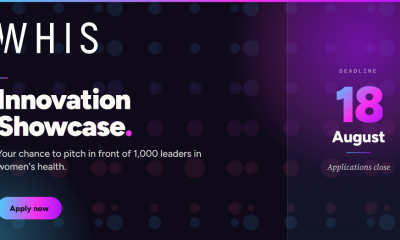
Applications close August 18 for Women’s Health Innovation Summit 2026 Innovation Showcase

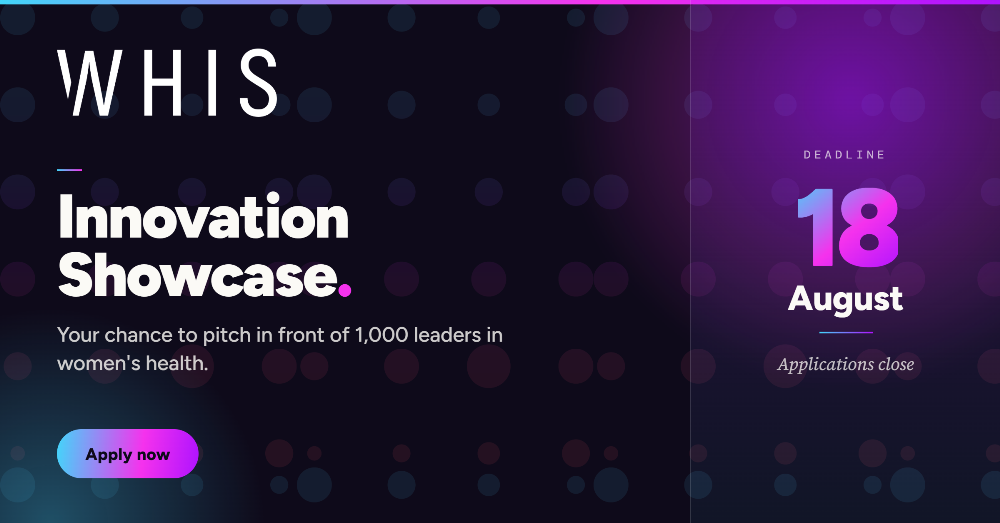
The Women’s Health Innovation Summit (WHIS) has reminded startups that applications for its 2026 Innovation Showcase close on Tuesday, August 18.
The Showcase gives early and growth-stage companies the opportunity to pitch live on stage to the most influential audience in women’s health, at a summit that convenes more than 1,000 senior decision-makers from across the ecosystem, including payers, providers, pharma, and investors.
Now in its eighth year, WHIS takes place October 13–15, 2026 at Encore Boston Harbor.
The event has built a reputation as the leading platform uniting the full women’s health ecosystem, from health systems and health plans to pharmaceutical leaders and the investors funding the next wave of innovation in the space.
A Direct Line to Funding, Partnerships and Adoption
Companies selected for the Innovation Showcase will present directly to an audience with the capital, clinical expertise and commercial relationships to move deals forward.
Past participants have gone on to secure investor introductions, commercial partnerships and clinical collaborations that started as presentations on the WHIS stage and turned into signed agreements.
Applications Reviewed by an Expert Selection Committee
Submissions are being reviewed by a selection committee of leading investors and industry operators, including:
- Parambir Bhangu, Executive Director, External Innovation & Emerging Science, Organon
- Elizabeth Bailey, Co-Founder & Managing Partner, Foreground Capital
- Karla Loken, Founder, Loken and Associates
- Mané Mikayelyan, Associate Partner, DeciBio
- Anna Valcheva, Founder, Managing Director & CEO, Astra Ventures
- Azin Radsan van Alebeek, Co-founder & General Partner, Emmeline Ventures
WHIS is where the women’s health ecosystem comes together to get deals done,” said Poppy Howard-Wall, Event Director of WHIS.
How to Apply
Early and growth-stage companies across digital health, therapeutics, diagnostics, med device and consumer health are encouraged to apply before the August 18 deadline.
Full details and the application form are available at whisusa.com/attend/start-ups.

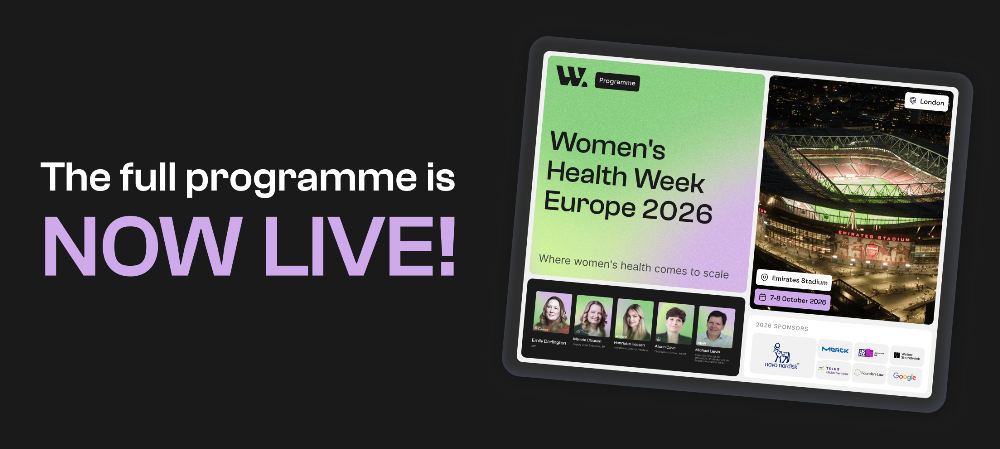
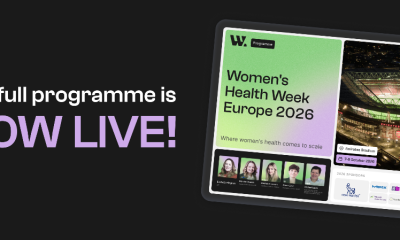
Women’s Health Week Europe 2026 has released its fully populated speaker and session lineup ahead of the event’s return to The Emirates Stadium in London on 7–8 October, with 80+ speakers now confirmed across two dedicated stages.
The programme
The agenda runs across two dedicated stages in parallel, plus two pitch competitions across both days.
The Global Stage opens with a keynote from Merete Clausen (EIF) before moving into sessions on funding trends, AI, the gender data gap, the wearable revolution, and European policy.
Standout sessions include The Age of Digital TransformAItion featuring Nichole Young-Lin (Google), Frida Polli (MIT), and Sapna Shah (Sie Ventures); Lone Wolf or Pack Leader on collaboration versus fragmentation, with Eirini Rapti (Inne), Tatum Getty (Thena Capital), Novo Nordisk, and Jen Roberts-Woods (Borski Fund); and a live debate on whether the women’s health label helps or hinders founders. Day one closes with a keynote from Alison Cave, Chief Safety Officer at the MHRA.
The Scale Stage runs a practical playbook track in parallel, with sessions covering regulatory approval pathways, international expansion, the founder’s legal playbook, PR strategy, and implementing AI into a women’s health business.
The Reverse Pitch flips the usual format: investors and corporates pitch the room on what they are actively looking to fund, acquire, or partner on right now.
Register here and receive a 15% discount on tickets. Redeem with code FEMTECHWORLD
Pitch competitions
The WHW Europe pitch competitions are back, taking place in front of the audience across both days on the mainstage. 16 finalists will compete across two categories: Consumer & Tech on day 1 and Medical Devices & Therapeutics on day 2.
Any company treating a condition that affects women exclusively, differently, or disproportionately is eligible to apply.
Applications and close 28 August 2026.
Previous alumni include Circe, who secured £100k from Innovate UK, BoobyBiome, who closed a £2.5M seed round post-WHW Europe, and Amilis, who secured £1M at London Tech Week after winning at WHW USA 2026.







 Entrepreneur2 weeks ago
Applications close August 18 for Women’s Health Innovation Summit 2026 Innovation Showcase

 Menopause2 weeks ago
Third of women unaware of perimenopause mental health impact

 Fertility6 days ago
Chelsea FC Women to launch first-of-its-kind player fertility fund
 Entrepreneur2 weeks ago
Women’s Health Week Europe 2026 releases fully populated agenda ahead of October summit

 Menopause1 week ago
Menopausal hormone therapy may lower dementia risk, study suggests

 Hormonal health2 weeks ago
We are wrapping our children in plastic and calling it care

 Menopause6 days ago
anna perimenopause app launches across 39 markets

 Pregnancy2 weeks ago
Chemicals in plastics may be linked to high blood pressure during pregnancy
1 Comment