



News
Resistance training has preventative effects in menopause, study finds

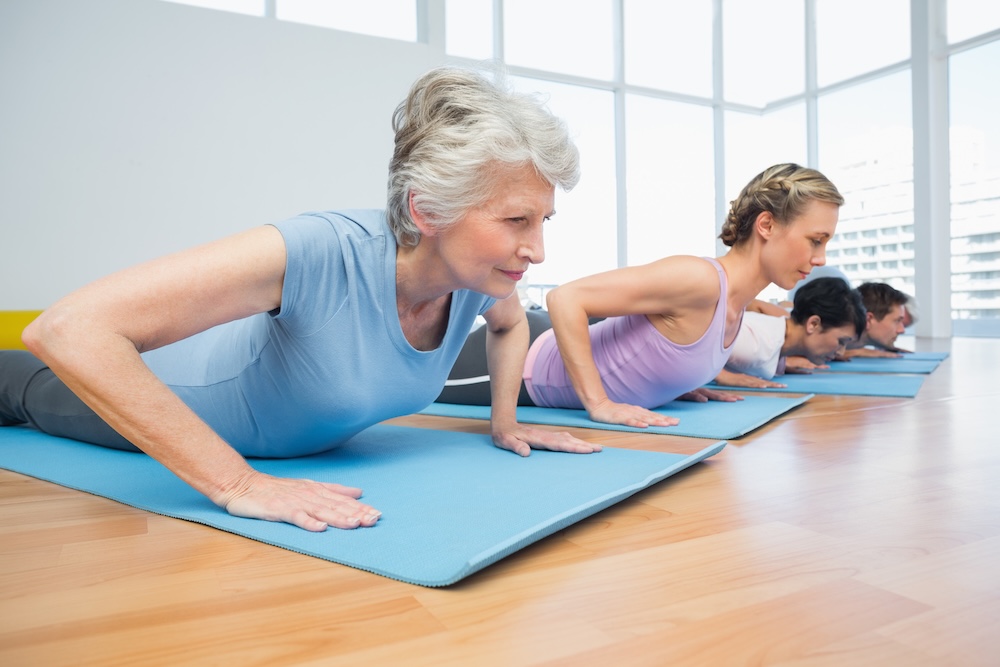
Resistance training improves hip strength, balance and flexibility during menopause and may also improve lean body mass, research suggests.
A study of 72 active women aged 46 to 57 found those who completed a 12-week supervised programme saw greater gains than those who kept to their usual exercise routines.
None of the participants were taking hormone replacement therapy.

The supervised, low-impact resistance exercise programme focused on strength at the hip and shoulder, dynamic balance and flexibility.
Participants used Pvolve equipment, including resistance bands and weights around the hips, wrists and ankles, and also lifted dumbbells of varying loads.
Women in the resistance training group showed a 19 per cent increase in hip function and lower-body strength, a 21 per cent increase in full-body flexibility and a 10 per cent increase in dynamic balance, meaning the ability to stay stable while moving.
Those in the usual activity group did not show any significant improvements.
Previous studies have assessed the decline in lower limb strength and flexibility during menopause, but this is said to be the first study to compare the effect of resistance training on muscle strength and mass before, during and after menopause.
This was done by including participants in different phases of menopause rather than following the same participants over a long timeframe.
Francis Stephens, a researcher at the University of Exeter Medical School in the UK, said: “These results are important because women appear to be more susceptible to loss of leg strength as they age, particularly after menopause, which can lead to increased risk of falls and hip fractures.
“This is the first study to demonstrate that a low-impact bodyweight and resistance band exercise training programme with a focus on the lower limbs, can increase hip strength, balance, and flexibility.
“Importantly, these improvements were the same in peri- and post-menopausal females when compared to pre-menopausal females, suggesting that changes associated with menopause do not mitigate the benefits of exercise.”
Although one of the researchers sits on Pvolve’s clinical advisory board, the researchers said the company did not sponsor the study or influence its results.
Stephens added that any progressive resistance exercise training focused on lower-body strength is likely to yield the same results.
He said: “The important point is for an individual to find a type of exercise, modality, location, time of day etc., that is enjoyable, sustainable, and improves everyday life.
“The participants in the present study reported an improvement in ‘enjoyment of exercise,’ and some are still using the programme since the study finished.”
Kylie Larson, a women’s health and fitness coach and founder of Elemental Coaching, who was not involved in the study, said the results were compelling.
She said: “This is particularly exciting for those that tend to think of menopause as ‘the end’. The study proves that if you incorporate strength training you can still make improvements to your muscle mass and strength, which will also have a positive ripple effect to your ability to manage your body composition.
“In addition, staying flexible and being able to balance are both keys to a healthy and functional second half of life.”
Participants in the study did four classes a week for 30 minutes each session, but Larson said even half that amount of strength training can go a long way, particularly if you emphasise progressive overload, which means gradually increasing muscle challenge through more weight.
Larson said: “Gradually increasing the challenge is what drives real change.
“Lifting heavier over time is what builds strength, protects your bones, and keeps your body resilient through menopause and beyond.”











Condé Nast will close its women’s health publication Self after 47 years, with unprofitable editions of Glamour and Wired also set to shut.
In a memo published on the magazine giant’s website on Thursday, the media company’s chief executive, Roger Lynch, said: “As audience behaviours shift, we have not seen a path for Self to continue in its current form as a digital publication.”
“Going forward, health and wellness content will be integrated into our other brands, including Allure and Glamour,” Lynch said, referring to Condé Nast’s other beauty and wellness titles.

Self, which moved to an online-only format in 2017, still reaches more than 20m people each month.
The publication has also earned significant recognition over the years, including a National Magazine award and a Webby’s People’s Voice award.
The closure is part of a wider set of operational changes across the company. Lynch also announced the end of Wired’s Italy edition, noting that while the brand “remains a strong global brand, the Italian edition has not kept pace with growth in our other markets”.
Condé Nast will also wind down Glamour’s publishing operations in Germany, Spain and Mexico.
Lynch said: “Taken together, Wired in Italy, Self and the affected Glamour markets represent a little over 1 per cent of our overall revenue.
“They also remain unprofitable, and continuing to operate them in their current form limits our ability to invest in the ideas and areas that will drive future growth.”
Beyond editorial changes, the company is also restructuring internally to adapt to technological shifts.
Lynch said Condé Nast would make “changes within our technology organisation, reflecting the rapid advancement of AI and its impact on our ability to innovate and build products faster”, adding: “Teams will be restructured to be more agile and to work more closely with our brands and customers, reducing barriers to execution.”
The latest moves follow a series of transformations at Condé Nast in recent years.
Glamour ended its print edition in 2018, followed by Allure moving to a digital-only format in 2022.
In 2024, music publication Pitchfork was folded into GQ, the company’s men’s style magazine.
More recently, last November, Vogue, one of Condé Nast’s key revenue drivers, announced it would absorb Teen Vogue to create a more “unified reader experience across titles”.
The media industry has been shrinking steadily over the years.
From 2010 to 2017, the industry lost an average of 7,305 jobs annually, according to data from Challenger, Gray & Christmas published in December 2025.
Since 2018, the average number of job cuts in the industry has risen to 14,298 a year.

A new Female Health Hub launched by the English FA will support women and girls in grassroots football in England with trusted advice on health issues affecting play.
The hub brings together expert-backed guidance, practical tools and player insights in one place, giving women and girls practical advice and reassurance on female health in football.
It has four core aims: to help women and girls better understand their bodies and how female health affects performance and participation, to educate players on key health topics and when to seek further advice or support, to provide practical strategies to help navigate common female health challenges, and to help break down taboos and normalise conversations around female health in football.

Users of the hub will also be able to hear directly from members of the England women’s national team, who share their own experiences of navigating female health matters while playing at the highest level of the game.
“Our ambition is to create a game where women and girls can thrive,” said Sue Day, the FA’s director of women’s football.
“To achieve that, it’s essential that players feel supported in environments that understand and respond to their female health needs.
“We’ve heard directly from grassroots players that they want better information and support around female health, but that they often don’t know where to find it.
“The launch of the Female Health Hub marks an important step in changing the landscape.
“We want every player to feel confident in her own skin and supported without judgment, so she can feel empowered by her body, rather than held back by it.”
The platform was launched following research conducted by the FA that highlighted the need for better education and support around female health in football.
According to the FA, 88 per cent of adult players surveyed said their menstrual cycle has an impact on their ability to train or play, but 86 per cent reported they had never received education about the menstrual cycle in relation to football performance and training.
The research also found 64 per cent of women experience issues related to sports bras or breast health while playing football, despite sports bras being considered one of the most important pieces of playing kit.
Players also expressed strong interest in learning more about injury prevention, at 87 per cent, nutrition, at 84 per cent, and mental health, at 77 per cent, in relation to female health.
The first phase of the Female Health Hub focuses on three of the most requested topics: menstrual health, breast health and injury resilience, with further content to follow, including nutrition and pelvic health guidance.











 Entrepreneur3 weeks ago
Three sessions that show exactly where women’s health is heading in 2026

 Menopause4 weeks ago
California plans US$3.4m menopause care overhaul

 Pregnancy3 weeks ago
How NIPT has evolved and what AI NIPT means in 2026

 Menopause4 weeks ago
Watchdog bans five ads for women’s heath claims

 Entrepreneur4 weeks ago
WHIS USA 2026 announces first ticket release for landmark Women’s Health Innovation Summit

 Menopause4 weeks ago
Menopause has no lasting impact on cognition, research finds

 News3 weeks ago
Two weeks left to make your mark in women’s cardiovascular health

 Opinion3 weeks ago
Q1 momentum: Female founders are advancing, but the system still hasn’t caught up
1 Comment