




Insight
Why generic fitness plans need to catch up to hormonal science


Each January, millions engage in intense workout routines and rigid fitness challenges in a bid to enhance personal fitness for the year ahead.
But women-led period and cycle tracker Clue warns that much mainstream fitness advice is based on a flawed assumption: that bodies perform the same way every day.
For people with menstrual cycles, hormonal fluctuations can shape energy, mood, sleep, motivation, perceived effort and recovery, meaning following a generic, one-size-fits-all training plan could in fact be the cause of increased burnout, injury risk and drop-off.
This January, Clue in partnership with ŌURA, the wearable health platform, are calling for a smarter approach to 2026 fitness plans: cycle-aware, data-led routines, that are built around strength, flexibility and recovery.
The January Fitness Boom
Insights from ŌURA prove January fitness culture is real compared to other winter months.
In the UK, ŌURA saw a 28.2 per cent increase in the percentage of days with a logged workout in January 2025 vs December 2025 (excluding housework, walking and “other”).
In the US, the increase was 19.5 per cent over the same period.
Dr Charis Chambers, chief medical officer at Clue, said: “Beginning the new year with a commitment to regular exercise is a common way to prioritise health, but abruptly starting intense fitness training can actually increase risks of health issues.
“This is why the ‘push through it’ fitness culture we often see in January can be particularly harmful for women and people with menstrual cycles.
“Rather than pushing through fatigue, pain or disrupted sleep, people will see greater long term benefit from adapting workouts to how their bodies feel across the cycle and using data to understand what’s normal for them.”
Data-driven Exercise
With wearable fitness tracking now mainstream, more women and people with cycles are building fitness habits using biometric feedback such as sleep, temperature trends and recovery.
This provides a broader picture of their health, allowing them to spot changes, monitor health goals, and adapt routines in ways that feel aligned with their bodies.
Dr Chris Curry, MD, PhD, clinical director of women’s health at ŌURA, said: “By combining ŌURA’s readiness, sleep, and activity data with Clue’s detailed cycle tracking, women have a more complete picture of how hormonal fluctuations impact overall health and well-being.
“This integration enables members to observe how their menstrual cycle phases may align with changes in sleep patterns, energy levels, stress resilience, and recovery capacity, informing more flexible, cycle-aware fitness routines that can be adapted to the body’s natural rhythm.”
Everyday high intensity exercise doesn’t work long term
January fitness culture often equates “more” and “harder”, leading many people to gravitate towards daily HIIT-style workouts that promise quick change.
But experts warn that this approach isn’t always sustainable, particularly for people with menstrual cycles.
Eve Lepage, senior reproductive health specialist at Clue, said: “High-intensity workouts create short-term increases in cortisol, which is normal.
“But repeatedly stacking intense sessions without adequate recovery can lead to fatigue, disrupted sleep and burnout.
What the evidence supports instead is balance, anchoring routines in strength training at least twice per week, using higher intensity in moderation, and allowing flexibility based on how you feel.”
By contrast, excessive cardio or high-intensity training without sufficient recovery can negatively impact the body’s cortisol patterns.
Clue user data shows that walking (32 per cent), rest days (24 per cent), and strength training (16 per cent) are the most commonly tracked activities, highlighting that consistent, everyday movement, rather than extreme routines, forms the foundation of how most people actually exercise.
According to Clue, this is an important reminder during January’s fitness push: movement doesn’t need to be extreme to be effective.
Cycle-awareness doesn’t mean rigid ‘cycle syncing’
While cycle-synced workouts have gained recent attention, Clue experts emphasise that there is a lack of scientific evidence to support this effectiveness as a one-size fits all approach.
Instead, a more effective approach is cycle aware and symptom-guided, using menstrual cycle tracking to understand individual patterns over time and adjusting training intensity based on how the body feels day-to-day.
“Cycle awareness isn’t about following strict rules, it’s about self-knowledge,” said Eve Lepage.
“Some people notice changes in energy, mood or perceived effort across their cycle. Some feel stronger or more energetic during the late follicular phase (on the days leading up to ovulation), while feeling more tired during the luteal phase (after ovulation and before the next period), while others don’t notice much difference at all.
Rather than asking ‘What should I do in this phase?’, a better question is: ‘How do I usually feel here?’ and adjust accordingly.”
Clue health experts encourage an approach to fitness that prioritises long-term health over short-term intensity.
Rather than aiming for perfection, Clue experts recommend building routines around four evidence-based principles, designed to support strength, recovery, and consistency:
- Strength training as the foundation – Supporting long-term muscle, metabolic and bone health, strength training is one of the most effective ways to build resilience and reduce injury risk. It also offers flexibility: intensity and load can be adjusted based on symptoms, fatigue, or low readiness days.
- Adequate recovery (non-negotiable) – Recovery is when the body adapts and improves. Without enough rest days, people are more likely to experience persistent fatigue, disrupted sleep, reduced motivation, or injury, all of which increase drop-off and burnout.
- Aerobic training with flexible intensity — not “push through it” culture – Sustainable fitness is built around adapting workouts to real-life signals. On lower-energy or symptom-heavy days, a routine might shift from HIIT to lower-impact movement like cycling, or reduce duration, all without “failing” the plan. Most important is to move regularly, on most days, even when it’s just going for a walk on some days.
- Listening to bodily signals (including cycle changes) – Persistent fatigue, pain, disrupted sleep, emotional exhaustion and even cycle changes such as irregular, missed or lighter periods can be signs the body is under excessive stress. Clue experts emphasise that the menstrual cycle is a vital sign, and significant changes can indicate it’s time to scale back and prioritise recovery.
Together, Clue’s cycle insights and ŌURA’s biometric tracking help people better understand how menstrual cycle phases may align with changes in energy, mood and recovery — supporting training routines that are sustainable year-round.
Head to www.helloclue.com for more information and to download the app and learn more about Oura Ring and Oura health insights at www.ouraring.com












News
The RESIL-Card tool launches across Europe to strengthen cardiovascular care preparedness against crises


By Women As One
Women As One is proud to have contributed to the development of the RESIL-Card tool as an active Advisory Board member, ensuring that gender equity and the perspectives of women cardiologists were embedded from the outset.
Through strategic input on the project’s design, formal support of its EU4Health funding application, and ongoing participation in advisory activities, Women As One has helped shape both the direction and implementation of this initiative.
By amplifying awareness, facilitating engagement from our global community, and advocating for inclusive representation, we have worked to ensure that RESIL-Card reflects the diverse realities of cardiovascular care and supports more equitable, resilient health systems in times of crisis. Read more about our involvement here.
On the European Day for Prevention of Cardiovascular Risk (March 14), the RESIL-Card consortium proudly announces the official launch of the RESIL-Card tool, a free online resource designed to help hospital cardiovascular professionals and other stakeholders assess and strengthen the resilience of their care pathways — ensuring that lifesaving care remains accessible even during times of crisis.
Available now at https://www.wecareabouthearts.org/resil-card/online-tool/, the RESIL-Card tool offers a structured self-assessment framework for evaluating the preparedness of cardiovascular services and identifying concrete actions to maintain continuity of care when health systems face disruption.
“Cardiovascular care must remain uninterrupted regardless of the challenges health systems face,” said Professor William Wijns, Research Professor in Interventional Cardiology, University of Galway, Ireland, and We CARE – RESIL-Card Coordinator.
“The RESIL-Card tool provides healthcare teams with a practical way to assess preparedness, identify improvement opportunities, and ultimately ensure that patients continue to receive lifesaving care when it matters most.”
Why the RESIL-Card tool was developed
Cardiovascular diseases remain the leading cause of death in Europe, making the continuity and resilience of care pathways a public health priority.
Despite advances in diagnosis and treatment, recent crises – from pandemics to geopolitical instability – have exposed the vulnerability of healthcare systems.
In today’s increasingly uncertain health landscape and global environment, proactive preparedness is no longer optional – it is essential.
The RESIL-Card tool was developed as part of an EU4Health-funded initiative to support organisations providing lifesaving cardiovascular care in strengthening their preparedness, improving coordination, and safeguarding patient outcomes in times of disruption.
The initiative focuses on practical resilience strategies to help health systems anticipate challenges rather than simply react to them.
“Healthcare systems today operate in an increasingly complex and unpredictable environment,” said Ariadna Sanz, Health Policy Manager at the Catalan Health Service (CatSalut).
“Tools like RESIL-Card help shift the focus from responding to crises toward proactively building strong, adaptable cardiovascular care pathways that protect patients over the long term.”
A collaborative and evidence-based methodology
The RESIL-Card tool is grounded in a robust, multidisciplinary development process involving cardiovascular experts, healthcare professionals, public health specialists, patient organisations, and policy stakeholders from across Europe.
Its development combined comprehensive literature reviews and analysis of existing preparedness frameworks with extensive stakeholder consultations and co-creation workshops. Real-world insights from healthcare providers and patient representatives were integrated throughout the process to ensure the tool reflects the practical realities of cardiovascular care delivery. The methodology also included iterative testing and validation phases, allowing the consortium to refine the tool and ensure it is both scientifically rigorous and practical for everyday use.
“From the outset, RESIL-Card was co-created with clinicians, patient representatives, and health system experts to ensure it reflects real-world practice,” said Professor Niek Klazinga, Em. Professor of Social Medicine, Amsterdam University Medical Centre / University of Amsterdam.
“The result is a tool that combines scientific rigour with practical usability, enabling healthcare teams to translate resilience concepts into concrete action.”
What the RESIL-Card tool is and how it works
The RESIL-Card tool is a practical online self-assessment instrument designed for use by a multistakeholder resilience team led by cardiovascular care providers.
Through a structured four-step process, including a questionnaire and guided analysis, users assess the preparedness and resilience of their cardiovascular care pathways and gain a clear understanding of how well their services can maintain care continuity during periods of disruption.
The assessment process helps teams identify existing strengths as well as potential gaps in service delivery.
Based on the responses provided, the tool offers tailored recommendations and examples of best practices to support improvement.
These insights can then inform strategic planning, helping organisations prioritise actions that reinforce care continuity, strengthen patient safety, and optimise the long-term sustainability of cardiovascular services.
Benefits for Key Stakeholders
For healthcare professionals and organisations delivering cardiovascular care, the RESIL-Card tool provides a structured way to strengthen preparedness and crisis-response capacity.
By helping teams assess their existing systems and identify areas for improvement, the tool supports better coordination across services and clinical disciplines.
It also facilitates evidence-based planning and quality improvement initiatives, enabling healthcare organisations to enhance their operational resilience while maintaining efficient and manageable care processes.
“By promoting awareness about strengths and limitations of each system, the RESIL-Card tool will help physicians to understand where improvements are needed and strengthen coordination and planning to face crises,” said Doctor Alfredo Marchese, Chief of Interventional Cardiology Department at Santa Maria Hospital, Bari, Italy and President of the Italian Society of Interventional Cardiology (GISE).
For patients and patient organisations, the RESIL-Card tool contributes to improving the reliability and continuity of essential cardiovascular care.
By encouraging healthcare providers to proactively address vulnerabilities in care pathways, the tool helps promote uninterrupted access to diagnosis, treatment, and follow-up services.
It also supports a more patient-centred and equitable approach to care delivery, encouraging collaboration and transparency in preparedness planning.
Ultimately, these improvements can contribute to better health outcomes and increased safety for people living with cardiovascular disease.
“For people living with cardiovascular disease, continuity of care is not optional — it is essential,” said Teresa Glynn, Senior Executive Strategy & Partnerships at Global Heart Hub.
“By helping healthcare providers strengthen preparedness, RESIL-Card supports more reliable and equitable access to treatment and greater confidence for patients and their families.”
At the European level, the RESIL-Card initiative contributes to a shared effort to strengthen the resilience of health systems.
By providing a common framework for assessing and improving preparedness, the tool encourages cross-border learning and facilitates the exchange of best practices among healthcare providers and policymakers.
It also aligns closely with European Union priorities on health system preparedness, crisis response, and sustainability.
By helping healthcare organisations identify vulnerabilities and implement practical resilience measures, the RESIL-Card tool can support efforts to reduce inequalities in access to high-quality cardiovascular care across EU Member States.
“Strengthening the resilience of cardiovascular care is a shared European priority,” said Rachel Kenna, Ireland’s Chief Nursing Officer at the Department of Health.
“While the RESIL-Card tool has not yet been tested in an Irish setting we look forward to seeing how it can support the development of more sustainable and prepared healthcare systems.”
Call to Action
Cardiovascular care providers and other healthcare professionals are encouraged to explore the RESIL-Card tool at https://www.wecareabouthearts.org/resil-card/online-tool/.
By using it to assess their cardiovascular care pathways, they will identify areas where resilience can be strengthened and ensure that essential services remain accessible during times of disruption.
Patient organisations also play an important role in this effort. By engaging with healthcare providers and policymakers, they can help promote the use of the tool and ensure that patient perspectives are meaningfully incorporated into preparedness and response planning.
Policymakers and health authorities are invited to support the adoption of the RESIL-Card tool within regional, national and European strategies aimed at strengthening healthcare system resilience.
Integrating the tool into policy frameworks can help safeguard access to essential cardiovascular services and enhance the ability of health systems to respond effectively to future challenges.
Learn more about Women As One at womenasone.org


By Women As One
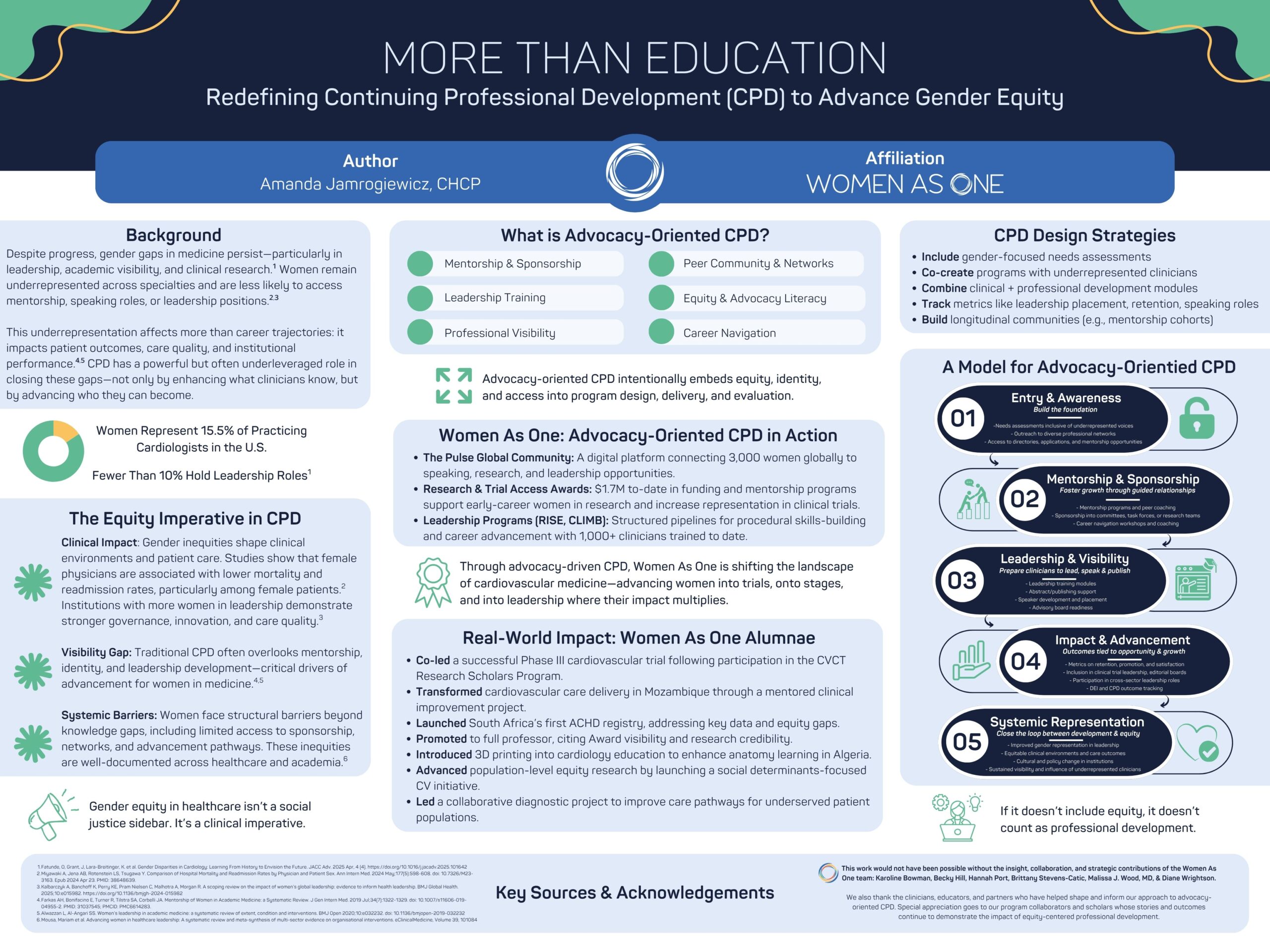
At the 2026 Alliance Annual Conference, Women As One presented a poster that asked a powerful question: What if continuing professional development (CPD) did more than teach clinical knowledge— and instead helped shape the future of the workforce itself?
For decades, professional education in medicine has focused primarily on what clinicians know and how they practice. That work remains essential.
But persistent gender gaps across cardiology—from leadership positions to research participation and speaking opportunities—demonstrate that knowledge alone is not enough to ensure equitable advancement.
To truly strengthen the field of cardiology, professional development must also support who clinicians become, the opportunities they access, and the voices that shape the future of cardiovascular medicine.
Our poster, More Than Education: Elevating Equity and Identity Through CPD, explores how a new model of advocacy-orientated CPD can help close these gaps.
Advocacy-orientated CPD expands the traditional model of professional education. In addition to building clinical expertise, it intentionally supports the structural elements that shape career advancement—mentorship, sponsorship, leadership development, visibility, and professional networks.
By integrating these elements into professional education, CPD can become a powerful engine for advancing equity—and ultimately improving patient care.
Why this matters
Gender inequities in medicine are not simply workforce issues. They influence research priorities, clinical trial representation, leadership decision-making, and ultimately the care patients receive.
When women clinicians have equitable opportunities to lead, research, and shape clinical practice, the entire healthcare system benefits.
Yet structural barriers remain. Women physicians often have less access to mentorship, sponsorship networks, and leadership pathways—factors that are critical for career advancement.
This is where advocacy-orientated CPD comes in.
By intentionally designing programs that foster mentorship, build leadership skills, create visibility, and support long-term professional growth, organizations can help ensure that the next generation of cardiovascular leaders reflects the diversity of the patients they serve.
Turning opportunity into impact
Since its founding, Women As One has supported thousands of women cardiologists across more than 100 countries, expanding access to mentorship, research opportunities, and leadership development.
Through programs like CLIMB, RISE, Mentorship Awards, and our global digital community, The Pulse, thousands of women cardiologists have gained mentorship, leadership training, and opportunities that accelerate their careers and expand their influence.
Today, the outcomes of these programs are shaping the field in tangible ways:
- Women As One alumnae are leading clinical trials and advancing cardiovascular research
- Clinicians supported through our programs are building registries, launching new care models, and expanding access to specialized care
- Women cardiologists are gaining greater representation on speaker panels, advisory boards, and leadership pathways
- A global community of more than 3,000 women cardiologists is strengthening collaboration, mentorship, and visibility across the profession
These outcomes demonstrate what becomes possible when professional development goes beyond traditional education to intentionally support leadership, identity, and community.
A call to the cardiovascular community
Advancing equity in cardiology is not the responsibility of one organization—it requires a collective effort across the entire ecosystem of clinicians, educators, institutions, and industry partners.
For women cardiologists, this means engaging in the programs, mentorship networks, and leadership opportunities that help shape the future of the field. Whether through CLIMB, RISE, research initiatives, or participation in The Pulse community, your involvement strengthens a growing movement dedicated to advancing women in cardiology.
For our partners and supporters, this work demonstrates the powerful impact that strategic investment in equity-focused professional development can have on the workforce and the patients we ultimately serve.
Together, we can redefine what professional development looks like in medicine—not just as a pathway for learning, but as a catalyst for leadership, opportunity, and lasting change.
Explore the poster
We invite you to explore the poster below (click here to download it) to learn more about the evidence, framework, and real-world impact behind this work—and to join us in continuing to expand what professional development can achieve for the future of cardiovascular medicine.
Learn more about Women As One at womenasone.org

By Morgan Rose, chief science officer, Ema and Erlyn Macarayan, PhD, vice president, data science at PatientsLikeMe
May is Mental Health Awareness Month.
Most of the conversation this month treats depression and anxiety as standalone conditions, things people experience independently of their physical health.
For the patients we serve through the PLM platform, that framing leaves out something important.
Mental health in chronic illness functions as an overlay on a condition that does not end. It runs alongside the disease for as long as the disease lasts.
We have been analysing anonymised, aggregated conversational data from Ema, our agentic AI for patient support, and PLM users.
One pattern stands out across the dataset: what people are reaching for when they reach out.
The single most common behavior in the data, appearing in nearly 500 unique conversations, is the search for someone with the same diagnosis.
“Can you connect me with an MS group?” “Are there other people here with fibromyalgia?” “Does anyone in my city have what I have?” “I am looking for people like me.”
That request has a name in the research literature. It is peer support, and in the context of chronic illness, it functions as a mental health intervention.
The clinical case for peer recognition
The literature on peer support in chronic illness is well-developed.
Connection with others who share your diagnosis is associated with reduced depression severity, better treatment adherence, and a measurable drop in perceived isolation.
The mechanism behind those outcomes is recognition.
Someone else has lived inside the same symptom, navigated the same medication side effect, sat with the same diagnostic delay, and that recognition closes a specific gap that conventional therapy alone often cannot reach.
Therapists matter.
So do the people who know what an MS fatigue day actually feels like, what a fibro flare does to a person’s sense of self, what it is to be 34 and on a chemo regimen your friends cannot picture.
In clinical terms, that community is part of the care infrastructure for chronic illness, alongside medications, specialists, and labs.
PLM was built around this insight.
What Ema adds is a conversational layer that can route someone toward that community at the moment of need, before they have finished learning a platform.
“The PatientsLikeMe community has made living with MS manageable and in some bizarre way, even enjoyable sometimes because I’ve garnered these friendships and I am no longer afraid because all these other people are doing it with me.”
- PLM member living with MS
Why the burden is hard to address inside a clinical visit
There is a structural reason the mental health weight of chronic illness routinely goes undertreated. The visit is consumed by the physical condition.
The provider’s task list is long, the slot is short, and there is rarely a person in the room whose role is to ask how the patient is actually doing.
Some of that weight is also biological.
Depression in MS, for example, is roughly twice as common as in the general population, and is frequently undiagnosed because fatigue, cognitive change, and social withdrawal can be read as MS symptoms.
Similar overlap exists across cancer, autoimmune disease, and chronic pain.
Two systems run in parallel, shaped in part by the same underlying biology, yet routinely treated as separate.
That gap is where unguarded conversation tends to appear, and where the PLM data gets revealing.
The disclosure pattern
When mental health is mentioned in the PLM dataset, it rarely appears at the start of a conversation.
It surfaces sideways, after trust has been established by a clinical or logistical question.
One thread opens with questions about gabapentin and how PatientsLikeMe works.
A few exchanges later, the same user asks whether Ema has crisis resources. The conversation moves to feeling anxious, then depressed, then “I don’t know how I feel.”
Another thread spends several turns on MS management, medication questions, and which groups exist on PLM. Then the user writes, “My MS is making me feel overwhelmed and like everything is just too much. I’m not sure how to go on.”
Ema’s response in moments like that one matters.
She receives what was actually said, validates its weight, offers concrete steps for support, and connects the user back to the PLM community for the kind of isolation a clinical encounter cannot address.
The conversation pivoted because the user needed it to, and Ema followed.
That arc, the one that begins with a logistical question and ends in a disclosure about feeling unable to go on, is one of the clearest pictures we have of what the untreated chronic illness mental health burden looks like from the inside.
Crisis in the middle of an ordinary conversation
In 25 separate conversations in the PLM dataset, the mental health weight rose to the level of crisis. Users disclosed suicidal ideation directly.
One wrote, “I’m thinking of suicide.” Another asked what to do “if having a crisis and feeling suicidal.”
These conversations were happening on a patient platform, amid otherwise routine exchanges about a chronic condition.
The disclosures came in mid-thread, with no triage process to queue them.
Ema’s response was immediate and grounded. Hotline numbers, emergency services, an acknowledgment of the seriousness, and a reminder that the person is not alone.
The infrastructure to capture a moment like that at any hour, with no wait time, is something the conventional care system struggles to provide at scale. People are reaching for something in those moments.
Ema is built to be the thing they reach toward, and to hand them off to the human resources they need next.
What the data points toward
Pulling the patterns together, a coherent picture emerges.
People living with chronic illness carry a real and persistent mental health burden, and the burden tends to surface in the same conversations where they are managing medications, asking about treatment, and looking for others who share their diagnosis.
The most common request across the dataset is the request for community.
For PLM, that is the platform’s foundational thesis turning up in every dataset.
The platform was built on the premise that finding others with your condition is therapeutic. The conversation data confirms this, with patients explicitly asking for the connection.
For Ema, the implication is a design constraint.
We need to recognise when a question about gabapentin is an entry point into a question about feeling overwhelmed.
The route to peer recognition has to be as accessible as the route to clinical information.
And a moment of disclosure, whenever it arrives, has to land somewhere it can be received and responded to with care.
For Mental Health Awareness Month, the implication for chronic illness patients is direct.
Mental health in this population does not require a separate appointment that most patients will not make. It requires the people who already share the diagnosis to be part of the conversation, and it requires the platform to make that connection fast.
That is the work. It is what the data is asking us to build.
About Morgan Rose
Morgan Rose is chief science officer at Ema, an AI platform for patient health engagement.
Ema partners with health platforms and life sciences organisations to deliver clinically grounded, emotionally intelligent AI support where patients already are.
Learn more about Ema at emahealth.ai











 Entrepreneur3 weeks ago
Future Fertility raises Series A financing to scale AI tools redefining fertility care worldwide

 News2 weeks ago
Women’s digital health market set to reach US$5.28 billion in 2026 – report
 Fertility4 weeks ago
Future Fertility partners with Japan’s leading IVF provider, Kato Ladies Clinic
 Diagnosis3 weeks ago
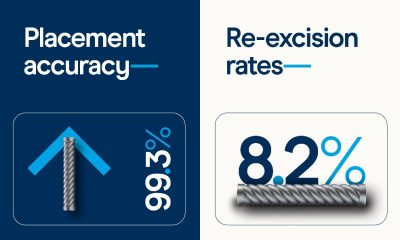
New meta-analysis further supports low re-excisions and high placement accuracy with the Magseed marker

 Menopause4 weeks ago
More research needed to understand link between brain fog and menopause, expert says

 Mental health3 weeks ago
Lifting weights shows mental health and cognitive benefits in older women, study finds

 Entrepreneur4 weeks ago
Flora Fertility closes US$5m seed round

 News3 weeks ago
Resistance training has preventative effects in menopause, study finds