Motherhood
Researchers to develop AI innovation to improve newborn eye screening
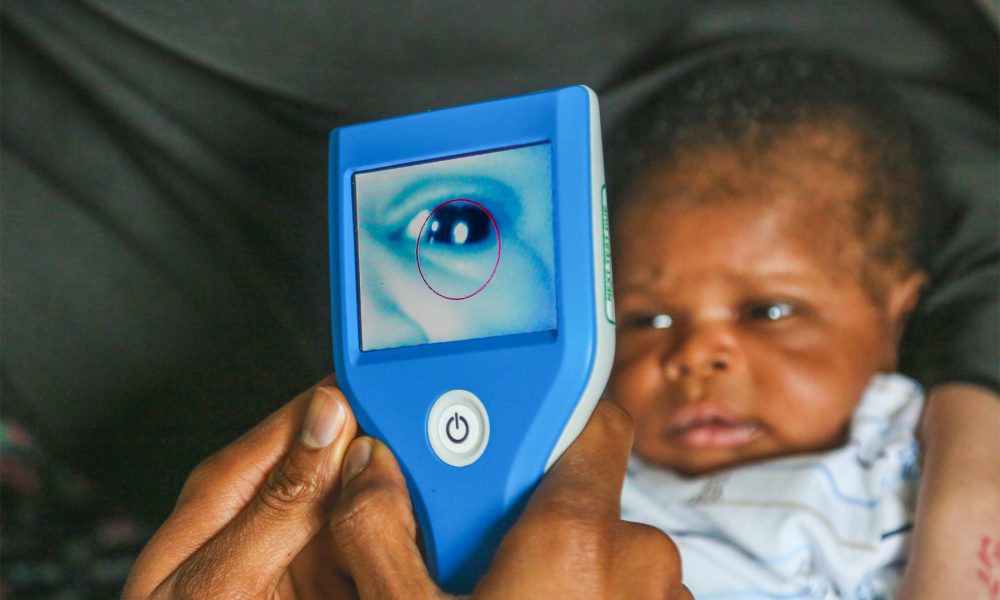
A Cambridgeshire hospital trust has teamed up with a local product innovation consultancy to develop an advanced AI feature for an innovative hand-held newborn eye screening device.
The innovation, being co-developed by Cambridge University Hospitals NHS Foundation Trust and 42 Technology, aims to further improve the accuracy of diagnosing congenital cataracts.
Cataracts are the leading cause of avoidable childhood blindness worldwide – when babies are examined in maternity wards shortly after their birth.
A prototype of the Neocam ophthalmic imaging device is currently being evaluated in a multi-centre clinical trial funded by the National Institute for Health and Care Research (NIHR) as part of the Digital Imaging versus Ophthalmoscopy (DIvO) study.

Dr Louise Allen is consultant paediatric ophthalmologist at Addenbrooke’s Hospital, Cambridge and Neocam’s inventor.
Allen said: “This novel eye screening technology has been designed to be an affordable, easy-to-use tool to improve the accuracy of diagnosing congenital cataracts in babies.
“The new added AI feature will build on 42 Technology’s previous design and development work, while ensuring the device is even easier for midwives and GPs to use when it is launched commercially.”
This five-year study, involving 30 NHS maternity units across England, aims to determine whether Neocam’s digital imaging technology can improve the detection of congenital cataracts compared with the standard ophthalmoscope test, which uses a bright visible light.
Although the final study outcomes are not due to be reported until 2027, the team has already noted some early positive findings.
For example, several babies have been diagnosed with rare but significant visual conditions that were missed by the standard screening tests being done at the same time.
The new AI feature will enable Neocam to immediately assess the quality of images as they are taken, providing instant feedback to maternity staff on whether a captured image is clear enough for accurate evaluation.
If an image does not meet the quality required, users can simply retake it.
In future, the AI could also potentially be developed to alert the screening midwife or GP to a possible cataract or other eye abnormality but this is not the prime objective for the first AI model.
The software engineering team at 42T will use 46,000 de-identified images from the DIvO study to train the machine learning model.
The aim being to integrate the new edge AI algorithms into the first commercially-available eye screening units so the device can analyse images using its existing processing capability – without added costs, needing any hardware redesign or impacting device performance.
The AI development project is being funded jointly by 42T and with an innovation grant from Addenbrooke’s Charitable Trust (ACT), which also helped fund early development and testing of the first prototype device called CatCam.
Insight
Caesarean births overtake natural vaginal deliveries in England for first time
Caesarean births (surgical births) have overtaken vaginal deliveries in England for the first time, with 45 per cent of births now by caesarean, NHS data show.
Last year, 44 per cent of births were through natural vaginal deliveries and 11 per cent were assisted with instruments such as forceps or ventouse, according to data published on Tuesday covering April 2024 to March 2025. Assisted deliveries use instruments to help the baby out during birth.
More than four in ten caesareans carried out by NHS England were elective, planned operations. For women under 30, natural vaginal birth remained the most common method, while for women aged 30 and over, caesareans were most common. For women aged 40 and over, 59 per cent of births were by caesarean.
In total, 20 per cent of births in 2024-25 were planned caesareans and 25.1 per cent were emergency, with both figures at record highs.
There were 542,235 deliveries in NHS England hospitals during this period, down from 636,643 in 2014-15. One in four births were to mothers aged over 35.
In 2014-15, caesarean deliveries made up 26.5 per cent of births. The increase over the past decade has been attributed to growing numbers of complex pregnancies, linked to factors including rising obesity rates and women waiting until they are older to have children.
Donna Ockenden, one of the UK’s most senior midwives who is leading the inquiry into maternity failures in Nottingham, told BBC Radio 4’s Today programme that the rise was a “complex” and “evolving picture over time”.
She said: “The thousands of women I’ve spoken to want a safe birth above everything else, so we should not vilify or criticise women who make those decisions.”
“In the reality of today’s maternity services – where women are living in poverty, deprivation, they’ve got pre-existing illnesses – obstetricians, midwives, nurses can only do so much, and we don’t always do enough in all cases to optimise women’s health prior to pregnancy.”
Soo Downe, a professor of midwifery at the University of Lancashire, added: “In some cases women are going for caesarean sections as a kind of least-worst option because they don’t really believe they’re going to have the kind of support they need to have a safe, straightforward, positive labour and birth in hospital.
“Or because their birth centres are being closed … or because they go into labour wanting a home birth and the midwife isn’t able to come to them because the midwife’s called somewhere else.
“But for some of them, it becomes the only choice on the table … and for other women, they choose a caesarean because they really want one, and that’s absolutely fine.”
Insight
UK gov responds to report into failings in black maternal health
Insight
COVID-19 vaccine significantly reduces risk to pregnant women and baby – study
Pregnant women who received a Covid-19 vaccine were far less likely to experience severe illness or deliver prematurely, according to a major new study.
The research, drawing on data from nearly 20,000 pregnancies across Canada, found that vaccination was strongly associated with lower risks of hospitalisation, intensive care admission and preterm birth. Preterm birth means delivery before 37 weeks.
These benefits persisted as the virus evolved from the Delta variant to Omicron.
Dr Deborah Money is a professor of obstetrics and gynaecology at UBC and senior author of the study.
She said: “Our findings provide clear, population-level evidence that COVID-19 vaccination protects pregnant people and their babies from serious complications.
“Even as the virus evolved, vaccination continued to offer substantial benefits for both mother and child.”
The findings revealed that vaccinated women were about 60 per cent less likely to be hospitalised and 90 per cent less likely to require intensive care compared with those unvaccinated at the time of infection.
Vaccination was also linked to fewer premature births, reducing the risk by 20 per cent during the Delta wave and 36 per cent during the Omicron wave.
Notably, the analysis found that women vaccinated during pregnancy, as opposed to before pregnancy, had even lower rates of preterm birth and stillbirth.
“But our data suggest there may be added benefits to receiving the vaccine during pregnancy,” said Dr Elisabeth McClymont, lead author and assistant professor in UBC’s department of obstetrics and gynaecology.
The findings arrive amid evolving vaccine guidance for pregnant women.
In the US, the Advisory Committee on Immunization Practices recently did not include a specific recommendation for Covid-19 vaccination during pregnancy in its updated adult immunisation schedule.
Meanwhile, public health officials in Canada and at the World Health Organization continue to recommend that pregnant women receive a Covid-19 vaccine.
-
Features2 weeks agoCannabis compounds kill ovarian cancer without harming healthy cells, research finds
-
Opinion4 weeks agoFemtech in 2025: A year of acceleration, and what data signals for 2026
-
Insight2 weeks agoMeta removes dozens of abortion advice and queer advocacy accounts
-
News4 weeks agoRound up: First wearable detects symptoms of perimenopause, and more
-
Insight3 weeks agoSperm donor with cancer-causing gene fathered nearly 200 children across Europe
-
Hormonal health4 weeks agoInsomnia combined with sleep apnea associated with worse memory in older women
-
News3 weeks agoUK couples exploiting legal loophole to rank embryos based on IQ, height and health
-
Entrepreneur4 weeks agoFemtech firm launches genetic test for perimenopause