Motherhood
Researchers to develop AI innovation to improve newborn eye screening
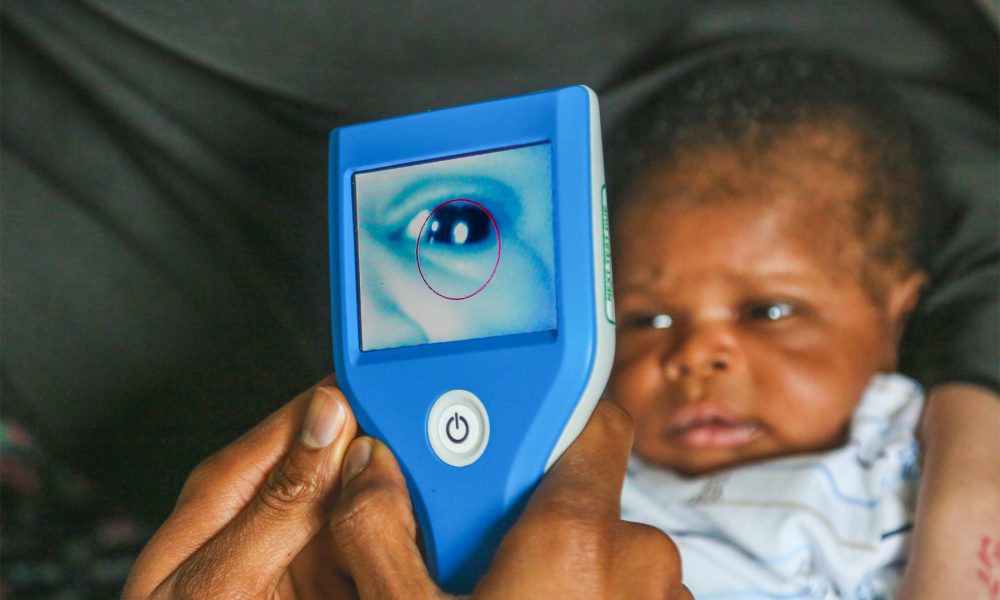
A Cambridgeshire hospital trust has teamed up with a local product innovation consultancy to develop an advanced AI feature for an innovative hand-held newborn eye screening device.
The innovation, being co-developed by Cambridge University Hospitals NHS Foundation Trust and 42 Technology, aims to further improve the accuracy of diagnosing congenital cataracts.
Cataracts are the leading cause of avoidable childhood blindness worldwide – when babies are examined in maternity wards shortly after their birth.
A prototype of the Neocam ophthalmic imaging device is currently being evaluated in a multi-centre clinical trial funded by the National Institute for Health and Care Research (NIHR) as part of the Digital Imaging versus Ophthalmoscopy (DIvO) study.

Dr Louise Allen is consultant paediatric ophthalmologist at Addenbrooke’s Hospital, Cambridge and Neocam’s inventor.
Allen said: “This novel eye screening technology has been designed to be an affordable, easy-to-use tool to improve the accuracy of diagnosing congenital cataracts in babies.
“The new added AI feature will build on 42 Technology’s previous design and development work, while ensuring the device is even easier for midwives and GPs to use when it is launched commercially.”
This five-year study, involving 30 NHS maternity units across England, aims to determine whether Neocam’s digital imaging technology can improve the detection of congenital cataracts compared with the standard ophthalmoscope test, which uses a bright visible light.
Although the final study outcomes are not due to be reported until 2027, the team has already noted some early positive findings.
For example, several babies have been diagnosed with rare but significant visual conditions that were missed by the standard screening tests being done at the same time.
The new AI feature will enable Neocam to immediately assess the quality of images as they are taken, providing instant feedback to maternity staff on whether a captured image is clear enough for accurate evaluation.
If an image does not meet the quality required, users can simply retake it.
In future, the AI could also potentially be developed to alert the screening midwife or GP to a possible cataract or other eye abnormality but this is not the prime objective for the first AI model.
The software engineering team at 42T will use 46,000 de-identified images from the DIvO study to train the machine learning model.
The aim being to integrate the new edge AI algorithms into the first commercially-available eye screening units so the device can analyse images using its existing processing capability – without added costs, needing any hardware redesign or impacting device performance.
The AI development project is being funded jointly by 42T and with an innovation grant from Addenbrooke’s Charitable Trust (ACT), which also helped fund early development and testing of the first prototype device called CatCam.
Pregnancy
Women’s health strategy a ‘missed opportunity,’ RCM says
Pregnancy
Scotland to publish dedicated miscarriage patient charter

Scotland is set to publish the UK’s first dedicated miscarriage patient charter, giving women and families clear information on NHS care and support.
Commissioned by the Scottish Government and developed with baby-loss charities Tommy’s, Held In Our Hearts and the Miscarriage Association, the charter sets out minimum standards for compassionate, clinically appropriate and culturally competent miscarriage care across Scotland.
It builds on the Scottish Government’s Delivery Framework for Miscarriage Care, which has already changed practice across NHS boards.
Jenni Minto, Scottish public health and women’s health minister, said: “Miscarriage is devastating, and for too long women have not had the care and support they deserve.
“That is changing. Scotland will become the first country in the UK to publish a miscarriage patient charter, meaning women know exactly how they will be supported by health services following their loss.”
Unlike previous UK-wide norms, where women were typically offered enhanced support only after three miscarriages, Scotland’s approach means women can receive appropriate support after their first miscarriage.
The charter also sets out clear rights and expectations so every woman, regardless of location or circumstance, understands the care she should receive.
It includes access to private rooms in hospitals rather than busy clinical areas or maternity settings, progesterone treatment where clinically appropriate, compassionate and culturally competent bereavement support, and clear information in 18 languages, including British Sign Language and audio formats.
Progesterone is a hormone that growing evidence suggests may help reduce the risk of miscarriage in certain cases when given to women who meet specific clinical criteria.
The Scottish Government said the charter is designed to ensure personalised, respectful care and to address long-standing inequalities experienced by women during miscarriage.
It is intended to provide clarity on the support women can expect, consistent standards across all NHS boards, stronger awareness and confidence among healthcare professionals, and better access to emotional and practical support services.
Charities involved in its development said many women still report feeling dismissed, uninformed or unsupported during miscarriage.
They said the new charter marks an important step towards making sure every woman feels heard, respected and cared for.
The charter aligns with Scotland’s wider Women’s Health Plan, which is improving care across reproductive, menstrual, maternal and perinatal health.
Recent national developments include greater investment in women’s health services, improved training for healthcare staff, new digital and in-person support tools, and targeted action to reduce inequalities in access and outcomes.
Together, these measures aim to create a more compassionate and equitable women’s health system.
Minto said: “This charter is a landmark moment.
“It tells women clearly what they should expect from their NHS, and it holds services to account for delivering it.
“Scotland is leading the way, and I am proud of the progress NHS boards and our charity partners have made together.”
The model is expected to inform wider UK discussions on miscarriage support, bereavement care and early pregnancy services.
The charter will be made publicly available, offering women, partners and families clear guidance on their rights and the standards they can expect when seeking care.
Motherhood
The maternity care crisis hiding in plain sight

By Adrianne Nickerson, founder and CEO, Oula
The numbers get the headlines. Maternal mortality rates. Access deserts. Workforce shortages. These are real and urgent problems, but they’re not the whole story.
There’s a quieter breakdown happening inside routine appointments, and it’s driving outcomes in ways that never show up in formal reports.
Women describe maternity care that feels rushed and transactional.
They talk about repeating their medical history at every visit, leaving appointments with questions they never got to ask, and receiving advice so generic it doesn’t seem to account for their actual lives.
These aren’t just complaints about bedside manner. They’re signals that the system is losing the thread, and when that happens, clinical risk follows.
A patient who doesn’t feel heard may decide a new symptom isn’t worth mentioning.
A patient who leaves an appointment without clear next steps may wait too long to call when something changes. These small moments of disconnection are where complications quietly take shape.
The system is structured to rush
This isn’t about individual clinicians failing women. It’s about a care model built around short, physician-led visits with limited coordination across roles — applied to pregnancies that are often medically and emotionally complex.
Clinicians are covering more ground in less time, and patients feel that compression. Women in marginalised communities feel it most acutely.
Reports of dismissal and bias are well-documented, and the consequences compound: when trust erodes, communication breaks down, and the window for early intervention narrows.
What women are actually asking for
Younger women in particular are entering maternity care with different expectations. They want explanations for recommendations, not just instructions.
They want to understand tradeoffs and have their preferences carry forward from one visit to the next. They’re not looking to reduce medical oversight, they’re looking for care that makes sense as a whole.
That’s driving real interest in collaborative care models that bring OBs, midwives, nurses, and behavioural health professionals into a coordinated framework.
When roles are clear and communication is shared rather than siloed, the experience changes, and so do outcomes.
Experience is clinical performance
Health systems are sophisticated at tracking infection rates and readmissions. The experience of care deserves the same level of attention, because it’s often where the clinical picture first starts to slip.
The fixes aren’t mysterious. A longer first visit can prevent confusion that compounds over months. Integrated mental health support surfaces concerns that might otherwise go unspoken.
Clear communication across the care team eliminates the mixed messages that erode confidence.
Postpartum services like pelvic floor therapy and lactation support – when easy to access and clearly explained – extend the impact of care well beyond delivery.
Workforce shortages and financial pressure make all of this harder. They also make it more urgent.
When women feel respected and informed, they raise concerns earlier, follow care plans more consistently, and seek help sooner.
That’s not a soft outcome – that’s how complications get prevented.
Simply put: adjusting how care is delivered is one of the most direct ways to improve clinical outcomes.
Fertility1 week agoFuture Fertility raises Series A financing to scale AI tools redefining fertility care worldwide
Diagnosis3 weeks agoFuture Fertility partners with Japan’s leading IVF provider, Kato Ladies Clinic
Menopause3 weeks agoMore research needed to understand link between brain fog and menopause, expert says
Mental health2 weeks agoLifting weights shows mental health and cognitive benefits in older women, study finds
News3 weeks agoSelf-employment linked to better cardiovascular health outcomes in Hispanic women
News5 days agoWomen’s digital health market set to reach US$5.28 billion in 2026 – report
Entrepreneur3 weeks agoFlora Fertility closes US$5m seed round
News2 weeks agoResistance training has preventative effects in menopause, study finds