




To receive the Femtech World newsletter, sign up here.
Entrepreneur
Could this start-up turn the tide on ovarian cancer?
Ovarian cancer causes more deaths than any other cancer of the female reproductive system


Nearly 225,000 women are diagnosed with ovarian cancer globally every year, but over 50 per cent of them will not survive. Could this biotech start-up have the solution?
March marks Ovarian Cancer Awareness Month – a chance to put ovarian cancer in the spotlight.
The disease causes more deaths than any other cancer of the female reproductive system and, according to the American Cancer Society, will kill in 2024 12,740 women in the US alone.
Despite this, awareness remains low. New data from Target Ovarian Cancer shows that, while progress has been made, things are not moving fast enough, with 40 per cent of UK women confusing cervical cancer and ovarian cancer.
“We don’t have enough awareness and advocacy around ovarian cancer to elevate the importance of the disease the way we do around breast cancer,” says Oriana Papin-Zoghbi, co-founder and CEO of the biotech start-up AOA Dx.
She believes this is directly linked to the low incidence of the disease – there are about 240,000 new cases of breast cancer in the US every year, compared to just under 20,000 of cases of ovarian cancer.
However, she says: “While we don’t see hundreds of thousands of cases, the percentage of women who die of ovarian cancer is significantly higher than almost any other gynaecological cancer.”
Ovarian cancer’s high fatality rate is largely attributed to a failure to recognise symptoms early on and a series of misconceptions around the disease, such as the idea that ovarian cancer is a “silent killer”.
Papin-Zoghbi agrees. Most of the things we hear about ovarian cancer, she says, are not actually true.
“Around 87 per cent of women with ovarian cancer experience symptoms early on, but they are misconstrued for different things.
“The vague abdominal symptoms that we hear about are commonly mistaken for conditions like endometriosis or irritable bowel syndrome because there is no diagnostic to differentiate them.”

Currently, the only way to confirm an ovarian cancer diagnosis is a tissue biopsy. Most women have a biopsy during an operation called laparotomy, where the surgeons make a large cut down the middle of the abdomen to take samples of tissue.
However, in some cases, doctors have to remove an ovary and have it tested for signs of cancer to confirm a diagnosis.
Papin-Zoghbi and her team at Boston-based AOA Dx are aiming to develop the first early-stage ovarian cancer liquid biopsy diagnostic test, which could significantly cut down fatalities and make the diagnosis process less invasive.
“The fact that 80 per cent of women are diagnosed with stage three and four ovarian cancer is unacceptable. Women need a much better chance,” she says.
“We are hoping that our solution will help elevate our understanding of ovarian cancer.”
The technology has shown over 90 per cent accuracy for detection of ovarian cancer and raises hopes for thousands of women globally. However, it will take time.
“There are certain that are not in our control,” says Papin-Zoghbi.
“It takes up every waking moment to build a company, but we have a strong team and we are very positive about the the path forward.
“We closed a US$17m financing round in October and we are currently focusing on building our lab, developing our product pipeline and conducting our clinical study to validate our technology. In the next couple of years, our aim is to focus on product development and clinical study data ahead of thinking about how we will bring the product to market.
“We’re optimistic – we know we can have a transformational impact on women’s health.”








The Women’s Health Innovation Summit (WHIS), the event uniting the global women’s health ecosystem, has just announced 18 new speakers joining the agenda for its 2026 summit, taking place October 13–15 at Encore Boston Harbor.
The latest additions bring further depth across pharma, clinical research, health systems, venture, and policy, reinforcing WHIS’s role as the only platform where the full women’s health ecosystem convenes under one roof.
Newly confirmed speakers include:
- Kelle Moley, MD – VP, Women’s Health Early Phase Clinical Development, Cardiometabolic Research, Eli Lilly & Company
- Justine Levin-Allerhand – Executive Partner, Chief Corporate Development Officer & COO, Flagship Labs, Flagship Pioneering
- Sebnem Yildirimoglu, MD, PMP – Executive Director, Women’s Health Strategy, Premier Research
- Terri Stewart – Head of Global Healthcare & Government Affairs, EMD Serono
- Dr. Morag Grassie – Executive Director, Blavatnik Fund for Innovation, Yale
- Sandra Butler – Director, Design Impact, Mass General Brigham
- Zhenya Lindgardt – Chief Executive Officer, Sera Prognostics
- Sadie Morahan – Head of US Revenue, Withings Health Solutions
- Angela Drew, PhD – Vice President, Regulatory Strategy, Premier Research
- Dr. Stephanie Lahr – CMIO, Aqurio
- Michelle Andrews – Contributing Writer, KFF Health News
- Charlotte Williams – CEO, My Bump Hub
- Clint Dart, MS – Director, NIH Women’s Health Data Coordinating Center, Premier Research
- Cass Sanford – US Venture Advisor, FemTech Lab
- Megan Mukuria – Founder & CEO, ZanaAfrica
- Tiffany Inglis, MD, FACOG – Chief Medical Officer, Sera Prognostics
- Angelean Hendrix, PhD – Vice President, Pharmacometrics and MIDD, Premier Research
- Amanda Ducach – CEO & Co-founder, EmaEQ
“WHIS is where the women’s health industry comes together to take action,” said Poppy Howard-Wall, Event Director at WHIS.
“This latest wave of speakers reflects exactly the kind of cross-sector expertise our attendees expect – from global pharma and clinical research leadership to venture, health systems, and grassroots innovation.
“It’s this breadth that makes WHIS the room where things actually move forward.”
Bringing the Full Ecosystem Together
These additions join a growing 2026 agenda spanning four content tracks that reflect the full lifecycle of healthcare innovation, from early-stage research and development through to patient delivery, system transformation, and commercial scale.
Attendees can expect over 1,000 senior decision-makers, 120+ expert speakers, four dedicated stages, and more than 10 hours of curated 1:1 meetings.
Full speaker and agenda details are available at whisusa.com/speakers-2026.
About WHIS
The Women’s Health Innovation Summit is the only platform uniting the full women’s health ecosystem – providers, payers, employers, pharma leaders, investors, and innovators -to increase deal flow, expand reimbursement, improve access, and deliver better outcomes for women at every stage of life.

Medtech startup Peripear has won an Innovate UK award for developing a wearable designed to prevent perineal trauma during childbirth.
The Oxford-based company is developing a hands-free warm compress device for use on the perineum during the second stage of labour.
Peripear describes its product as the world’s first automated perineal thermotherapy wearable, designed to prevent perineal trauma during childbirth.

The device is intended to reduce severe tearing and episiotomies while improving maternal comfort.
Peripear has secured an Innovate UK Women in Innovation Award and a £74,974 grant.
The funding will support further product development ahead of the company’s planned first-in-human study.
Nina van Schaick, co-founder and chief operating officer of Peripear and midwife, said: “I’m sure I wasn’t the only one to see this gap.
“I was incredibly lucky to meet my co-founder, Eviatar Natan, right as my frustration about the lack of translation of evidence into practice had peaked.
“There was a proven mechanism that could reduce injuries occurring in up to 90 per cent of vaginal births, and it was being left out of clinical pathways simply because no standardised tool existed to deliver it.
“I’m a farmer’s granddaughter, and when I started practising over 14 years ago, I asked: where is the tool I need to implement this evidence? I looked around and realised we were still asking clinicians to improvise.
“Peripear is what happens when the person who has lived the problem, both personally and professionally, meets the person who can help her build the solution.”
Entrepreneur
Applications close August 18 for Women’s Health Innovation Summit 2026 Innovation Showcase

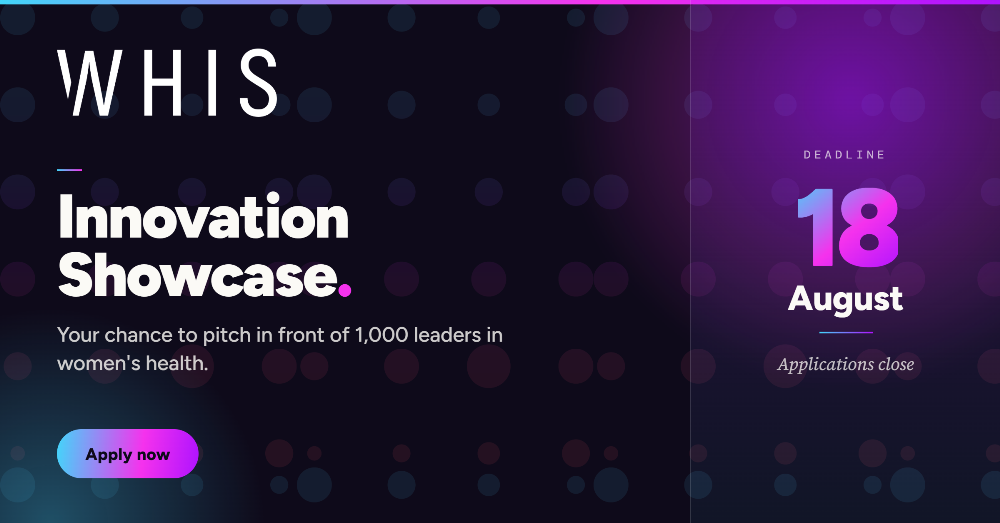
The Women’s Health Innovation Summit (WHIS) has reminded startups that applications for its 2026 Innovation Showcase close on Tuesday, August 18.
The Showcase gives early and growth-stage companies the opportunity to pitch live on stage to the most influential audience in women’s health, at a summit that convenes more than 1,000 senior decision-makers from across the ecosystem, including payers, providers, pharma, and investors.
Now in its eighth year, WHIS takes place October 13–15, 2026 at Encore Boston Harbor.
The event has built a reputation as the leading platform uniting the full women’s health ecosystem, from health systems and health plans to pharmaceutical leaders and the investors funding the next wave of innovation in the space.
A Direct Line to Funding, Partnerships and Adoption
Companies selected for the Innovation Showcase will present directly to an audience with the capital, clinical expertise and commercial relationships to move deals forward.
Past participants have gone on to secure investor introductions, commercial partnerships and clinical collaborations that started as presentations on the WHIS stage and turned into signed agreements.
Applications Reviewed by an Expert Selection Committee
Submissions are being reviewed by a selection committee of leading investors and industry operators, including:
- Parambir Bhangu, Executive Director, External Innovation & Emerging Science, Organon
- Elizabeth Bailey, Co-Founder & Managing Partner, Foreground Capital
- Karla Loken, Founder, Loken and Associates
- Mané Mikayelyan, Associate Partner, DeciBio
- Anna Valcheva, Founder, Managing Director & CEO, Astra Ventures
- Azin Radsan van Alebeek, Co-founder & General Partner, Emmeline Ventures
WHIS is where the women’s health ecosystem comes together to get deals done,” said Poppy Howard-Wall, Event Director of WHIS.
How to Apply
Early and growth-stage companies across digital health, therapeutics, diagnostics, med device and consumer health are encouraged to apply before the August 18 deadline.
Full details and the application form are available at whisusa.com/attend/start-ups.










 Entrepreneur2 weeks ago
Applications close August 18 for Women’s Health Innovation Summit 2026 Innovation Showcase

 Mental health2 weeks ago
Third of women unaware of perimenopause mental health impact

 Wellness1 week ago
Chelsea FC Women to launch first-of-its-kind player fertility fund

 Menopause2 weeks ago
Menopausal hormone therapy may lower dementia risk, study suggests

 Opinion1 week ago
anna perimenopause app launches across 39 markets

 Hormonal health2 weeks ago
We are wrapping our children in plastic and calling it care

 Pregnancy2 weeks ago
Chemicals in plastics may be linked to high blood pressure during pregnancy

 News2 weeks ago
Women with endometriosis face 46% higher risk of type 2 diabetes – study