




News
Amazon to expand access to fertility and family-building benefits
Workers will be eligible for free virtual family-building care to support preconception, egg freezing, IUI, IVF, adoption, and surrogacy


Amazon has teamed up with Maven Clinic to expand its fertility and family-building support programme in a bid to attract and retain employees.
As part of the partnership, the giant says it will give its workers and their partners free access to board-certified reproductive endocrinologists, obstetricians, gynaecologists, nutritionists, mental health providers and adoption coaches.
Virtual care will be available through video or message chat with doctors, nurses, coaches, and other experts across 35 languages.
Full-time, part-time, and hourly workers will have access to free local support through a care advocate who will help them navigate their fertility and “family-building journey”, provide referrals and advise them on local family-building guidelines.
“Our benefits are designed to care for all our employees’ needs, and that means ensuring they have the resources they need to live their best lives, regardless of their personal circumstances,” said Lian Neeman, global director of benefits at Amazon.
“Maven is an employee-friendly benefit that takes the guesswork out of the family-building process, which can often be confusing and overwhelming.
“Its approach to fertility and family building is tailored to each person and will support our employees around the world.”
Kate Ryder, founder and CEO of Maven Clinic, said: “There are too many barriers to care in healthcare systems that were not built around the needs of women and families, and Amazon is cutting through that complexity by making it exceptionally easy for their employees to access high-quality, personalised care in their own language at any hour of the day or night.
“We’re delighted to support Amazonians around the world as they plan and grow their families.”
Heather Mellish, global president of Families@, Amazon’s family-focused affinity group, added: “It’s great to see the addition of Maven to our benefits, which means that more Amazon families have access to world-class family-building resources.
“This sort of support across the entire definition of the word ‘family’ is exactly what a company should provide for its employees.”
The demand for workplace fertility benefits is on the rise, with close to 90 per cent of those experiencing infertility willing to change jobs solely for the benefits.
Last year, fertility advice provider FertilityIQ estimated that 800 large organisations around the world offered benefits such as assistance with fertility, adoption or fostering, a 59 per cent rise on 2019’s total.
Starbucks, Walmart, Apple, Spotify, Hootsuite and LinkedIn are among the biggest employers offering fertility benefits.
Data shows feedback for the benefits has been overwhelmingly positive, with Hootsuite’s employee-engagement score jumping from 66 per cent to 81 per cent after the introduction of the scheme.


British women are among the angriest in Europe, a global health survey has revealed.
More than 20 per cent of women in Britain said they had experienced feelings of rage for much of the previous day.
British women were also 47 per cent more likely to say they felt angry than a year earlier.
The findings were published in the Hologic Global Women’s Health Index, a yearly league table based on polling of more than 76,000 women and girls aged over 15 worldwide.
Anna O’Sullivan, co-founder of women’s health awareness group CensHERship and founder of the FutureFemHealth news platform, told the Daily Mail: “These figures reflect years of long waiting lists, delayed diagnoses and women’s health being treated as an afterthought.
“We’ve seen a significant increase in awareness and discussion about women’s health over the last few years, but access to care has not kept up with that.
“These findings should be a wake-up call that it’s time for long-term, sustainable investment to ensure women can access timely healthcare, trusted information and earlier diagnosis before conditions become more complex and costly to treat.”
The data suggested anger levels among British women have risen sharply.
Rates across the rest of Europe, however, remained broadly the same.
The survey, which involved more than 140 countries, found three in 10 UK women said they felt sadness, compared with the EU average of 25 per cent.
The data, collected in February 2024 and released this week, also showed that around four in 10 women in both the UK and EU felt worry.
A third of women in the UK reported being in pain, up 10 per cent on the previous year.
Three in 10 women also said they lived with chronic health problems, up seven per cent on the year before.
Chronic health problems are long-term conditions that may need ongoing care or management.
Health experts said women in the UK were increasingly frustrated by the gap between the NHS care they expected and the care they received.
The report took a snapshot of the national mood, with participants asked about the emotions they had experienced “during a lot of the day yesterday”.
The UK placed sixth among 37 European countries for anger.
The highest levels were recorded in Malta, where 26 per cent of women reported feelings of rage, followed by Greece at 25 per cent, the Czech Republic and Albania at 23 per cent, and Spain at 22 per cent.
Ireland ranked at 18 per cent, while Germany, France and Switzerland each reported 17 per cent.
Britain has also slipped in Hologic’s overall global rankings for women’s health.
The UK is now 48th, close to dropping out of the top third of countries worldwide, after ranking 40th out of 142 countries last year.
Taiwan ranked first, followed by Latvia, Japan, Vietnam and Poland. Singapore, Germany and Austria were also among the leading countries.
Tim Simpson, a senior manager at Hologic, said: “Women are telling us they want earlier diagnosis and faster access to care.
“Improving women’s health will take continued commitment from policymakers, the NHS, clinicians and industry working together to deliver the changes women are asking for.”
A separate Hologic survey carried out last month found that almost 70 per cent of women had faced delays seeking NHS care in the past five years.
Two in five said difficulties accessing healthcare had left them feeling frustrated or anxious.
The survey’s findings reinforced official figures showing that Britain has become more anxious since before the pandemic.
The Office for National Statistics said 22.5 per cent of UK adults reported “high anxiety yesterday” between July and September 2024, up from 20.4 per cent in the same period in 2019.
Among women, the figure was 26.3 per cent, compared with 18.5 per cent among men.
A Department of Health and Social Care spokesperson said: “It is unacceptable that the UK continues to lag behind other countries when it comes to women’s health.”
By Ritika Sukhani – Psychologist, part of Véa’s Clinical Advisory Board
Women’s mental health often unfolds before, between and around appointments, long before it can be neatly explained in one conversation.
A woman arrives at a GP appointment with six months of feeling “off” behind her. Not acutely unwell. Not necessarily in crisis. Just not herself.
Poor sleep. Brain fog. Lower tolerance. Irritability before her period. Anxiety before meetings. A sense that her cycle, workload, relationships and energy are interacting – but not in a way she can neatly explain when the appointment begins.
She has tracked symptoms, Googled at midnight, screenshotted articles, made notes in her phone and tried to remember what changed, when it changed and what might have triggered it.
But when she finally gets the chance to talk, the task is not only to describe how she feels. It is to organise months of fluctuating experience into a story clear enough to communicate.
This is one of the most overlooked forms of labour in women’s mental health: not simply experiencing distress but having to make it coherent.
In the NHS, women’s mental health rarely arrives through one door. It may appear in primary care as exhaustion, poor sleep or “not feeling like myself”.
It may appear in NHS Talking Therapies as anxiety or low mood. It may sit beneath a menopause conversation, a fertility journey, chronic pain, trauma, caring responsibilities, burnout or the quiet work of holding everyone else together.
The NHS provides essential care.
NHS Talking Therapies received 1.81 million referrals in 2024/25, with 1.21 million referrals accessing services and 50.5 per cent of referrals moving to recovery after completing treatment.
But women’s lives do not unfold in pathway-shaped ways.
Their distress is often cumulative, contextual and relational. It is shaped not only by symptoms but by the conditions around those symptoms: work, debt, trauma, hormones, caregiving, discrimination, physical health, relationships, sleep and the pressure to keep functioning.
That is why women’s mental health needs more than access to services.
It needs continuity.
The work before the appointment
Women are often encouraged to advocate for themselves in healthcare. At its best, this is empowering. It supports agency, preparation and active participation in care.
But self-advocacy can also become another unpaid job.
It requires women to notice what is happening, remember when it started, connect it to context, decide what feels relevant, find the right words and communicate it clearly – often while already tired, anxious, in pain or emotionally overwhelmed.
In clinical care, distress is often the beginning of an assessment. Clinicians are trained to explore duration, severity, functioning, risk, context, history and meaning.
That process matters. It is how distress becomes understood with care.
The issue is broader than any single consultation.
Women’s mental health experiences often unfold over weeks, months and years, while healthcare conversations may happen in short, pressured windows.
Patterns form outside the appointment room: between cycle phases, work demands, caring responsibilities, relational stress, poor sleep and moments of emotional overload.
The UK Government’s Women’s Health Strategy survey found that 84 per cent of respondents said there had been times when they, or the woman they had in mind, were not listened to by healthcare professionals.
It points to something structural: the difficulty of making complex, fluctuating and context-dependent experiences legible inside systems that are often fragmented, time-limited and under pressure.
Endometriosis shows why continuity, language and recognition matter.
Research has found that delays in diagnosis can occur at both patient and medical levels, including when symptoms are normalised by women themselves and by doctors.
For many women, receiving a diagnosis did more than name pain; it provided language, reassurance and possible management strategies.
This is the point we should pay attention to.
Women do not always lack information. Often, they have fragments of it.
The challenge is how to preserve context, recognise recurrence and bring scattered experiences into a form that supports reflection, communication and earlier action.
Tracking captures moments. Continuity reveals patterns
We have made enormous progress in helping women track their bodies.
We can now log cycles, sleep, mood, fertility windows, temperature, symptoms, recovery and heart rate variability with increasing precision. Period-tracking apps, for example, have been described as tools that can support body awareness and menstrual health literacy, while also introducing new forms of work, distress and privacy concern for some users.
That tension matters.
Tracking can help women notice what is happening. But noticing is not the same as understanding. And understanding is not the same as being able to explain.
A cycle tracker can show when a period started. A wearable can show disrupted sleep. A symptom log can hold isolated data points. A notes app can capture fragments of a difficult week.
But unless those pieces are brought together, the interpretive work still falls to the woman.
She is left asking: Is this hormonal? Is this stress? Is this burnout? Is this anxiety? Is this normal for me? Is this pattern important? Should I mention it? How do I explain it?
This is where the first wave begins to meet its limits.
The first wave helped women capture signals.
The next wave could help women interpret context.
The promise of patient-generated health data has always been that it could bridge the gap between everyday life and formal care. But reviews continue to highlight challenges around integration with electronic health records, trust, provenance, data quality and contextual information.
That matters because women’s health data does not become useful simply because it is collected. It becomes useful when it is contextualised.
A poor night’s sleep means something different after one stressful day than after six weeks of overextension.
A low mood entry means something different when it appears in isolation than when it appears repeatedly around a cycle phase, a work pattern or a relationship dynamic.
A spike in anxiety means something different when it is viewed alongside workload, recovery, conflict, hormonal change or self-critical thinking.
The value is not in turning every experience into a metric.
The value is in seeing what repeats, how it repeats and what else is happening around it.
Women’s mental health is systemic
The latest Adult Psychiatric Morbidity Survey found that one in five adults in England had a common mental health condition, with prevalence higher in women at 24.2 per cent compared with 15.4 per cent in men.
It also found a clear socioeconomic gradient, with common mental health conditions more prevalent in the most deprived areas and among people with problem debt.
These figures matter because they remind us that women’s mental health cannot be understood only at the level of individual coping.
Of course, individual support matters. Therapy matters. Medication may matter. Assessment, formulation, risk management and diagnosis all have their place.
But a systemic lens asks what else is happening around the woman.
Who is she caring for? What is she carrying at work? What has she had to normalise? What physical symptoms have been separated from her emotional life? What inequalities shape how quickly she is heard, referred or supported? What happens while she is waiting?
Women’s mental health is often partly biological, partly psychological, partly relational, partly occupational and partly social.
It may not fit neatly into one symptom box at first. It may need time, pattern and context before it becomes clear what kind of support is needed.
This is why the missing layer is not more monitoring – it is supported sense-making.
The need for supported sense-making
Supported sense-making means moving beyond isolated logs and dashboards towards tools that help women understand how different parts of their lives interact over time: body, mood, cycle, stress, relationships, work, recovery and self-talk.
It also means being clear about what technology should and should not do.
Technology should not replace clinical assessment. It should not diagnose from a journal entry.
It should not turn ordinary emotion into pathology or place yet another responsibility on women to optimise themselves.
At its best, it can support the wider ecosystem around care.
It can help women hold onto context before an appointment.
It can help them notice patterns while they are waiting. It can support reflection between sessions. It can help them arrive at conversations with more continuity, while respecting the clinical judgement, formulation and relational care that services provide.
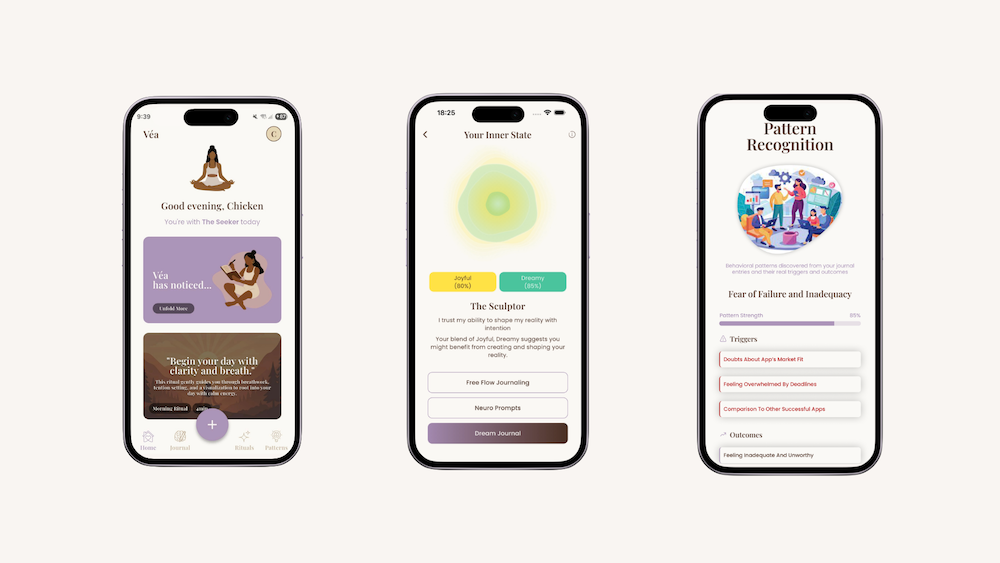
This is where platforms like Véa point toward a thoughtful role for women’s health technology.
By treating reflection, emotion and language as part of women’s longitudinal health context, Véa supports the kind of pattern recognition that often gets lost in daily life. Through micro-check-ins, journalling and reflective prompts, it helps women notice shifts in their internal state over time – not to self-diagnose but to build a clearer relationship with their own patterns.
For some women, that may support a better conversation with a clinician.
For others, it may help them recognise early signs of burnout, understand cyclical changes or notice when work, relationships and recovery are interacting in ways they had not previously named.
At its best, this kind of technology reduced the burden of self-interpretation. It helps women hold onto the thread.
From more data to better continuity
The women’s health gap is often discussed as a research gap, a funding gap and a diagnostic gap.
It is all of those things. McKinsey Health Institute and the World Economic Forum estimate that closing the women’s health gap could add at least $1 trillion annually to the global economy by 2040.6
But there is another gap sitting underneath the others.
A continuity gap.
Women’s mental health experiences are often long, fluctuating and context-dependent. Healthcare systems often encounter them in snapshots. Workplaces may only notice them when performance drops. Women themselves may only recognise the pattern once they are already exhausted.
That gap between lived experience and later explanation is where too much meaning gets lost.
The next generation of women’s health technology should help preserve the story behind the symptom.
It should make room for emotional, cognitive, hormonal and social context without collapsing everything into diagnosis or optimisation. It should support better conversations without pretending to replace clinical care.
Women should not have to rely on memory alone to make sense of months of fluctuating emotional, cognitive and physical experience.
The future of women’s mental health will not be built by asking women to monitor themselves more closely.
It will be built by helping them understand themselves sooner – and arrive at conversations about their health with more continuity, context and clarity.
Learn more about Véa at veajournal.app














 Menopause1 week ago
Perimenopause misinformation ‘putting women at risk’

 News4 weeks ago
NIH Grant terminations disproportionately impact minority scientists, research finds
 Insight3 weeks ago
PCOS renamed after decade-long campaign to end ‘cyst’ misconception

 Adolescent health4 weeks ago
WUKA brings Period-Positive Pool Party to London Aquatics Centre to keep girls swimming through puberty

 Hormonal health2 weeks ago
NHS urged to update website following renaming of PCOS

 Menopause4 weeks ago
CBT shows promise for menopause insomnia and hot flashes

 Events1 week ago
Women’s Health Innovation Summit opens submissions for 2026 Innovation Showcase
 News1 week ago
Three menopause innovators shortlisted for Femtech World Award