




Cancer
FDA approves ovarian cancer treatment













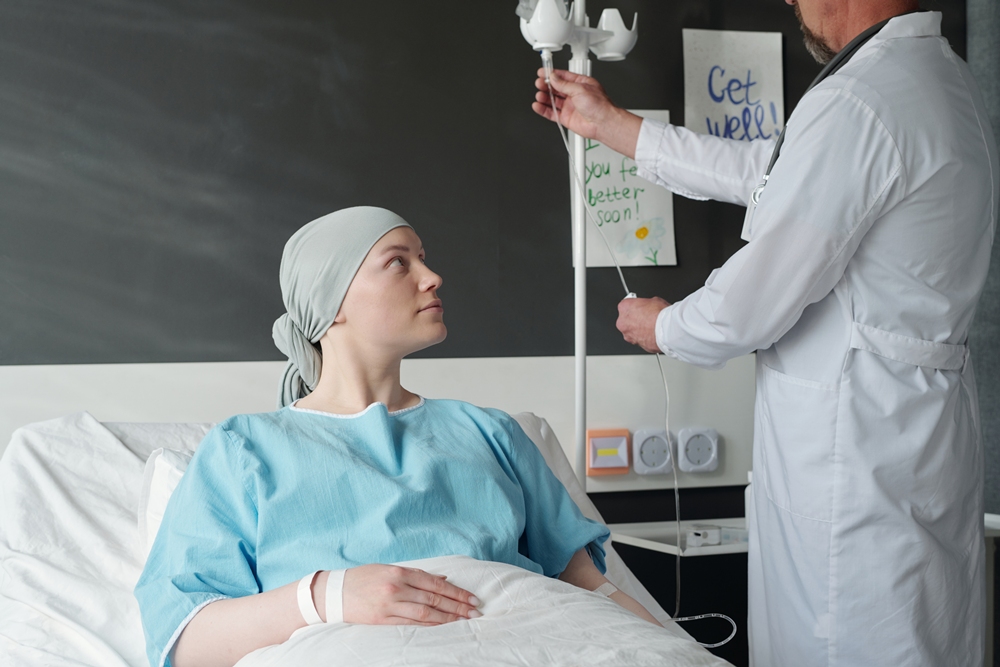
A woman with advanced ovarian cancer has become the first patient globally to receive an experimental off-the-shelf cell therapy.
Tracy Tomlinson, 58, was given the experimental drug ZI-MA4-1 at the Christie NHS Foundation Trust in Manchester.
The treatment forms part of a clinical trial evaluating its use against several cancer types, including ovarian, lung, head and neck cancers and sarcomas.

The Christie is leading the trial, with a second site at the Royal Marsden in London. It involves patients with advanced cancers who may have few other treatment options.
Tomlinson, from Chadderton in Greater Manchester, has undergone surgery and multiple rounds of chemotherapy since she was diagnosed in 2020.
She said: “They’ve got rid of the cancer twice but then it came back about two and a half years ago, and we’ve never seemed to get rid of it since then.
“The chemotherapy has shrunk it but when treatment stops, it has come back.
“It is a lot to live with and there’s been ups and downs – there’s been elation, there’s been disappointment, and bits in between.
“But I try very, very hard to remain very positive. Every day that I wake up is a positive. You’ve got to have hope.”
ZI-MA4-1 combines two approaches to cancer treatment.
It uses natural killer cells, known as NK cells, which are specialist immune cells that identify and destroy abnormal cells.
T-cell receptors on the donor cells are also engineered to recognise and target tumours producing a protein called Mage-A4.
Mage-A4 is found in several types of cancer and is considered by experts to be a potential target for attacking abnormal cells.
Unlike personalised treatments, ZI-MA4-1 is designed as an off-the-shelf therapy using immune cells from donors.
The treatment is manufactured in advance rather than being made separately for each patient, with hundreds of doses potentially produced from one manufacturing batch.
Experts believe this approach could make advanced cell therapies available to more patients, more quickly and at a lower cost.
Tomlinson was diagnosed with ovarian cancer that had spread shortly before Christmas 2020 and began treatment immediately.
By summer 2021, scans showed no evidence of disease, but the cancer returned around a year later.
Despite further treatment and 48 chemotherapy infusions, the cancer continued to return.
The former Civil Service manager was diagnosed with stage 3C ovarian cancer, meaning cancer growths had spread into the peritoneum, the tissue lining the abdominal cavity.
She currently has a tumour between her liver and kidney, as well as smaller tumours elsewhere.
She said: “They’ve got rid of the cancer twice but then it came back about two and a half years ago, and we’ve never seemed to get rid of it since then.
“The chemotherapy has shrunk it but when treatment stops, it has come back.
“It is a lot to live with and there’s been ups and downs – there’s been elation, there’s been disappointment, and bits in between.
“But I try very, very hard to remain very positive. Every day that I wake up is a positive. You’ve got to have hope.”
Tomlinson said she had been target-driven during her working life and had set herself high standards.
“But you can’t control cancer,” she said. “What I can control is how I look at it, how I deal with it, and trying to eat healthily and taking the positives in everything.
“And I’ve learned to appreciate the smallest of things that we take for granted – and the people around you and what they mean to you.
“Also, the beauty of outside and the trees and the colour of the trees and the birds singing.
“We just go from A to B, don’t we? Busy, busy, busy. But we never slow down and take in the wonder of what’s around us.
“I often think, ‘I’m still here’, and that’s helped me think, ‘Why can’t I still be here in 10 years?’, ‘Why can’t I still be here in 15 years?’
“And I believe taking all the treatments offered to me is helping me kick that can a bit further down the road.
“I don’t want to go anywhere. I’ve still got a lot of things I want to do and things I want to achieve.”
Tomlinson said her husband Paul, whom she married in 2022, is her “rock”. She is also close to her son Harry, 28.
Last year, she was referred to the Christie’s early-phase clinical trials team for extensive screening and learned she was eligible for the Zima-101 clinical trial.
She said: “I decided almost straight away that I was going to go for it.
“Then afterwards you think, ‘Am I doing the right thing?’, because it is a little bit scary being the first person in the world to have the treatment.”
She has received three infusions of the therapy, with the option of a fourth depending on her scan results.
She said: “If it benefits me, absolutely fantastic. But if it benefits other people in the future, that’s important too.
“I don’t want to have gone through everything I’ve gone through for nothing. I want to feel like I have made a difference.”
Professor Fiona Thistlethwaite, consultant medical oncologist at the Christie, said: “While this is an early-stage study primarily focused on safety, it represents an exciting step forward in efforts to develop new treatment options for people like Tracy with advanced solid tumours.
“We hope the knowledge gained will help shape future cancer treatments and ultimately improve outcomes for patients.”
Dr Jon Lim, consultant medical oncologist in advanced immunotherapy and cell therapy at the Christie, told PA: “What’s very exciting about this is that these are essentially not kind of antibody-based, but living cells.
“These are live immune cells that are infused in hundreds of millions back to the patient, and the idea of this is that it is a little bit more targeted.
“The reason this is very interesting is because this is the first of its kind globally in this approach, where it’s taking donor immune cells, manipulating or engineering them, and putting them into the recipient.
“Tracy is essentially getting somebody else’s immune cells that have been engineered to ‘see’ her cancer.
“We’re very excited. This is a novel approach in the cell therapy space. We are also really showcasing what we can do in the UK.”
Namir Hassan, chief executive of Norwegian company Zelluna, which makes ZI-MA4-1, described Tomlinson’s first dose as a “landmark moment”.
He said: “It represents the moment when years of research moved beyond the laboratory and into the clinic, offering a new potential treatment option for patients facing advanced cancers with limited alternatives.”
Only around 15 per cent of women survive ovarian cancer for five years or more after diagnosis.
Dr Diana Hernandez, director of immune and advanced therapies at Anthony Nolan, said: “NK cells have huge potential as off-the-shelf therapies, and this trial takes us one step closer to a wider application of engineered NK cells in the targeted treatment of cancers.”


Johnson & Johnson has offered an estimated US$5.5bn settlement covering about 76,000 claims that its talc products caused ovarian cancer.
The proposed agreement could end a contentious legal dispute over the company’s baby powder and other talc-based products that has lasted around a decade.
Johnson & Johnson said the settlement covers claims consolidated in a federal court in New Jersey and related cases in state court.
The claims represent nearly all the remaining talc cases against the US multinational, according to the company.
Johnson & Johnson has previously settled most claims alleging that its talc contained asbestos and caused mesothelioma.
Mesothelioma is a rare cancer affecting the lining of organs, most commonly the lungs, and is usually linked to asbestos exposure.
Law firms representing claimants confirmed the proposed deal, describing it as a good resolution after around 10 years of litigation.
The agreement must be accepted by 95 per cent of ovarian cancer claimants in state or federal court before it becomes final.
Erik Haas, vice-president of litigation at Johnson & Johnson, said the claims were “meritless” and that the company was willing to settle to bring the litigation to a close.
“While we are confident the company would have ultimately prevailed with further litigation, as it has in the vast majority of cases tried to date, this resolution allows the company to put this matter behind it and remain focused on its mission to develop medicines and devices that save lives,” Haas said.
The company expects to pay US$3bn in 2027, with further payments due in 2028.
The deal could be worth more, depending on how many people take part in the settlement.
Chris Seeger, a lawyer representing around 2,500 clients with talc claims who helped negotiate the agreement, said Johnson & Johnson could ultimately pay US$7bn or more.
The settlement assigns specific values to qualifying ovarian cancer claims but does not cap the company’s total payout.
“We got a fair settlement, and our clients are going to be happy with it,” Seeger said.
Johnson & Johnson reached the agreement after a series of court victories, including wins in individual trials and successful efforts to disqualify claimants’ lawyers from the litigation.
The company also secured court rulings against experts used by claimants to support their cases.
A federal judge last week questioned whether individual claimants could prove that talc had specifically caused their ovarian cancer.
Johnson & Johnson has consistently denied that its talc products caused cancer, maintaining that the products were safe and did not contain asbestos.
The company stopped selling talc-based baby powder in the US in 2020 and switched to a cornstarch-based product.
Litigation resumed in March 2025 after being paused for more than three years while Johnson & Johnson pursued a bankruptcy strategy known as the “Texas two step”.
The company filed three bankruptcies through a shell-company subsidiary in an attempt to settle the cases. Each bankruptcy was dismissed.
Before the bankruptcy attempts, Johnson & Johnson had a mixed record in talc trials.
These included a multibillion-dollar verdict for 22 women who said baby powder caused their ovarian cancer, alongside trials won by Johnson & Johnson and other verdicts later reduced on appeal.
Unlike the proposed bankruptcy settlements, the latest agreement applies only to existing claims and does not cover future lawsuits.
Seeger said excluding future claims made more money available for current claimants than the bankruptcy proposal and would allow all claims to be paid within 18 months rather than over more than a decade.
The Welsh Government has been urged to invest in breast cancer services after figures showed continuing delays in diagnosis and treatment.
Breast Cancer Now said the target for 75 per cent of patients to be seen within 62 days of initial referral has been met only three times since the Suspected Cancer Pathway was introduced in 2020.
The latest figures, published on July 23, showed that 172 patients, or 60 per cent, were seen within 62 days of being initially referred.
The charity said performance varied widely between health boards.
Melanie Sturtevant, associate director of policy, evidence and influencing at Breast Cancer Now, said: “We have a bold vision that by 2050, everyone diagnosed with breast cancer, lives and lives well, but to see this become reality in Wales we need real action and ambition from the new government for quicker and earlier diagnosis of breast cancer to save and improve lives.
“We’re ready to work with the new government to ensure people in Wales are diagnosed quicker and start treatment faster through reduced waiting times, and earlier with improved breast screening uptake through a breast screening awareness campaign, and provision of more convenient, flexible access to breast screening services.”
Breast Cancer Now called on the Welsh Government to invest in improving waiting times and warned of what it described as “complacency” in Wales.
It said health boards need greater support to identify and address the underlying causes of delays and measure performance at key stages of the cancer pathway.
The charity also urged the new government to prioritise earlier diagnosis by improving participation in NHS breast screening.
It called for Wales to meet the minimum screening uptake standard of 70 per cent and aim for the achievable standard of 80 per cent.
The charity said the NHS breast screening uptake target has been missed in Wales for the past seven years.
Breast cancer is the most common cancer among women in Wales, with 2,800 people diagnosed each year.
The number is projected to rise by 23 per cent to 3,449 cases by 2035.
Breast Cancer Now said urgent action was therefore needed from the new Welsh Government to make early diagnosis a priority.
In response, the Welsh Government said: “We recognise that performance against cancer waiting times is not where we want it to be which is why, as a new Government, we are taking decisive action on cancer by developing a 10-year National Cancer Strategy to transform the way the health service prevents, diagnoses, and treats the disease.
“The strategy will set out an ambitious vision for cancer care in Wales. This will include emphasis on earlier diagnosis of cancer, including breast cancer.
“Optimal pathways of care for all types of cancer will be developed in partnership with patients and clinical experts to ensure that modern, evidence-based care is available wherever a person lives in Wales.
“In the meantime, NHS Performance and Improvement is working with health boards in Wales to improve cancer waiting time performance.”










 Entrepreneur2 weeks ago
Fertility startup American Baby Company secures US$4m

 Insight2 weeks ago
Natural Cycles receives sixth FDA clearance for fertility algorithm

 Wellness6 days ago
Cancer patient receives ‘landmark’ treatment in world-first

 News2 days ago
UK femtech investment surges 194% in a decade, research finds

 Insight2 weeks ago
Experimental treatment significantly slows progression of fatal brain disease in women, study finds

 Sponsored Content2 weeks ago
The room is filling up at WHW Europe 2026 with super early bird pricing ending this Friday

 Insight1 week ago
Johnson & Johnson offers to pay US$5.5bn to settle talc cancer lawsuits

 News2 weeks ago
Planetary Health Diet lowers heart risk in older women, study finds