Connect with us

Hormonal health

Start-up inne raises US$10m to expand hormone-tracking platform
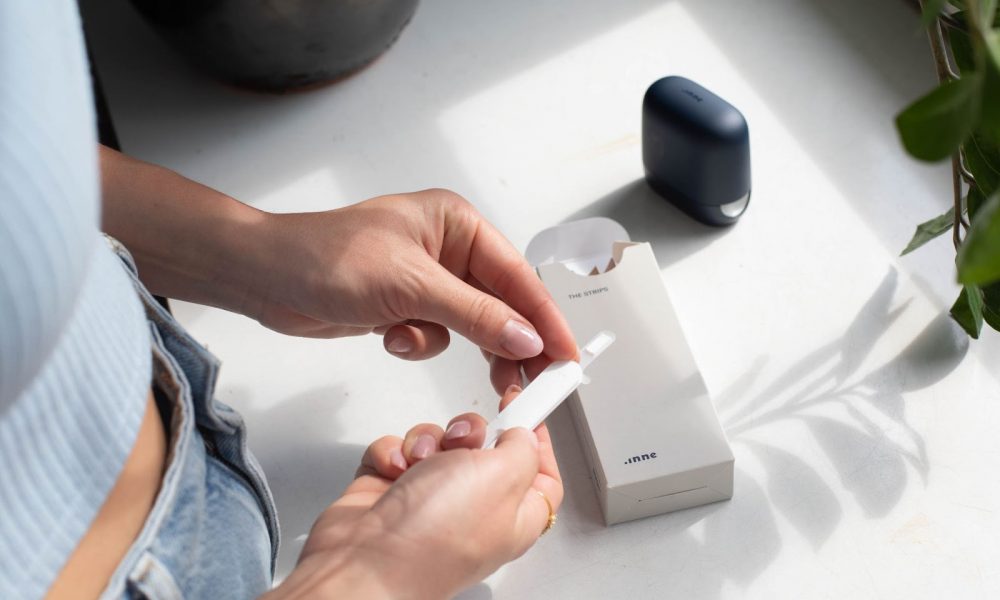
The Berlin-based company announces a US$10m funding round to cover more areas of women’s health and expand in the US

Published

on

Inne, a start-up leveraging technology to empower women to understand their reproductive health, has raised an additional US$10m in funding to continue developing its ‘minilab’ and platform.

Founded in 2017 by Eirini Rapti, who previously worked in the healthcare sector, inne was created to help women harness the power of technology to understand more about the hormonal levels of their bodies.

Using inne’s biosensor minilab, women can discover their daily progesterone levels – a key indicator of reproductive health and an ovulation indicator – by performing a daily saliva test. By using saliva – rather than temperature –  the minilab has been proven to be as accurate as a lab progesterone test, to produce a more precise picture of a woman’s menstrual cycle.
Inne is now expanding its progesterone tracking feature to perimenopause through an exclusive US partnership. As part of the offering, the minilab will be leveraged to help women track hormonal changes during perimenopause.

Women will be able to use the data tracked by the minilab to understand more about ovulation and how their progesterone levels may cause or worsen certain symptoms, giving them the information they need to make lifestyle changes to minimise side effects.

Women’s health is consistently one of the most under-funded areas of medical research, with women only officially required to be included in clinical research in the US for the first time in 1993,” says Eirini Rapti, founder and CEO at inne. “This means that women have less information about what is happening to their bodies and that makes it harder for them to improve their health and lifestyle.

“This gap has been a driving force for me in creating inne and I’m thrilled that we are now able to help women learn about their bodies and be proactive in managing their own health and fertility. Inne can be the trusted partner for millions of women around the world, democratising the access to insight and information.”

The start-up will also be adding the ability to analyse stress through a dedicated cortisol tracking strip. Sustained cortisol levels affect the body by lowering oestrogen levels which can lead to weight gain, night sweats, sleep problems and mood swings. By tracking cortisol levels, women will be able to use these insights to make lifestyle adjustments to improve their long-term health. This can be particularly useful if they are trying to get pregnant or manage perimenopause symptoms.

Inne will launch its perimenopause feature initially in the US in a closed beta with its partner, Phenology, with an expanded product launch later this year. The cortisol tracking feature will also be available in the US in 2022. Both features will be launched in Europe and the UK at a later date.

The US$10m fund has brought the total funding raised to US$18.8m from new and existing investors, along with strategic health and women investors. This will enable the company to expand its team and invest more in data science, algorithmic development and content, so it can continue to provide personalised health data.

Pieter Wolters, managing director at DSM Venturing, one of the firms leading the US$10m fund, says that: “We believe the market for women’s health is largely underserved, and inne’s hormone tracking technology gives women greater control in managing and navigating their own hormonal health journey.

“We are excited to be supporting inne through an investment and a close collaboration with Hologram Sciences.”

For more info, visit inne.io.



News

Relaunched women’s health strategy aims to tackle ‘medical misogyny’

Published

on

Health secretary Wes Streeting has relaunched England’s women’s health strategy, vowing to stop women being “gaslit” by doctors.

Speaking before publication of the renewed strategy, the health secretary said the NHS was “failing women” and set out measures to help them access the healthcare they need.

The government said the strategy would include a new standard of care to ensure women were offered pain relief for invasive procedures, such as fitting a contraceptive coil and hysteroscopies.

Feedback would be directly linked to provider funding through a new trial, giving women more power to affect change if they have a poor experience.

Action would also be taken to ensure women no longer face long waits for diagnoses for conditions such as endometriosis, which can take a decade to diagnose.

Streeting said: “[Women] have for so long been let down by a healthcare system that too often gaslights women, treating their pain as an inconvenience and their symptoms as an overreaction.

“Whether it’s being passed from one appointment to another for conditions like endometriosis and fibroids, or a lack of proper pain relief during invasive procedures, through to having to navigate symptoms for years before receiving a diagnosis, it’s clear the system is failing women.

“Women’s voices must be central to delivering effective, respectful and empathetic care. We need to hit medical misogyny where it hurts – the wallet.

“Today’s renewed strategy will tackle the issues women face every day and ensure no woman is left fighting to be heard.”

A report last month by the women and equalities committee found that gynaecological and menstrual health had not been “sufficiently prioritised” by the government.

MPs said parts of the 10-year women’s health strategy, launched in 2022 by the Conservatives, were at risk of being scaled back or discontinued under wider changes to the NHS.

These included initiatives that had reduced waiting lists and improved women’s access to healthcare, such as women’s health hubs.

Sarah Owen, chair of the committee and a Labour MP, said: “This would be a disaster for girls’ and women’s menstrual healthcare, when it is in dire need of more support.

“It is a national scandal that nearly half a million women are on hospital gynaecology waiting lists when there are effective treatments that could be administered in primary and community care, if only they could access them.”

The report said women faced “medical misogyny” and were left to “suck it up” and suffer in pain for years because of a lack of awareness of women’s health conditions.

A redesign of clinical pathways for some women’s health issues will aim to speed up diagnosis and treatment, and there will be a review of support for families who experience repeated baby loss.

The government also promised a “single referral point” to ensure women were directed to the right place the first time they sought help.

Dr Sue Mann, NHS England’s women’s health director, said too many women were dismissed for “serious symptoms” that affected every part of their lives.

“The renewed women’s health strategy will build significantly on the work the NHS has been doing to ensure women are heard and get the specialist care they need,” she said.

Women’s health groups cautiously welcomed the renewed strategy. Emma Cox, chief executive of Endometriosis UK, said decisive action would be vital to improve women’s healthcare in England.

Continue Reading

Menopause

Watchdog bans five ads for women’s heath claims

Published

on

Five adverts for supplements claiming to treat menopause and other women’s health issues have been banned by the Advertising Standards Authority (ASA).

Ads for 222 Balance Me, Lunera, Minerva and Nova Menopause Vitality all claimed their products could prevent, treat or cure the symptoms of the menopause.

An advert and website for PolyBiotics implied its food supplements could prevent, cure or treat polycystic ovary syndrome, or PCOS.

ASA investigations manager Catherine Drewett said when it comes to women’s health, ‘people deserve clear and accurate information’.

She added: “Ads making misleading claims about treating symptoms of the menopause, PCOS and other hormonal conditions can cause real harm and today’s rulings hold advertisers to account.’

“We’ll continue to monitor this sector closely and we encourage anyone with concerns about an ad they’ve seen to get in touch.”

The ASA said it had taken a close look at adverts that might prey on people’s health worries, emotional concerns or financial pressures.

The regulator said it had used AI to analyse health claims in online adverts, which revealed emerging and ongoing issues around misleading claims and informed its rulings on the supplements.

The ASA said many of the claims in the adverts were ‘unacceptable’ and had not only broken a number of its rules but risked misleading vulnerable people, or steering those who needed it away from appropriate medical advice.

222 Collective accepted that wording in its adverts may have ‘inadvertently implied’ its product could ‘treat or relieve symptoms such as PMS, menopause-related symptoms, anxiety, bloating, heavy bleeding, or mood disorders’.

The company said it was a new, founder-run small business and still learning about the requirements of advertising regulations and was working with Trading Standards to ensure it did not make explicit or implied disease or symptom treatment claims.

Lunera said it accepted its claims would be understood by consumers to attribute a medicinal property to a food supplement and should not have appeared.

PolyBiotics told the ASA it accepted references to PCOS, ovulation, fertility, cycle regulation, insulin resistance and related symptoms constituted disease treatment or symptom-management claims, which were not permitted for food supplements.

Minerva and Nova did not respond to the ASA’s enquiries.

Continue Reading

Menopause

Non-hormonal menopause pill approved for NHS use

Published

on

A new daily menopause pill approved for NHS use could bring relief to women with debilitating hot flushes and night sweats.

Around 500,000 women are expected to be eligible for the treatment, which experts say could help those unable to take hormone replacement therapy, or HRT.

The drug, fezolinetant, also known as Veoza, is a daily non-hormonal tablet designed to target the brain signals that trigger some of the most disruptive menopause symptoms.

In final draft guidance published today, the National Institute for Health and Care Excellence recommended the 45mg tablet for women experiencing moderate to severe hot flushes and night sweats.

More than two million women in the UK are thought to suffer these symptoms during menopause, often beginning during the earlier stage known as perimenopause.

For many, the effects are severe, disrupting sleep, affecting concentration and straining relationships. In some cases women are even forced to cut back on work.

An estimated 60,000 women in the UK are currently out of work or on long-term sick leave due to severe menopause symptoms, costing the economy roughly £1.5bn a year.

Research also suggests one in 10 women has left the workforce entirely because of a lack of support.

Continue Reading

Trending

Copyright © 2025 Aspect Health Media Ltd. All Rights Reserved.