




News
Daye launches workplace app to plug gaps in female healthcare support
The service helps promote health equity in the workplace by providing vital resources to support women’s health conditions


The award-winning UK gynaecological health company Daye has launched its new workplace app, Daye for Work.
The app can be offered to employees across the UK as a workplace benefit, providing them with much-needed access to services that are often lacking from the NHS and even private healthcare companies.
Women face a widening gap in healthcare provision, with three-quarters saying they cannot access the services they need and 84 per cent reporting not being listened to by a healthcare professional.
Health issues can have a big impact on women’s careers, with three in five women saying a female health condition has affected them in the workplace.
However, support for women’s health is often lacking in the workplace. According to Benenden Health, four in ten women have heard derogatory comments about a female employee’s health in the workplace.
As a result, 42 per cent of females admit that they are uncomfortable discussing health issues with their manager.
In addition, more than two thirds of female employees (70 per cent) have found it difficult to deal with periods at work and 64 per cent have faced challenges when experiencing menopause.
Offering support to employees struggling with female health conditions can help attract and retain staff, with 70 per cent of workers willing to change jobs for women’s health benefits.
Daye for Work provides an accessible and personalised service for women and assigned female at birth (AFAB) individuals.
Through the app, employees of businesses who sign up for Daye for Work can access Daye’s Menstrual Health Programme, which provides access to period pain support, plugging a major gap in healthcare provision as it can take years to diagnose conditions linked to menstrual health, such as endometriosis and adenomyosis.

Currently, menstrual pain support is also not offered by major private healthcare providers. Yet period pain can be so severe that nearly a quarter of women (23 per cent) have taken time off work for menstrual symptoms in the last six months, with nine days of productivity per woman lost every year, according to the British Medical Journal.
In monetary terms, women can lose tens of thousands during their careers as they are forced to take time off work.
Daye for Work also offers a Gynae Health Screening Programme, where users can access specialists for gynaecological-related health issues, such as recurrent vaginal infections, which is another service lacking through the NHS and private healthcare companies.
While users can access help from leading specialists through instant virtual appointments, Daye also offers at-home diagnostic tampon tests that can detect vaginal infections and STIs such as chlamydia and gonorrhoea, and soon they will also be able to detect HPV, which is the biggest cause of cervical cancer.
Users receive clear, actionable results via the platform and have prescriptions delivered to their homes.
Daye also offers educational support programmes, including workshops and webinars covering hot topics in female health, and HR policy and internal comms support. Employees signed up through their company get 20 per cent off products on the Daye website.
Valentina Milanova, founder and CEO of Daye, said: “Gaps in women’s health provision are impacting workplaces all over the UK. Female and AFAB staff are regularly forced to take time off while struggling to access much-needed support, advice and diagnosis, hitting workplace productivity and all too often being detrimental to women’s careers.
“Daye for Work will play a vital role in plugging the gaps in female healthcare, offering services that take years to access on the NHS and aren’t available from private healthcare providers.
“Offering such tailored support is transformational for workplace culture, making staff feel valued and understood, while also helping to attract and retain talent.”
To receive the Femtech World newsletter, sign up here.












Weekly app monitoring can reduce fatigue and improve daily life for women with metastatic breast cancer, according to a study.
The approach involves regularly asking patients about their wellbeing through an app and responding quickly when problems are identified.
Germany’s Federal Joint Committee, known as the G-BA, has recommended that the treatment model be incorporated into standard care.

Professor Maria Karsten, senior attending physician at the Charité Breast Cancer Center and initiator of the PRO B project, said: “The new medications often no longer need to be administered at the hospital but can be taken at home.
“As a result, we see patients less frequently at the hospital, and our medical oversight has become somewhat incomplete.
“In order to close this gap and provide patients with close support in spite of the distance, we have developed the PRO B digital treatment concept.”
Around 68,000 women in Germany are living with metastatic breast cancer, meaning the disease has spread to other organs.
At this stage, the cancer is generally considered incurable. Modern treatments can, however, temporarily control the disease and extend life expectancy by several years, with some women able to continue working.
At the centre of PRO B is an app that asks women up to 52 structured questions once a week about their symptoms, daily life and emotional wellbeing.
Questions include whether they have experienced pain, felt too tired to carry out their usual activities or experienced shortness of breath.
An algorithm analyses the answers and immediately alerts the treatment team when relevant changes are detected.
The team then contacts the patient within 48 hours to decide whether any action is needed.
Karsten said: “During these phone calls, for example, we discuss whether the dosage of anti-nausea medication should be adjusted or offer practical tips for managing the various symptoms.
“But we also detect serious side effects more quickly – such as those indicated by a seemingly harmless symptom like fatigue – and can immediately schedule the patient for an appointment at the hospital.”
The study involved 909 women with metastatic breast cancer aged 19 to 81 across 52 breast cancer centres in Germany and followed them for one year.
Around half received PRO B care alongside drug-based cancer treatment.
The other half answered questions about their wellbeing once every three months and were not contacted by their treatment teams in response.
Women receiving PRO B care reported significantly less fatigue, which refers to physical, emotional or mental exhaustion that can severely restrict daily life.
They also rated their physical functioning more positively and required fewer hospital admissions.
Karsten said: “These are effects that have a noticeable impact on the patients’ daily lives; the women are more capable and better able to manage their lives.
“We even have evidence that the PRO B approach extends the remaining lifespan for some patients. We are achieving all of this not through a new medication, but simply by regularly and systematically assessing the women’s well-being and responding accordingly.”
More than 90 per cent of women in the PRO B group said after the study that they wanted the approach to become part of routine care.
Stephanie Neumann-Johnston, 51, who took part in the study, said: “I feel like the app has saved my life several times.
“There are so many situations and incidents that you can’t make sense of – you have so many questions.
“With the app, I can look up common problems and find medically reviewed information, for example, about fatigue. That way, I can help myself, also on the weekends.
“And the personal contact provides me with emotional and medical support.
“For example, I can find out whether I’m allowed to take certain medication for a fever, or get an assessment of my situation: Should I go to the emergency department with these symptoms or not? The app takes a huge weight off your shoulders.”
Based on the medical findings and a health economic analysis, the G-BA recommended in June that PRO B should be incorporated into standard care.
This would allow patients with statutory health insurance to access the model in future when they receive the relevant diagnosis.
PD Dr Christoph Kowalski, department director at the German Cancer Society and a co-author, said: “This recommendation must now be implemented as quickly as possible.
“If a new care concept offers medical and economic benefits, we should not withhold it from the most seriously ill women.”
The health insurance companies involved in the project are also planning further developments so affected women can receive routine PRO B care before its wider introduction into standard care, with access expected to begin this autumn.
The care model will continue under the name “ida”, led by Karsten and her team.
The PRO B project ran from 2020 to 2024 and received around €4.8m from the Innovation Committee of the Federal Joint Committee.
The project was led by Karsten, with consortium partners BARMER, mkk – meine krankenkasse, DAK-Gesundheit, the German Cancer Society and OnkoZert GmbH.
Breast cancer is the most common cancer among women in Germany, with around one in eight expected to develop the disease during their lifetime.
Worldwide, breast cancer is the leading cause of cancer-related deaths.
Despite advances in treatment, 30 per cent of women with early-stage breast cancer and up to 70 per cent of those with lymph node involvement in later stages develop distant metastases, which typically make the disease incurable.
For patients with metastatic breast cancer, treatment aims to prolong life while maintaining the best possible quality of life.
Since 2016, the G-BA has been responsible for supporting new forms of care that go beyond existing standards, as well as health services research aimed at improving healthcare quality in Germany.
Its Innovation Fund is financed through contributions from statutory health insurance plans and the Health Fund.


Higher cumulative doses of common fertility drug clomiphene citrate may increase pregnancy loss risks, according to new research.
Around one in six people experience infertility, with irregular or absent ovulation among the most common causes.
Clomiphene citrate has long been a mainstay of fertility treatment, but Adelaide University research has raised concerns about higher cumulative doses.
The new study found that high doses of clomiphene citrate accumulated over multiple fertility treatment cycles could increase the risk of pregnancy loss.
Lead author associate professor Sheree Boulet said the findings showed a clear dose-response relationship, meaning the risks increased as cumulative exposure rose.
She said: “Women who received higher cumulative doses of clomiphene citrate experienced progressively greater risks of adverse pregnancy outcomes.
“We examined more than 21,000 embryo transfer cycles across four cumulative dose categories and found that increasing the dose did not significantly improve the chance of a live birth.
“Our findings suggest there may be a point where increasing the dose offers little additional benefit while exposing women to greater risk, highlighting the importance of carefully balancing effectiveness with safety when making treatment decisions.”
Supported by the NHMRC and conducted in partnership with Boston University and the Centers for Disease Control and Prevention, researchers analysed 21,004 IVF embryo transfer cycles in the US.
Women receiving cumulative doses of 500mg to 749mg of clomiphene citrate had a 12 per cent higher risk of miscarriage, while those receiving 750mg to 999mg had a 38 per cent higher risk.
Women receiving cumulative doses of 750mg or more were also more than twice as likely to have twins or other multiple births.
Rates of spontaneous abortion, another term for miscarriage, increased as the dose rose.
Researchers also recorded more than a threefold increase in stillbirth at the highest dose, although the finding was not statistically significant because that dose was rare. Larger studies are needed to confirm the association.
The finding is consistent with an earlier Adelaide University study that showed a doubling of neonatal death in pregnancies involving clomiphene citrate. Neonatal death means the death of a baby shortly after birth.
Higher cumulative doses did not improve the chance of a live birth, but did increase twinning, which raises the risk of adverse outcomes for both mother and child.
Clomiphene citrate is one of the world’s most widely prescribed fertility drugs. It has been prescribed to millions of women worldwide since 1967 and remains a recommended first-line treatment for ovulation induction.
The drug is recognised as an essential medicine by the World Health Organization. It works by stimulating the ovaries to release eggs, increasing the chance of pregnancy.
Women who do not respond to lower doses, or who require multiple treatment cycles, may receive progressively higher cumulative doses over time.
The findings build on a series of studies from Adelaide University’s Robinson Research Institute linking clomiphene citrate with increased risks of pregnancy loss, stillbirth, perinatal death and some birth defects.
Experimental studies in mice supported these findings, showing that higher doses reduced successful pregnancies and were associated with pregnancy loss, impaired fetal growth and developmental abnormalities.
Professor Michael Davies, senior researcher and co-author of all the studies, said the latest work builds on more than two decades of Adelaide-led research into the safety of fertility treatments.
He said: “Clomiphene citrate has been used by many women since 1967, but it has never been comprehensively evaluated in large prospective clinical trials.
“Our studies indicate that women respond differently to clomiphene citrate and that increasing cumulative doses may increase the risk of adverse pregnancy outcomes without improving the likelihood of a live birth.
“The findings confirm and extend our previous studies in both human and mouse models which highlight the need to better understand the dose-response relationship and whether more personalised dosing strategies could improve safety.
“Until we can better understand these differences, it remains important that clinicians rigorously follow manufacturer’s safety recommendations and avoid unnecessarily increasing cumulative doses.
“The same questions are now being asked of newer ovulation-inducing medications, so any move away from clomiphene citrate should also be guided by robust evidence rather than assumptions about safety.”
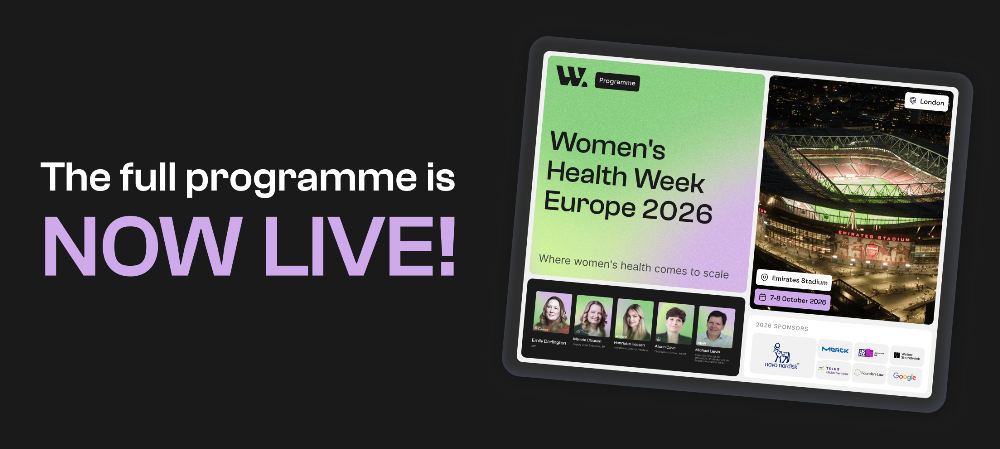
Women’s Health Week Europe 2026 has released its fully populated speaker and session lineup ahead of the event’s return to The Emirates Stadium in London on 7–8 October, with 80+ speakers now confirmed across two dedicated stages.
The programme
The agenda runs across two dedicated stages in parallel, plus two pitch competitions across both days.
The Global Stage opens with a keynote from Merete Clausen (EIF) before moving into sessions on funding trends, AI, the gender data gap, the wearable revolution, and European policy.
Standout sessions include The Age of Digital TransformAItion featuring Nichole Young-Lin (Google), Frida Polli (MIT), and Sapna Shah (Sie Ventures); Lone Wolf or Pack Leader on collaboration versus fragmentation, with Eirini Rapti (Inne), Tatum Getty (Thena Capital), Novo Nordisk, and Jen Roberts-Woods (Borski Fund); and a live debate on whether the women’s health label helps or hinders founders. Day one closes with a keynote from Alison Cave, Chief Safety Officer at the MHRA.
The Scale Stage runs a practical playbook track in parallel, with sessions covering regulatory approval pathways, international expansion, the founder’s legal playbook, PR strategy, and implementing AI into a women’s health business.
The Reverse Pitch flips the usual format: investors and corporates pitch the room on what they are actively looking to fund, acquire, or partner on right now.
View the full agenda and speaker lineup
Pitch competitions
The WHW Europe pitch competitions are back, taking place in front of the audience across both days on the mainstage. 16 finalists will compete across two categories: Consumer & Tech on day 1 and Medical Devices & Therapeutics on day 2.
Any company treating a condition that affects women exclusively, differently, or disproportionately is eligible to apply.
Applications and close 28 August 2026.
Previous alumni include Circe, who secured £100k from Innovate UK, BoobyBiome, who closed a £2.5M seed round post-WHW Europe, and Amilis, who secured £1M at London Tech Week after winning at WHW USA 2026.











 Entrepreneur4 days ago
UK femtech investment surges 194% in a decade, research finds

 Entrepreneur2 weeks ago
Fertility startup American Baby Company secures US$4m

 Insight2 weeks ago
Natural Cycles receives sixth FDA clearance for fertility algorithm
 Wellness1 week ago
Cancer patient receives ‘landmark’ treatment in world-first

 Insight2 weeks ago
Experimental treatment significantly slows progression of fatal brain disease in women, study finds

 Sponsored Content2 weeks ago
The room is filling up at WHW Europe 2026 with super early bird pricing ending this Friday

 Insight2 weeks ago
Johnson & Johnson offers to pay US$5.5bn to settle talc cancer lawsuits

 Entrepreneur5 days ago
TidalSense raises £14m to expand five-minute COPD test across NHS