



Adolescent health
Wildfire smoke linked to smaller babies in exposed areas


Exposure to wildfire smoke and extreme heat before or during pregnancy may increase the risk of babies being born smaller than expected, particularly in climate-vulnerable neighbourhoods, new research suggests.
The study found that women exposed to these conditions as early as the month before conception were more likely to give birth to small-for-gestational-age (SGA) babies – infants whose birth weight is below the 10th percentile for their stage of pregnancy.
Researchers examined 713 births from the MADRES cohort – an ongoing study of pregnant women in Los Angeles – between 2016 and 2020.
They tracked exposure to wildfire smoke and high temperatures across the preconception period and the first trimester.
The team from the University of Southern California found that greater exposure to wildfire smoke and heat during these stages was linked to higher risks of SGA births.
Roxana Khalili is a researcher in the department of population and public health sciences at the Keck School of Medicine of USC and lead author.
Khalili said: “We already know that poor air quality is associated with adverse health outcomes and that pregnant women and fetuses are especially vulnerable.
“Our knowledge about the specific effects of wildfire smoke during pregnancy has been limited. We know even less about the impact of these hazards right around or before conception.”
To estimate wildfire exposure, researchers used data from CalFIRE to identify fire events and calculated smoke density and ground-level particle pollution – including soot, black carbon and burned vegetation – using data from the NOAA hazard mapping system.
Exposure estimates were matched to each participant’s daily residential location.
Women exposed to moderate smoke-density days during their first trimester also had a higher likelihood of giving birth to low-birth-weight babies – defined as weighing less than five pounds, eight ounces.
Both SGA and low birth weight are associated with short-term complications and long-term cognitive, metabolic and developmental concerns.
Heat stress exposure was assessed using detailed meteorological data on temperature, humidity, and wind speed, along with additional modelling to account for sun angle and cloud cover – a method designed to reflect how hot days feel outdoors.
Living in climate-vulnerable neighbourhoods – areas experiencing high environmental stress and limited resources – nearly doubled the effect of preconception heat stress on the likelihood of SGA births.
Khalili said: “Where you live makes a difference in your health.
“So does the timing of your exposure during or immediately before pregnancy.
“We wanted to better understand how these risks might differ for women who lived in neighbourhoods that experience more climate-related stressors and have fewer resources to deal with them.”
The researchers also found that Fenton Z-scores – which measure how much an infant’s size deviates from the expected average – significantly decreased with more wildfire days during pregnancy.
Khalili said: “Overall, we found consistent associations between increased exposure to wildfire smoke and heat stress during preconception and the first trimester with the odds of having an SGA infant.”
The findings are especially relevant following prolonged wildfire events in Los Angeles in January 2025 and the increasing frequency of climate-related hazards across the US.


Joy Parenting Club acquires Heba Care, widening its parenting support platform, and will roll out an AI tracker for feeding, sleep and nappies to all Joy users in 30 to 60 days.
The tracker is currently in beta testing.
Joy combines AI guidance on feeding, sleep, child development and everyday parenting with access to clinically validated tools. Families who used Heba, including those supporting children with developmental differences or complex health needs, will have the option to join Joy. AI refers to software that learns from data to offer tailored prompts and insights.
“At Joy, our mission is to ensure every parent has access to trusted support whenever they need it,” said Emily Greenberg, president of Joy. “Heba has built powerful technology for families navigating some of the most complex challenges in parenting. Integrating their tools and expertise into Joy allows us to reach even more parents globally and continue building the most comprehensive support ecosystem for families.”
An independent study funded by Innovate UK found a 37 per cent improvement in care coordination and a 38 per cent reduction in stress for Heba users.
“We started Heba to help families never feel alone – especially when facing complex health or developmental challenges,” said Sam Milliken-Smith, founder of Heba. “Joining Joy allows us to take that mission further and faster.”
The acquisition follows Joy’s US$14m Series A in November 2025. With more than a third of children’s centres and family hubs closing since 2009, and 80 per cent of parents turning to social media for guidance, families are increasingly seeking digital support. Joy offers 24/7 access to certified parenting experts, from parent coaches to lactation consultants. The company is backed by Forerunner Ventures, Raga Partners, Magnify Ventures and Obvious Ventures.
Heba, founded in 2022, offers a mobile app used by more than 15,000 families across the UK, US, Australia and Canada. The app, rated 4.9 stars, works with organisations including the NHS, Bupa and national charities, and has received grants from the National Institute for Health Research, Innovate UK and the University of Cambridge.

By WUKA sports ambassador, Hannah Miley MBE 3x Olympian & Commonwealth champion
I started swimming when I was really young, I just loved being in the water.
The pool quickly became my second home, the place where I felt most like myself. I wasn’t a natural swimmer, but I loved to work hard, and racing gave me that outlet for my competitive side.
There was something about the rhythm of the strokes, the smell of chlorine, and the quiet hum beneath the surface that made me feel free.
I got my first period around age 12, and it was daunting. My body was changing, and I didn’t know what that meant for my swimming.
Wearing a swimsuit every day made me feel exposed, and I just assumed everything I was going through (heavy bleeding that lasted up to two weeks, cramps so bad they left me doubled over) was normal.
There were moments that really knocked my confidence: not realising my tampon string was visible, or climbing out of the pool to find blood running down my leg.
At competitions, I’d sometimes sit on my towel because I’d leaked through.
The heavy bleeding left me anaemic and constantly tired, but I kept pushing through. I wanted to swim at the highest level I could even if it meant battling my body every month.
Competitions & The Pill
I’ll never forget the 2004 Commonwealth Youth Games. My period started mid-competition, and during one race, the cramps hit hard.
Swimming through that pain was frustrating, all that training felt wasted. When I saw my GP back home, I was told the best way to “fix my period problems” was to go on the pill.
Those two words, fix and problems, shaped how I thought about my body for years.
At first, the pill seemed like the perfect solution. No more painful, unpredictable periods! I ran packets back to back to skip bleeds during competitions, thinking I was being smart.
What I didn’t realise was that the seven day break wasn’t a real period at all, it was a withdrawal bleed. I thought I was in control of my cycle, but I was actually masking it.
I didn’t understand how important my hormones were for health, recovery, and performance.
On the surface, everything looked fine. Beneath that, I was struggling. Under-fuelling, getting ill before big meets, and picking up constant shoulder and knee niggles.
But I didn’t connect any of it to my hormonal health. The pill blurred the picture, and for years, I lived in fear of my period returning at the “wrong” time.
Nothing compares to the emotion you feel when you make an Olympic team.
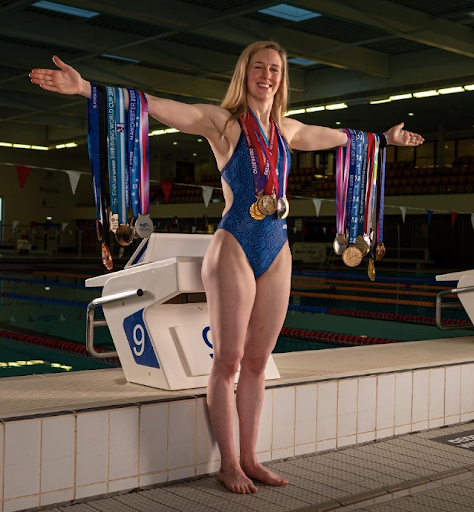
When I realised I had qualified for my first Olympics in 2008, it was surreal the culmination of years of early mornings, long sessions, and relentless dedication.
Standing on the pool deck with “Team GB” on my kit felt like stepping into a dream that little Hannah could only have imagined.
Racing around the world, representing Scotland and Team GB, was the greatest honour of my career.
Each competition taught me more about resilience, discipline, and the incredible things the human body can do when you push it to its limits.
I went on to swim at three Olympic Games, and while each one was different, they all shaped me not just as an athlete, but as a person learning to listen to and respect her body.
It wasn’t until 2020, during lockdown, that I finally came off the pill after more than 15 years. I was speaking to Dr Georgie Bruinvels when she asked a simple but powerful question:
“When was the last time you actually had a period?”
That question stopped me in my tracks. The answer? Not since before I started the pill as a teenager, over 15 years ago.
I learned that I should have taken longer breaks to let my hormones reset after five years.
It was probably mentioned when I first started but at 15 the chances of me remembering were going to be slim. I wished someone had reminded me.
For the first time, I began tuning into my body, tracking my cycle, adjusting my nutrition, and paying attention to the signals I’d ignored for so long. The difference was incredible.
My periods now last about five days, my cramps are mild and manageable, and I finally feel in sync with my body instead of fighting against it. And no little pill to remember to take each day.
The knowledge I have now would’ve been game changing for me as a young athlete.
Finding Freedom Again — This Time, on My Period
WUKA Sports Ambassador
Becoming a WUKA Sports Brand Ambassador felt like everything coming full circle.
To work with a company whose values aligned with my mission, supporting and empowering female athletes was incredible.
As an athlete, I only ever used tampons because I thought that was my only option.
But discovering products like period underwear and period swimwear has completely changed how I feel about my body and my period.
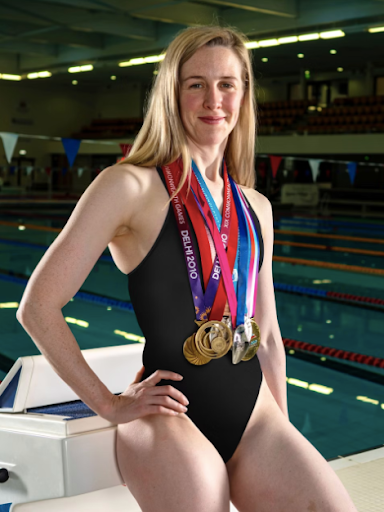
The first time I tried WUKA period pants, I couldn’t believe how comfortable they were. No rustling, no movement, and no fear of leaks. I actually forgot I was wearing them!
And their period swimwear? Game changer. No more worrying about climbing out of the pool and noticing blood running down my leg just confidence and freedom.
I can’t help but think how different my experience as a teenager could have been if products like this had existed then.
They would’ve given me comfort, reassurance, and a sense that my period wasn’t something to hide or fear.
That’s why I’m so passionate about opening up conversations around periods in sport.
For so many young athletes, missing training isn’t an option, but competing while bleeding can be stressful and distracting.
Period-proof swimwear can take away that anxiety — letting you focus on your performance, not your period.
What I’ve Learned
My journey has taught me that periods aren’t a “problem” to be fixed, they’re a natural, powerful part of who we are.
With the right knowledge, support, and tools, we can work with our bodies, not against them.
Period proof swimwear might seem like a small thing, but for a young swimmer, it can mean the world. It can mean the difference between fear and freedom, between shame and Confidence.
Periods are not the enemy of performance.
Ignoring them is.
Find out more about Wuka at wuka.co.uk
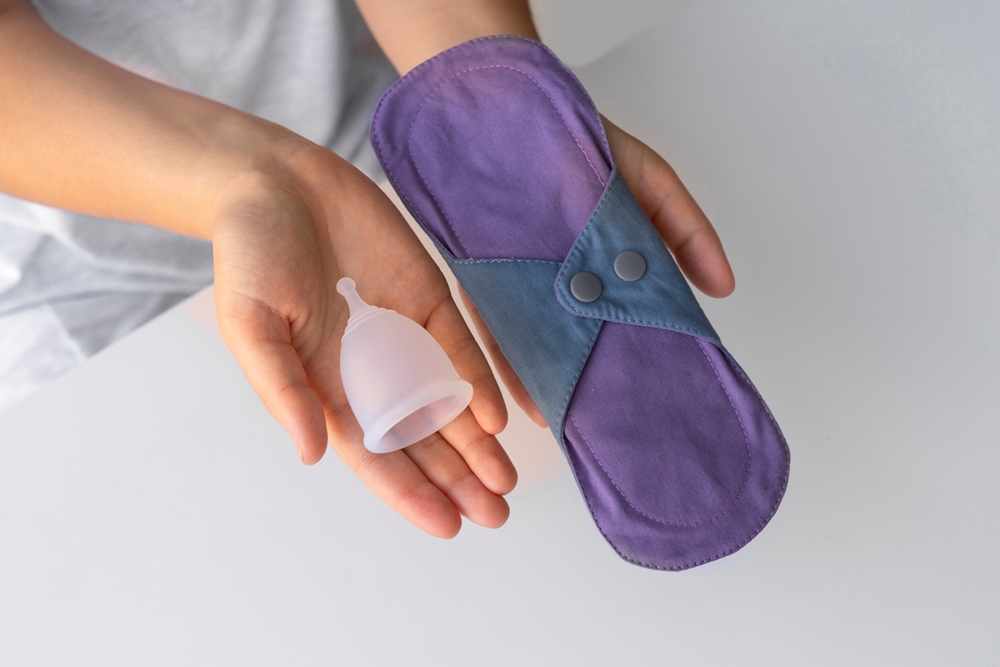
Despite Scotland’s free period products law, research finds reusable period products remain little used, with only 3 per cent in Scotland relying on reusables.
Dominique Haig, a master’s student at Queen Margaret University (QMU), has investigated why take-up of reusable menstrual products stays low, despite the Period Products (Free Provision) (Scotland) Act 2021 encouraging their distribution.
The findings reveal multiple obstacles – from institutional issues to education gaps and poor infrastructure – that stop organisations properly understanding and meeting the Act’s goals around equity, sustainability, and choice. (Reusable menstrual products include menstrual cups and washable pads.)

Haig, a student in QMU’s Institute of Global Health and Development explained: “We found that while reusable products are technically available across colleges, universities and public organisations, they’re often out of sight – sometimes hidden behind reception desks or restricted to student unions.”
This type of gatekeeping, combined with poor signposting and limited education, means many students, who may be particularly vulnerable to period poverty, don’t even know they have the option of accessing the free sanitary products.
The research discovered that students most likely to benefit from reusable products – including low-income, disabled, and trans/non-binary individuals – encounter major obstacles.
These include:
- Patchy menstrual education and insufficient teacher training, leaving students unaware of their entitlements and product options.
- Parental influence, which can shape attitudes toward menstruation and product choices, especially when stigma or misinformation has shaped communication.
- Inadequate washing facilities and lack of private spaces, which make using reusables impractical in many institutions.
“One teacher told us that students often don’t receive menstrual education until halfway through the school year,” Haig explained.
“By then, their understanding is shaped mostly by what their parents have told them.”
Additionally, student input rarely influenced procurement practices which led to purchases of reusable products that didn’t match students’ needs for quality and appearance – wasting budgets and maintaining dependence on single-use sanitary wear.
“We spoke to one university procurement officer who confirmed that students had to go to a specific location to collect reusable products,” Haig added.
“That alone can be a deterrent, especially if the space isn’t welcoming or inclusive.”
Haig concluded: “The availability of free sanitary wear across Scotland has been an excellent way of improving equality for women across the country.
“However, without targeted interventions, Scotland risks entrenching its dependence on single-use menstrual products, which ultimately undermines the environmental and social equity goals of the Period Products (Free Provision) (Scotland) Act 2021.
“We are therefore calling for improved menstrual education and teacher training; inclusive procurement processes that reflect student preferences; better infrastructure to support reusable product use; and clearer signposting and more accessible distribution methods.
“This will help protect the dignity of everyone who menstruates and the sustainability of service provision, ensuring every student has real choices.”









-

 Features1 week ago
Cannabis compounds kill ovarian cancer without harming healthy cells, research finds
-
 Insight3 weeks ago
Femtech in 2025: A year of acceleration, and what data signals for 2026
-

 News4 weeks ago
Innovate UK relaunches £4.5m women founders programme
-

 Insight2 weeks ago
Meta removes dozens of abortion advice and queer advocacy accounts
-

 News3 weeks ago
Round up: First wearable detects symptoms of perimenopause, and more
-

 Insight2 weeks ago
Sperm donor with cancer-causing gene fathered nearly 200 children across Europe
-
 Mental health3 weeks ago
Insomnia combined with sleep apnea associated with worse memory in older women
-
 Insight4 weeks ago
Canada targets US$37bn femtech opportunity