




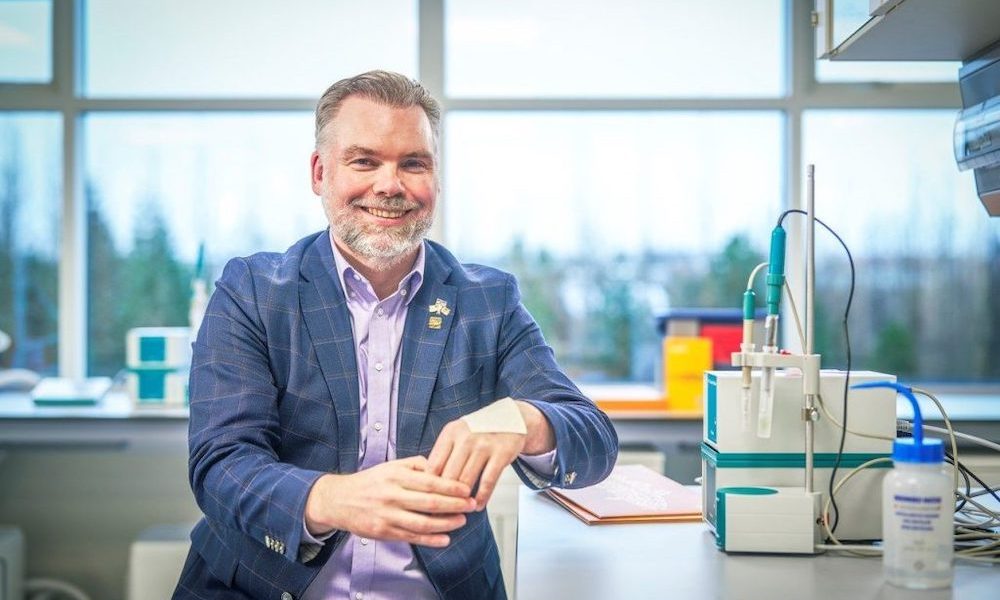
Iceland’s first billion-dollar ‘unicorn’ – which harnesses fish skin to treat wounds and burns – is now aiming to help women recovering from mastectomies.
Kerecis has disrupted the global market for wound, burn and trauma treatment in the last decade, thanks to a biproduct of one of Iceland’s biggest exports.
It utilises North-Atlantic cod skins to create a natural graft material that enables cellular therapy, tissue regeneration and protection.
Last year it became Iceland’s first unicorn after the Danish healthcare products multinational Coloplast acquired it for US$1.3bn.

To date its focus has been limited to chronic, acute and surgical wounds, burns and trauma. This is supported by growing body of clinical evidence for faster wound healing via its products.
But speaking to Femtech World in Reykjavik, CEO and founder Fertram Sigurjonsson reveals that the company’s research and development team is now working on applying fish skin to improve post-mastectomy breast reconstruction procedures.
“We have three avenues for growth,” he says. “The first is geographical expansion, and we will do that through the [parent] company. The second is to expand within the business we are already in, which is chronic wounds, burns and surgical wounds; so more features and products.
“The third avenue for expansion is new indications, including breast reconstruction.
“When women lose breasts after a mastectomy for cancer, there is a pocket that is put into the chest, stapled into the muscles. You can then put a silicone implant into the pocket. The silicone implant is heavy and so there is a sling that keeps the breast elevated normally. This sling is made of plastic. This means the woman has two foreign bodies, plastic and silicone.
“We are developing the use of fish skin as a sling that will keep the breast elevated over half a year to a year. This skin will eventually be replaced by the woman’s own tissues when they are strong enough to keep the breast elevated.”
Sigurjonsson says being part of a publicly listed company prevents him from sharing when the innovation may be available to women undergoing mastectomies; he also admits that a long road awaits in terms of building evidence and clinical data needed to reach that goal.
With Kerecis spending 10 to 15 per cent of revenue on research and development, including via investigations into hernia and ligament repair solutions, it is clearly committed to broadening the reach of medical fish skin to help more patients globally.
Sigurjonsson says: “We need new research, new trials and new regulatory submissions. Of course, now we are part of a bigger company and we have more money, this becomes more realistic.”
Bringing new medical applications to the fore is a notoriously cost-intensive, long-haul journey that requires patience among investors and shareholders; and an abundance of research funding.
Given the bright business outlook for Kerecis, however, the company seems to have these fundamentals in place as it looks to realise its mastectomy hypothesis and other new applications.
“I’ve raised money from shareholders four times and [each time] I was able to provide them a very good return on their investment,” says Sigurjonsson.
“We have very good market access in the United States, with 600 employees [there] and we are by far the fastest growing wound care company in the US.
“We are continuing to operate the Swiss unit and we are treating thousands of people every day with our products
“Coloplast has operations in 140 countries. I have the ability to work with them and over the next decade, make my invention from my hometown a global product around the world.”
Kerecis was conceived after a journey of discovery for Sigurjonsson as he sought a new and improved approach to wound care.
“I was an employee in several medtech companies and then came back to Iceland and had an opportunity to found Kerecis.
“I’m a specialist in wounds and wound treatment. Wounds are a huge global problem. People get diabetes, then lose the sensation their legs. They get a small wound and sometimes the wounds get bigger and bigger because of bad blood circulation in diabetics. Half a million people [every year] will have an amputation [in their lower extremities because of this].
“There are three generations of wound treatment products. Firstly gauzes, which keep the wound very dry. This is not very good for cells because they need to proliferate and need moisture and humidity. The second generation, emerging in the 50s, was moist wound dressings. Then in the first decade of this century, the third generation emerged, which is biologic material from animals or humans.”
The origins of such products developed to date include pigs and human foetal sacs.
Through fish, Sigurjonsson took this product class into entirely new territory.
“I came back here looking for a new project that inspired me, with a material that Iceland has a lot of. Of course we have fish all around the country, we have small fishing towns everywhere and there is a lot of fish export.
“I started to think about using scales from the fish, but then when I was studying more about the anatomy of fish skin, I found out that it is identical to human skin. You might think that human skin is very different from fish. We used to be fish two million years ago, but actually evolution has focused on the brain, the fingers and the feet. The epidermis, dermis, subcutaneous tissue are identical, except we have developed hairs out of scales.”
Furthermore, because there is no known risk of viral disease transmission, fish skin needs only minimal processing by Kerecis, preserving its structure and components.
“When I discovered these things, the first person I talked to about it, apart from my wife, was a patent attorney.”
Today, the Kerecis product journey starts with fish caught in the North Atlantic, off the township of Isafjordur, on Iceland’s northwest coast. Skins that would otherwise have been thrown away are sent to the company’s processing plant in the same town – where products are made for the rest of Europe, the US and other jurisdictions.
The continued presence of Kerecis in its homeland has helped to draw attention to the country’s growing prowess in health innovation. Sigurjonsson believes its emergence as the country’s first unicorn has also helped to change the mindset of investors.
“Iceland does not have a very developed investor community. Most investments in the past have been in real estate and traditional businesses. Companies on the Icelandic stock exchange have their values based on multiples of EBITDA [earnings before interest, taxes, depreciation, and amortisation].
“There has not been a big history of venture investments in Iceland. But, because people can see others making money now, there is now substantially more investment interest in start-ups.”
Femtech World was speaking to Kerecis CEO and founder Fertram Sigurjonsson at an event organised by Business Iceland on behalf of Reykjavik Science City.


Newsletter
Sign up for free weekly updates
The latest femtech news, research and investment, straight to your inbox.




