




Pregnancy
30-year-old embryo brings birth of world’s ‘oldest baby’


A baby has been born in the US from an embryo frozen in 1994, potentially making him the world’s oldest baby born from cryopreservation.
Thaddeus Daniel Pierce was born on 26 July in Ohio to Lindsey and Tim Pierce, using a donated IVF embryo that had been stored for more than 30 years.
The embryo was originally created in 1994 during IVF treatment for Linda Archerd and her then husband. In vitro fertilisation involves fertilising eggs with sperm in a laboratory to help people conceive.

Four embryos were created. One was transferred to Archerd and became her daughter, now 30 and mother to a 10-year-old. The remaining three were cryopreserved using specialist freezing techniques.
Lindsey told MIT Technology Review: “We didn’t go into it thinking we would break any records.
“We just wanted to have a baby.”
Archerd was awarded custody of the embryos following her divorce.
She chose to donate them through an “embryo adoption” process, a type of donation where both donor and recipient can help choose the match.
She preferred the embryos go to a white, Christian, married couple—leading to the Pierces receiving the embryo that became Thaddeus.
Lindsey said: “We had a rough birth, but we’re both doing well now,” “He is so chill. We are in awe that we have this precious baby.”
Archerd said: “The first thing that I noticed when Lindsey sent me his pictures is how much he looks like my daughter when she was a baby.
“I pulled out my baby book and compared them side by side, and there is no doubt that they are siblings.”
The embryo transfer was carried out at a clinic run by John Gordon, a reproductive endocrinologist and Reformed Presbyterian who advocates for reducing long-term embryo storage.
Speaking about the transfer, Gordon said: “We have certain guiding principles, and they’re coming from our faith.
“Every embryo deserves a chance at life and that the only embryo that cannot result in a healthy baby is the embryo not given the opportunity to be transferred into a patient.”
In the UK, IVF births have increased from 1.3 per cent in 2000 to 3.1 per cent in 2023—the equivalent of one in every 32 births, or roughly one child per classroom.
Among women aged 40 to 44, 11 per cent of UK births were from IVF in 2023, up from 4 per cent in 2000.
IVF accounts for around 2 per cent of births in the US, according to the Human Fertilisation and Embryo Authority.












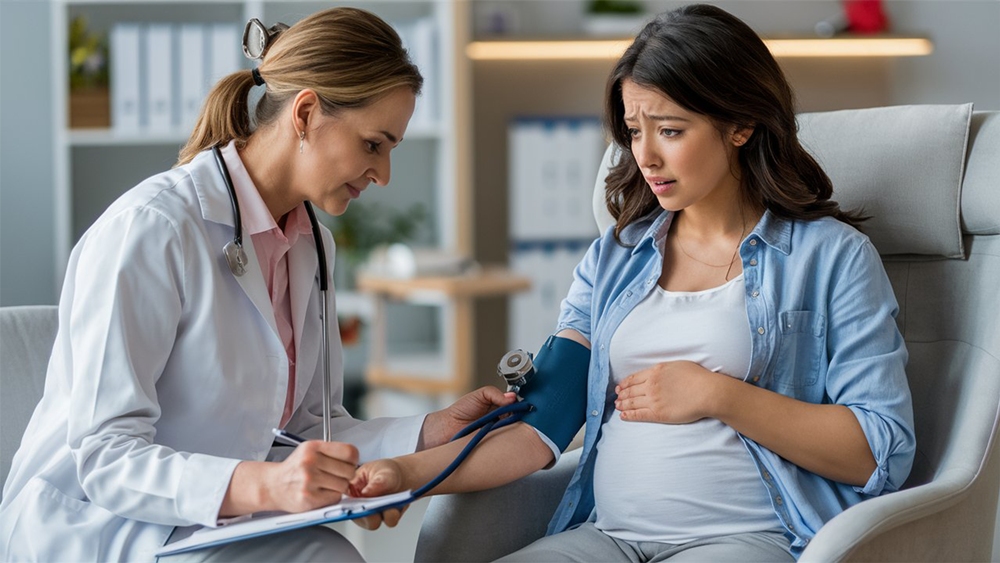
Women who develop pre-eclampsia face a higher risk of chronic kidney disease and high blood pressure later in life, new research suggests.
The amount of protein found in the urine during pregnancy may help identify those at greatest risk of developing long-term health problems.

Pre-eclampsia usually involves high blood pressure and increased protein in the urine. Some women also experience severe headaches and changes to their vision.
The condition cannot be treated during pregnancy and, in some cases, labour must be induced early to protect both the woman and baby.
The study found that the condition may be linked to longer-term health problems.
Anne Høy Seemann Vestergaard, a medical doctor and PhD at the department of clinical medicine at Aarhus University, said: “What we can see is a clear association between pre-eclampsia and the development of high blood pressure, chronic kidney disease and cardiovascular disease later in life.”
The researchers found that the amount of protein passed in the urine during pregnancy was linked to the risk of developing chronic conditions after giving birth.
Protein in the urine can indicate that the kidneys are not filtering blood normally.
Vestergaard said: “The most surprising finding was how clearly the amount of protein in the urine during pre-eclampsia was linked to the risk of later high blood pressure and chronic kidney disease. Women with moderate to severe protein excretion had a higher risk of both conditions compared with women with low or no protein excretion.”
Among women with pre-eclampsia and moderate to severe levels of protein in the urine, around one in 20 developed chronic kidney disease within 10 years and around one in six developed high blood pressure.
Most women in the study did not develop long-term complications, but the researchers said the increased risk should still be taken seriously because the potential effects can be severe.
Vestergaard said: “At first glance, this may sound like a low number, but it represents a markedly increased risk when the groups are compared. In the group with pre-eclampsia and high levels of protein in the urine, around 1 in 20 women developed chronic kidney disease within ten years, including early stages of the disease, compared with around 1 in 100 in the group with lower or no protein excretion.”
She added: “That is a considerable number in light of the fact that chronic kidney disease is a potentially serious condition that can progress to kidney failure if isn’t diagnosed early.”
The findings suggest women who experience pre-eclampsia may benefit from more systematic monitoring after pregnancy.
Vestergaard said: “Our study suggests that these women may benefit from monitoring of blood pressure and kidney function after pregnancy.”

Light exercise and less sitting may reduce pregnant women’s risk of serious blood pressure complications, according to a new study.
Researchers have proposed a daily activity and sleep guide that they say was linked to a nearly 30 per cent lower risk of hypertensive disorders of pregnancy.
The suggested pattern includes fewer than eight hours of sedentary time, at least seven hours of light physical activity, around 22 minutes of more intense activity and nearly nine hours of sleep.

The University of Iowa-led study examined the daily behaviours of 470 pregnant women across all stages of pregnancy.
Participants wore monitors that measured physical activity over 24-hour periods and recorded how long they spent asleep.
Hypertensive disorders of pregnancy include chronic high blood pressure, gestational hypertension and pre-eclampsia.
Gestational hypertension is high blood pressure that develops during pregnancy, while pre-eclampsia is a potentially serious condition involving high blood pressure and signs that organs may be affected.
Sedentary behaviour means being mostly inactive, such as sitting or lying down.
Light physical activity can include casual walking, moving around the home or standing.
Moderate to vigorous activity includes movement such as brisk walking, where breathing and heart rate increase.
Kara Whitaker, associate professor in the department of health, sport, and human physiology at Iowa and corresponding author of the study, said: “We are identifying the optimal composition of movement behaviours across the day associated with the lowest risk of developing HDP and the most improved health outcomes.
“This blueprint holds for each and every trimester of pregnancy.”
Study participants were enrolled at sites in Iowa City, Pittsburgh and Morgantown, West Virginia.
The women wore activity and sleep monitors for at least one week during each trimester of pregnancy.
Four in five participants were non-Hispanic white and nearly a quarter lived in rural areas.
The data showed a steep rise in risk among pregnant women who were sedentary for more than 10 hours a day.
Women who increased light physical activity to at least four hours a day reduced their risk of hypertensive disorders of pregnancy to 15 per cent from 30 per cent.
Whitaker said: “Just moving around more seems to have significant health benefits.
“And I think it also may be a more feasible target for women who are pregnant who are not exercising regularly.”
The researchers said they were surprised that longer durations of moderate to vigorous physical activity did not appear to provide additional benefit.
Sleep beyond a certain duration also did not appear to bring major further benefits.
Whitaker said: “Through this study, we are providing evidence that reducing sedentary behaviour and engaging in light physical activity are important, and maybe more important, when it comes to pregnancy and health.”
The findings may be relevant beyond pregnancy because clinical research has shown that women who develop hypertensive disorders of pregnancy are more than twice as likely to develop heart disease later in life.
Cardiovascular disease includes conditions affecting the heart and blood vessels, such as heart disease and stroke.
Whitaker said: “We know that cardiovascular disease is the number one killer of women, and if we can intervene in pregnancy and prevent women from developing a hypertensive disorder of pregnancy, we are putting them on a better trajectory, away from cardiovascular disease and toward more optimal cardiovascular health.”
The study was published online on June 10.
A second study, published online on May 27, looked more closely at the ratio and type of sedentary behaviour and light physical activity linked to a lower risk of hypertensive disorders of pregnancy.
Whitaker is a lead co-author on that study.
Co-authors in the June 10 study include Alex Crisp, Jaemyung Kim, Karina Smith, Donna Santillan, Mark Santillan and Bridget Zimmerman, from Iowa; Jacob Gallagher, from Iowa State University; Melissa Jones, from Oakland University in Michigan; Bethany Barone Gibbs, Katrina Wilhite, Alexis Thrower and Iqra Sheikh, from West Virginia University; and Sabera Rahman, Janet Catov, Christopher Kline and Maisa Feghali, from the University of Pittsburgh.
The National Institutes of Health, the University of Iowa Institute for Clinical and Translational Science, the University of Pittsburgh Clinical and Translational Science Institute and the West Virginia Clinical and Translational Science Institute funded the research.











 Hormonal health4 weeks ago
Perimenopause misinformation ‘putting women at risk’

 Entrepreneur3 weeks ago
Women’s Health Innovation Summit opens submissions for 2026 Innovation Showcase

 Insight2 weeks ago
British women among angriest in Europe, health survey reveals

 Menopause3 weeks ago
Women still being failed when they reach menopause, experts say

 Menopause3 weeks ago
Sweden eyes domestic production of oestrogen patches amid menopause treatment shortage

 News3 weeks ago
Three menopause innovators shortlisted for Femtech World Award

 News1 week ago
Femtech World Awards 2026: Winners revealed

 Menopause2 weeks ago
Apple Health adds menopause and perimenopause tracking