




To receive the Femtech World newsletter, sign up here.
News
FDA clears prescription digital therapeutic for postpartum depression
MamaLift Plus is a digital therapeutic that provides neurobehavioral interventions to patients with mild to moderate postpartum depression


The US Food and Drug Administration (FDA) has granted clearance to a prescription digital therapeutic for postpartum depression.
Postpartum depression is a type of depression that happens after giving birth. It affects up to one in seven US women within a year of giving birth.
MamaLift Plus, developed by Curio Digital Therapeutics, is the first digital therapeutic for the treatment of postpartum depression.
The solution, which can be used on a mobile device, is a prescription‐only digital therapeutic intended to provide neurobehavioral interventions to patients 22 years of and older, as an adjunct to clinician‐managed outpatient care.
It treats mild to moderate postpartum depression through digital cognitive behavioural therapy, behavioural activation therapy, interpersonal therapy and dialectical behaviour therapy.
“Our goal has always been to provide innovative solutions for women’s health, specifically around the challenges they face with behavioural health,” said Dr Shailja Dixit, founder and CEO of Curio Digital Therapeutics.
“MamaLift Plus is the first and only digital solution that can help address the serious unmet need uniquely faced by women who have recently delivered.”
Dixit told Femtech World: “It was a pleasure working alongside the FDA on such a monumental step forward in improving access to care and treatment options for women struggling with postpartum depression.
“We applaud the collaborative effort involved for pushing this new frontier forward.”
The clearance of MamaLift Plus was based on results from the Supporting Maternal Mental Health and Emotional Regulation (SuMMER), a national randomised controlled trail of 141 participants, who had recently had a live birth and were diagnosed with postpartum depression.
The study met its primary endpoint, improvement of four or more points on the Edinburgh Postnatal Depression Scale (EPDS). The EPDS is a clinically validated screener that is recommended by the American College of Obstetricians and Gynecologists (ACOG).
Jean-Pierre Lehner, ex-Global CMO Sanofi, and board of director Curio, said: “MamaLift Plus opens a new chapter of prescribed digital therapeutics that provide women with a non-pharmaceutical alternative.
“I am happy to support this groundbreaking innovation.”
Alice D. Domar, women’s health expert and Curio scientific advisor, added: “This is an incredible development for women suffering from postpartum depression who are looking for non-pharmaceutical alternatives given the shortage of trained mental health professionals.”


Entrepreneur
Women’s Health Week Europe 2026 opens pitch applications for mainstage showcase at The Emirates Stadium

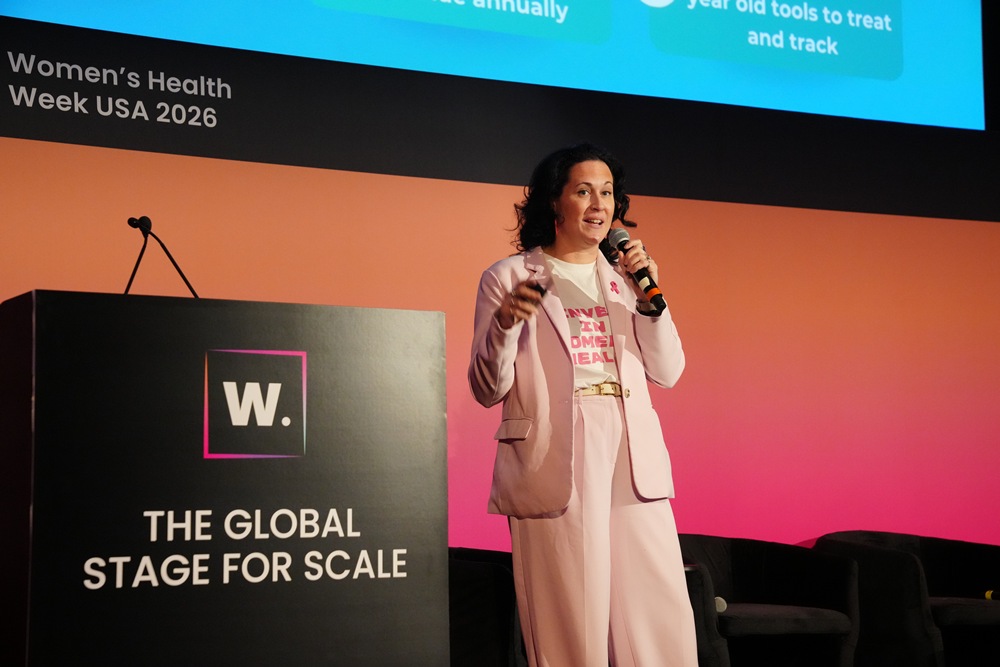
Women’s Health Week Europe 2026 has opened applications for its flagship start-up Pitches, giving women’s health innovators the chance to present on the mainstage at The Emirates Stadium in London on 7-8 October.
16 finalists will be selected across two categories: Medical Devices & Therapeutics and Consumer & Tech, with the shortlisted companies receiving the opportunity to pitch in front of 700+ investors, corporates, other innovators and strategic partners actively seeking solutions that can scale.
Two categories, one stage
The Medical Devices & Therapeutics category is open to companies working across medical devices, therapeutics and pharma innovation, regulated digital health, and deep-tech or science-led platforms.
The Consumer & Tech category covers consumer health and wellness brands, digital health platforms, wearables and connected data, employer and payor-led solutions, and commerce and marketplace businesses.
Any company treating a condition that affects women exclusively, differently, or disproportionately is eligible to apply.
Applications are completely free, so what do you have to lose?
Apply to pitch at WHW Europe 2026 now.
What’s in it for you?
Unmatched exposure
Present in front of 700+ investors, corporates, clinicians, and strategic partners actively seeking solutions that can scale.
With WHW Europe 2026 relocating to The Emirates Stadium and expanding to 700+ attendees across two stages, the 2026 edition represents the largest platform the series has offered to date.
A proven platform
The WHW Pitch Sessions have become one of the most commercially significant showcases in women’s health, with previous cohorts including companies that have gone on to raise investment and secure major strategic partnerships. 2024 alumni BoobyBiome, closed a £2.5M seed round in the year following their pitch at WHW Europe.
The Watchlist
All registered applicants will have the opportunity to be featured in The Watchlist, WHW Europe’s official directory of women’s health innovators to know, giving companies visibility beyond the pitch stage itself.
Applications close 28 August 2026.
Find out more about WHW Europe.


A vaccine trial will test whether an mRNA jab can help stop precancerous cells developing into bowel and ovarian cancer in people with Lynch syndrome.
The first stage is due to launch this summer and will assess whether the jab can train the immune system to recognise and eliminate precancerous cells before cancer develops.
Around 175,000 people in England have Lynch syndrome, but only five per cent, or around 10,000 people, know they have it.

The inherited condition increases the risk of developing bowel cancer by 80 per cent and is linked to around 1,100 bowel cancer cases each year.
Lynch syndrome is also linked to a far higher risk of bowel, womb and ovarian cancer, alongside other types including stomach, pancreatic, kidney and skin cancer.
While the syndrome does not directly cause cancer, the genetic changes can lead to more abnormal cells developing, which then multiply and increase the risk of cancers such as bowel, prostate and endometrial cancer.
It is caused by an alteration in a mismatch repair gene. Carriers do not have any symptoms.
The new Intercept-Lynch trial is part of a scientific collaboration between the University of Oxford and Moderna, while Cancer Research UK has backed the vaccine’s development.
Once patients receive the new mRNA-4194 jab, experts will analyse their immune responses, assess the best dose and check whether the jab is safe.
The second phase of the study will include multiple centres across the UK, including Oxford, and is expected to begin in 2027.
The aim of the trial is to train the immune system with a vaccine to recognise abnormalities and stop them developing into cancer.
Professor David Church, Cancer Research UK senior cancer research fellow in the University of Oxford’s centre for human genetics and lead investigator of the trial, said: “People with Lynch syndrome are at risk of cancers over their entire lives.
“So, it’s very common, for instance, a woman to have a first cancer of her womb, and then some years later have a bowel cancer, or vice versa.
“The targets we’ve chosen for the vaccine were chosen based on their sharedness across multiple cancer types in Lynch syndrome, so we think they should provide broad protection, if the vaccine works.”
In people with Lynch syndrome, mutations can build up, making the cells containing them more likely to turn into cancerous cells.
However, those mutations can be made visible to the immune system and, with enough stimulation, the immune system can attack the abnormal cells and stop cancer from forming.
Professor Church said the mRNA jab acts as “an instruction manual” for the body to attack precancerous cells.
He added that, as with many vaccines, patients may need a booster jab at some stage.
On whether similar approaches could help prevent cancers not caused by Lynch syndrome, Professor Church said: “In terms of proof of principle that we can train the immune system to recognise these cancer-associated alterations and enhance the immune response against them to prevent these pre-cancers or prevent the progression of pre-cancer to cancer, that proof of principle should give us insights that are generalisable.”
David Berman, chief development officer at Moderna, said: “By applying mRNA technology earlier in the patient journey, we aim to harness the immune system when it can have the greatest impact.
“We are proud to bring this innovation to the UK, building on our long-standing collaboration with leading UK institutions to advance mRNA research and development.”

Apple announced menopause and perimenopause tracking for its Health app at WWDC 2026, with symptom logging and cycle alerts for some users.
The update expands the app’s cycle tracking beyond fertility and menstrual periods.
If logged cycle patterns suggest a user may be experiencing perimenopause, the app will send a notification prompting a conversation with a doctor.

However, this perimenopause-specific cycle deviation notification is only for users aged 40 and over and is not intended to replace a doctor’s diagnosis or treatment.
Stacey Ford, Apple’s vice-president of OS management, said users will also be able to log menopause and perimenopause symptoms in the Health app.
Educational content will also be available to help users learn more about these life stages and understand changes in their bodies.
Every year, about 2 million women enter perimenopause, the stage before menopause when levels of the hormone oestrogen decline.
According to a February 2025 survey involving 4,432 participants aged over 30, more than half of women aged 30 to 35 experienced moderate or severe perimenopause symptoms.
The findings suggest perimenopause does not affect only older adults.
About 6,000 women in the US enter menopause every day, according to the Society for Women’s Health Research.
Given the number of women affected by perimenopause and menopause, the update broadens the Health app’s scope.
The app launched in 2019, meaning it has gone seven years without these women’s health tracking features, which could help users better understand their bodies and prepare for informed conversations with doctors.











 Menopause2 weeks ago
Perimenopause misinformation ‘putting women at risk’

 Hormonal health3 weeks ago
NHS urged to update website following renaming of PCOS

 Insight4 weeks ago
PCOS renamed after decade-long campaign to end ‘cyst’ misconception

 News2 weeks ago
Women still being failed when they reach menopause, experts say

 Events2 weeks ago
Women’s Health Innovation Summit opens submissions for 2026 Innovation Showcase

 Fertility4 weeks ago
AI could transform ovarian care through personalisation, study finds

 News2 weeks ago
Three menopause innovators shortlisted for Femtech World Award

 News3 weeks ago
Low insulin diet and avoiding four food groups may prevent menopause weight gain
1 Comment