Connect with us

Insight

Cutting through the noise in femtech – key takeaways from Women’s Health Week 2025

Published

on

The flagship women’s health summit brought together over 400 visionary founders, funders and innovators, with a shared mission of transforming women’s health worldwide.

This year’s Women’s Health Week, which took place at the Barbican, London from 14-17 October, showcased a sector once considered by funders to be too much of a ‘niche’, meeting a crucial unmet need with huge market demand.

Investments are outperforming their value, regulators want to speed up the route to market, and clinical validation is cutting through the noise and demonstrating real results.

There is a buzz about the femtech sector – or at least there was in the Barbican last week – but experts have urged founders should move forward responsibility, building ethics and equity into their innovations.

Here’s our takeaways from the key conversations at Women’s Health Week.

1. Women’s health is outperforming – but angels and influencers are crucial for raising capital

Investment in women’s health is outperforming, and this trend is expected to continue, according to the panel at Women’s Health Week on Thursday 16th, where fund managers and founders highlighted significant returns, growing institutional interest, and the critical role of early-stage backers.

Sanji Chotai, a senior investment manager at British Business Bank, says she is seeing “really encouraging data” and anticipates more “outperformance”, particularly in medtech, which is drawing interest thanks to “shorter timelines to regulatory approval” and rapid commercialisation.

Series A and B activity is also picking up, but the panel agreed that early-stage capital and angel investors remain essential.

“My first angel investment in a women’s health company, I think on Series A, is going to be 20x on multiple and for our fund, it’s going to be around 9x,” said Trin Linamagi, founding partner at Sie Ventures.

“We need to take bigger bets and double down – and actually put the capital behind these businesses early on.”

Having driven successful campaigns for Soulcycle and Barry’s Bootcamp, Tatum Getty, now a founding general partner at THENA, also highlighted the importance of influencers – and not just on Instagram.

“Who is that person who believes in what we’re building and will tell their friends,” she said.

“Women have not been traditional investors they are more risk averse, smaller investment but bigger impact. They add so much more value than the amount of capital that they contribute.”

2. NICE and new pathways for health technologies

During a discussion on mastering Europe’s regulatory process, a representative from the National Institute for Health and Care Excellence (NICE) outlined how new rules-based approval routes, now being introduced for health technologies, are designed to speed access to innovation.

The body is also better aligning processes with the Medicines and Healthcare products Regulatory Agency (MHRA) to reduce the time it takes to regulatory approval.

“We’re taking forward the rules-based pathway for health tech,” said Kendall Gilmore, a senior advisor at NICE.

“Developing a model more similar to the medicines pathway, where, for some products, it goes through the MHRA, through NICE and then comes with a recommendation that has a funding mandate attached.”

The pathway, currently being developed will see health technologies assessed in a similar way to medicines with the first products approved from April next year.

NICE currently evaluates only a fraction of the 500,000 technologies used daily in the NHS. While a NICE recommendation is “not mandatory”, it can be a “powerful signal” to the NHS.

NICE is constantly “horizon scanning” for “disruptive products” further down the pipeline and is engaging more directly with innovators, industry associations and international partners to identify promising technologies earlier, and a new early value assessment route is giving promising products a faster track.

“If it meets an unmet need, it should be used with further evidence generation,” Gilmore explained.

“This is particularly relevant for digital health and diagnostics.”

3. Scientific validation is the most effective way to ‘cut through the noise’ 

In a panel exploring how to “cut through the noise” in femtech, founders were urged to bake credibility into product design from day one, with scientific proof and clinical validation the sharpest differentiator, according to Soun Rakshit, of MV Health.

“You have to spend probably two years going through the R&D process,” said Rakshit.

“That is the best and probably the only way to do it, so that by the time you get regulatory approval, you have already had significant patient feedback and iteration.”

Earning trust also means collaborating with experts who understand the problem, as Helen O’Neil, founder of Hertility, explained.

When in the development stage, O’Neil reached out to professionals, including obstetricians and gynaecologists to understand the right questions to ask based on their “clinical intuition and personal experience”.

Rakshit added: “If we can show true clinical evidence, and it does take time, it is the best way to cut through the noise.”
4. Bias in AI is ‘real and harmful’ – and founders need to know how to address it

Experts discussed the role of AI and its potential to both help and harm women’s health, urging proactive testing and human oversight to avoid the risk of decades of a “male default model” being implemented into new solutions.

“AI that’s trained on that skewed data can really fail women,” said Sarah Montgomery Taylor, clinical lead of GenAI evaluation and scaled services at Google, highlighting familiar examples such as heart-attack presentation.

“Biases are real, and they are really harmful, and so being aware of them is so crucial.”

Panellists also flagged “measurement bias” and the “historical dismissal of women’s pain,” where systems trained on those records “can learn to deprioritise” certain signals.

Beyond bias in diagnostics, Marinos Ionnides, head of software and AI medical devices regulation at the MHRA, highlighted the risks of implementing AI in areas where there may be hidden bias.

“I’m quite worried about the deployment of software AI in places where we aren’t we didn’t know we would be finding bias [such as] appointment booking,” he said, adding that in these “unknown unknowns,” “the regulator has their greatest role”.

Founders were urged to be responsible when scaling AI, introducing guardrails such as building in equity and collecting data from the very beginning for “rigorous real-world validation”.

Clinicians need to be able to test the product and understand it to build trust, while regulatory processes should be “adaptive”, offering “clarity on what the path is to market”.

Chen Davies, founder at Anya, shared a real-world example of how products and content tailored for underserved groups drove measurable change, including a “10% population-wise” rise in breastfeeding rates in a deprived area of Blackpool after six months.

“AI should gradually complement human support without replacing it,” said Davies.

5. Consumer data can play a critical role in building the clinical evidence-base 

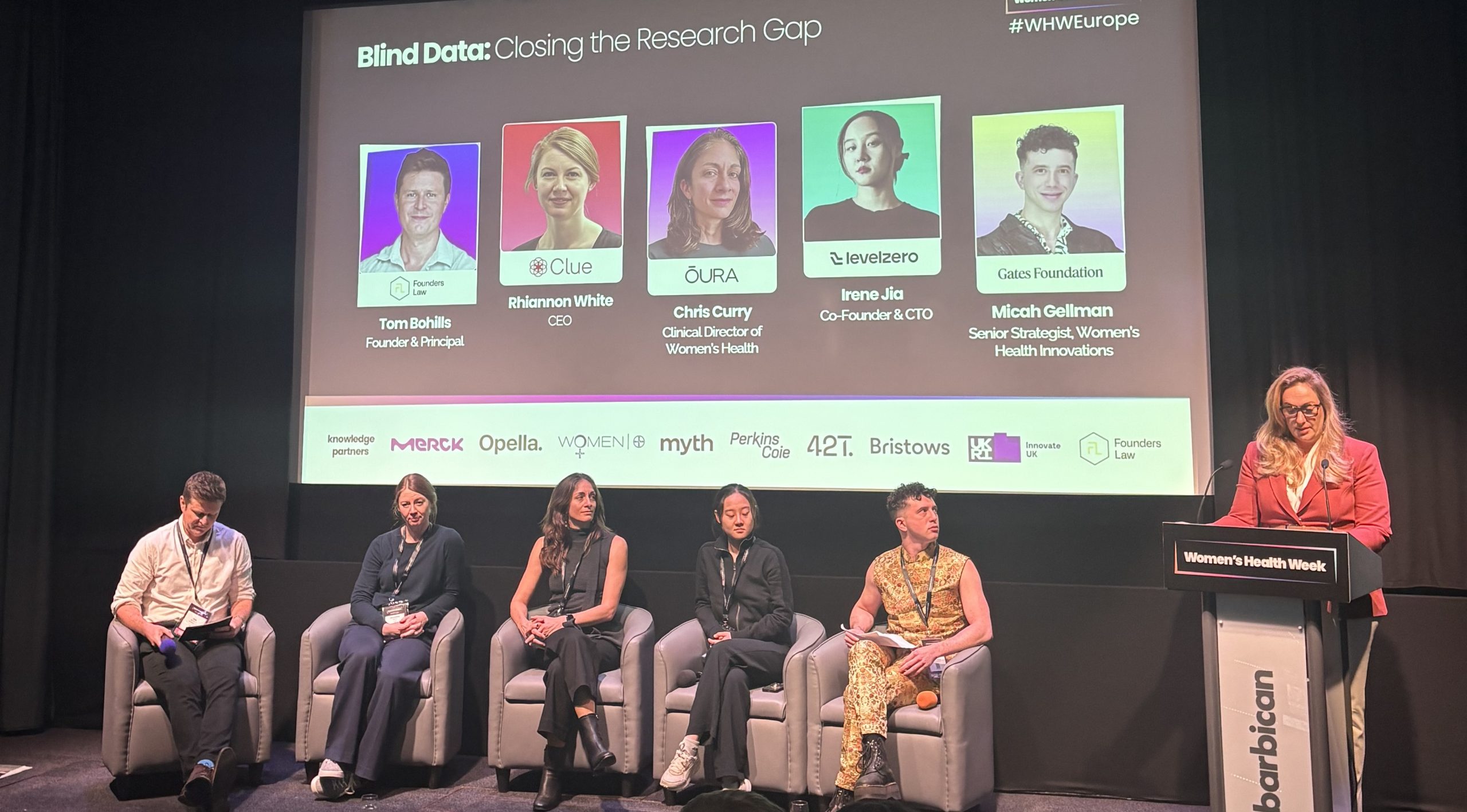
During the final panel, participants argued that continuous real-world data, paired with clinical benchmarks, is the fastest way to fix women’s health’s “male baseline” problem and turn lived experience into evidence.

Dr Chris Curry, clinical director for women’s health at Oura, argued that wearables are “one of the big unlocks” by collecting data that gives the “whole picture of the human”.

But tracking can – should – meet clinical standards, with the panel pushing for globally representative consumer datasets.

“I see consumer data if it’s truly representative, if it’s truly globally representative, being critical,” said Micah Gellman, a senior strategist for women’s health innovation at the Gates Foundation.

“It helps us calibrate and link consumer insights and lived experience to clinical anchors and value outcomes… this kind of consumer data is one avenue that we have to really change investor appetite.”

Rhiannon White, CEO of Clue, which has a long-running research collaboration with Oura, including collecting symptom tracking data on perimenopause and pain, added that women’s spending power can actually steer where future R&D should be focused.

“We are able to shape and direct where people will put their research and put their development with our spending power,” she said.

6. The crisis in government support can be an opportunity for more innovative funding pathways 

With the Gates Foundation recently committing an additional US$2.5bn for research in women’s health, Gellman also reframed the reduction in government funding for women’s health – such as that seen under the Trump administration in the US – as an opportunity for more innovate financing.

“There is a real opportunity for European and Asian government funding to step up and fill some of those gaps,” said Gellman.

“An opportunity for government funding and philanthropic funding to take new forms and to be partnering in new ways to catalyse innovation and to work with academics and industry players.”

Rather than a binary between grants and VC, the panel highlighted “blended financing mechanisms, venture philanthropy… different kinds of outcome-based financing” with public and philanthropic dollars used “to de risk, early-stage investment”.

Gellman added: “This crisis that we’re in, in terms of government funding is also an opportunity for innovative financing.”

The comments brought the conference full circle, reminiscent of those made earlier in the day, by Tatum Getty, who highlighted: “Women and small amounts of capital, can make a big difference.”


News

Bridging the metabolic wealth gap: The telehealth platform bypassing insurance to democratise care

Published

on

As weight-loss treatments remain locked behind prohibitive paywalls, a new direct-pay initiative is cutting costs in half for low-income patients, and it could provide a new blueprint for health equity.

It is one of the most persistent, frustrating paradoxes in modern healthcare: the medical innovations most capable of addressing widespread chronic conditions are overwhelmingly priced out of reach for the populations most vulnerable to them.

Nowhere is this more evident than in the current landscape of metabolic health and weight management.

As state governments and insurance providers increasingly restrict coverage for advanced weight-loss medications due to skyrocketing costs, a stark dividing line has emerged. Clinical need is no longer the primary factor in who receives treatment. Affordability is.

This financial barrier disproportionately impacts women, who not only face high rates of metabolic conditions but also frequently serve as the primary caregivers in their households.

For a single mother managing childcare, grueling work hours, and the relentlessly rising cost of living, personal well-being is often the first casualty of a tight budget.

These patients are forced into a holding pattern, watching their conditions progress year after year while highly effective, life-changing treatments remain separated from them by a paywall.

Now, a telehealth platform called Amble Health is attempting to dismantle that wall by bypassing the traditional insurance apparatus entirely.

A Structural Shift for Access

Today, Amble Health announced the launch of the Amble Cares Program, a national initiative designed to cut the cost of medical weight-loss treatments in half for low-income Americans.

The programme arrives at a critical inflection point.

Today, roughly one in eight U.S. adults have utilized advanced metabolic medications, according to a recent KFF Health Tracking Poll.

This surge in adoption has driven a fundamental shift in preventative care, but the distribution of that care has been deeply uneven.

Through the Amble Cares Program, eligible patients can access comprehensive medical weight-loss programmes, which may include prescription medications if clinically appropriate, at up to 50 per cent below standard rates.

To ensure the discounts reach the intended demographic, eligibility is determined by an independent, third-party verification partner, based on verified financial need.

The programme explicitly prioritises individuals and families with limited disposable income, including parents and guardians whose financial flexibility is tied up in providing for dependents.

Once verified, patients are connected directly to licensed clinicians to begin treatment immediately, stripping away the friction of waiting periods.

“Healthcare should not be a luxury item,” said Joey Stiver, CEO of Amble Health. At Amble, we believe that a patient’s zip code or income shouldn’t dictate their metabolic health outcomes.

“The Amble Cares Program is our direct response to the cost of living crisis, moving beyond talk of ‘affordability’ to actually delivering it to the people the traditional system has left behind.”

The Direct-Pay Trade-Off

However, this rapid, lower-cost access comes with a significant structural trade-off.

To achieve these price reductions and eliminate the administrative delays, denials, and red tape associated with traditional healthcare, Amble Health operates strictly as a direct-pay platform.

This means participants cannot use outside coverage. The programme does not accept Medicaid, Medicare, commercial insurance, or even HSA/FSA funds.

For some patients, being entirely locked out of utilizing their existing health benefits may present a new kind of hurdle.

But for those who have already found themselves abandoned by traditional coverage networks, facing outright denials, unnavigable prior authorisations, or insurmountable deductibles, the direct-pay model offers a predictable, transparent alternative to a broken system.

Ultimately, the Amble Cares Program is making a bold bet: that the most efficient way to deliver equitable healthcare to disenfranchised populations isn’t to fix the traditional insurance system, but to innovate entirely around it.

Continue Reading

News

UK report warns against ‘financial half measures’ for women’s health

Published

on

The Women and Equalities Committee (WEC) has warned against “financial half measures” on women’s health as the government published its response to the report.

Ministers launched the renewed Women’s Health Strategy in April after the committee’s March report concluded it was not convinced that the menstrual and gynaecological needs of young women and girls had been sufficiently prioritised in wider healthcare reforms.

It followed the committee’s 2024 “medical misogyny” report, which found women with painful reproductive health conditions such as endometriosis, adenomyosis and heavy menstrual bleeding were frequently finding their symptoms “normalised” and their “pain dismissed” when seeking help.

In both reports, MPs called on the government to recognise the benefits of increased investment in early diagnosis and treatment of women’s reproductive health conditions and provide additional funding needed to transform the support available to millions of women.

In its response, published on 26 May as a command paper, the Department of Health and Social Care outlined action on reducing gynae waiting times, ensuring procedures are conducted with women’s full consent and adequate pain relief, and improving access to contraception for menstrual healthcare in line with the committee’s recommendations.

It said: “The government agrees with the committee’s overarching findings and recommendations for improving women’s health outcomes and experiences.

“We acknowledge the impact that menstrual health conditions can have on women’s lives, relationships, and participation in education and the workforce.

“We recognise that more needs to be done to support women with menstrual health conditions, particularly around listening to women, improving information and education, and enhancing patient experience.”

However, there was no commitment to increase school nurse provision, no measurable actions and targets on countering online misinformation, no new commitments to end inappropriate censorship of women’s online health content, and no further initiatives on tackling racial discrimination or understanding the menstrual wellbeing needs of young disabled and Deaf women.

The response comes after analysis by The Times suggested the government is allocating 60 per cent more funding to its men’s health strategy than to its renewed strategy for women’s health.

Sarah Owen, chair of the Women and Equalities Committee and Labour MP, said: “WEC’s 2024 ‘medical misogyny’ report warned 18 months ago of women in unnecessary pain and undiagnosed for years and called on the Government to recognise the benefits of increased investment in early diagnosis and treatment.

“Our follow up report this March cautioned girls’ and women’s health are not being sufficiently prioritised in system-wide NHS reforms, while initiatives which have proven to be successful in reducing waiting lists and improving women’s healthcare access, such as women’s health hubs, risked being scaled back or discontinued.

“While it’s welcome to see a focus on tackling ‘medical misogyny’ in April’s renewed Women’s Health Strategy and an emphasis on women’s voices being heard, this must be backed by adequate funding, not financial half measures, particularly when compared to men’s health.

“Significant questions remain following today’s response publication over the adequacy of investment being provided, including for workforce training, menstrual health education in schools, research and additional ring-fenced funding for women’s health hubs to deliver services within the emerging neighbourhood health framework.

“There are both opportunities and risks when it comes to increasing use of technology in women’s healthcare.

“As the Committee’s report set out, social media companies should be held to account for inappropriate and disgraceful ‘shadow banning’ censorship of important women’s health content and there should be a rigorous approach to tackling the risks from ineffective, unsafe and exploitative for-profit FemTech apps.

“The Government should take the problem of ‘shadow banning’ more seriously.

“A strategy which does not fully address the concerns set out in WEC’s report, alongside measurable actions and timescales, will only scratch the surface of the issues facing women’s health.

“WEC will keep a close eye on progress and continue to push for long overdue tangible change for women and girls.”

Continue Reading

Insight

Early PET scan could chemo response in aggressive breast cancer – study

Published

on

An early PET scan after one cycle of chemotherapy may help predict how aggressive breast cancer responds to treatment, a study suggests.

Research led by The Institute of Cancer Research, London and King’s College London suggests that an early scan taken after one cycle of chemotherapy could help predict how well a patient’s cancer will respond to treatment.

The study focused on patients with triple-negative breast cancer (TNBC), an aggressive form of the disease in which cancer cells lack receptors for the hormones oestrogen and progesterone, as well as the HER2 protein.

Patients with TNBC are usually treated with chemotherapy prior to surgery. While many respond well, residual disease at surgery, typically around six months later, is associated with a significantly poorer prognosis. Identifying people sooner who are unlikely to respond remains a major clinical challenge.

The research explored whether using PET imaging shortly after treatment begins, rather than relying only on MRI scans later in the treatment process, could provide earlier insight into how a patient’s cancer is responding. Twenty-two patients were recruited, with fourteen undergoing FDG-PET scans before treatment and after the first cycle of chemotherapy.

The findings, published in Clinical Cancer Research, showed that changes seen on PET scans after just one cycle of chemotherapy were strongly associated with subsequent response, including whether there was no detectable cancer, known as a complete response, by the end of treatment. Importantly, early PET response showed stronger associations with treatment outcomes than standard mid-treatment MRI scans in this study.

Being able to identify patients who are not responding well at an early stage could allow clinicians to adjust treatment sooner or consider alternative approaches. These findings may also support future strategies to better tailor treatment intensity to individual patients.

The study also compared two types of PET tracers, FDG and FLT, to determine which was most suitable. While both met the study’s technical criteria, FDG-PET was selected for further evaluation due to its better image quality, greater consistency and wider use in clinical practice.

The research also explored how imaging changes after just one cycle of chemotherapy relate to the body’s immune response to treatment. Biopsies taken before and after the first cycle of chemotherapy showed that an increase in immune cells within the tumour was strongly associated with both early PET changes and improved treatment outcomes.

The researchers emphasise that these findings now need to be validated in larger studies. Future work will aim to confirm these results in broader patient groups and explore more accessible imaging approaches, such as ultrasound, alongside PET and MRI.

Sheeba Irshad, professor of cancer immunology at King’s College London and lead of the Breast Cancer Now KCL Research Unit, said:

“In patients who had PET scans both before treatment and after the first cycle, we found that this early scan could predict whether they were likely to achieve a complete response by the end of treatment. These findings highlight the potential of early imaging to guide treatment decisions, and now need to be validated in larger, modern clinical trials.”

Andrew Tutt, professor of breast oncology at The Institute of Cancer Research, London, said:

“Research that helps us determine early who is already benefitting from standard neoadjuvant chemotherapy and who might benefit from clinical trials to find better treatments is vital. This study shows that FDG-PET may have great value in this regard. We hope to be able to design studies that further investigate and validate these findings.”

The study was supported by funding from King’s College London and Guy’s and St Thomas’ NHS Foundation Trust, Breast Cancer Now, Cancer Research UK, and Guy’s and St Thomas’ Charity.

Continue Reading

Trending

Copyright © 2025 Aspect Health Media Ltd. All Rights Reserved.