




Connect with us

News

Experts call for regulation of toxic period product chemicals

Published

on

Academics are calling for regulation banning toxic chemicals in period products as a major menstruation conference prepares to open in Brighton.

The design, health and sustainability of period products will be a central theme at the Menstruation Research Conference 2026.

Keynote speaker Helen Lynn will discuss the lack of regulation and encourage attendees to support an open letter from the Women’s Environmental Network (Wen) calling for change.

Lynn, an honorary researcher at the University of Exeter and senior consultant and research fellow at Wen, said independent tests had found toxic chemicals in period products.

These included PFAS, known as “forever chemicals”, the heavy metals lead, arsenic and mercury, the pesticide glyphosate, biocidal silver and synthetic fragrances.

She said: “Period products are placed in prolonged contact with the highly permeable vulval and vaginal tissues.

“The vaginal tissue itself is thought to be up to 80 per cent more absorbent than the skin elsewhere on the body.

“Repeated tests have shown that toxic chemicals are present in period products.

“Worryingly, we know there are no safe levels of exposure for many of these chemicals, so even small amounts could be harmful.

“We believe everyone who needs them should have access to safe, sustainable and accessible period products, and we’re calling on governments to take action now.”

Lynn’s talk will head two days of events at Brighton and Sussex Medical School on the University of Sussex campus on 7 and 8 July.

The conference is hosted by the Menstruation Research Network and the 4M Consortium, a group of researchers focusing on menstruation and mental health.

The organisations have combined their conferences for the first time, making the event the largest ever held in the UK and one of the largest in the world.

More than 300 research presentations will feature at the conference. Registration remains open.

Co-organiser Professor Gemma Sharp, of the University of Exeter, leads the 4M Consortium.

She said: “We know that research into women’s health has been woefully under-funded, and our conference is crucial to advancing knowledge in this area.

“We’re learning ever more about how menstruation and menopause link to wider issues in our physical and mental health.

“Our conference also brings in the psychological, biomedical and environmental experience across the life course, to foster crucial collaborations to improve health.”

Co-organiser Dr Chi Eziefula, of Brighton and Sussex Medical School, said: “This conference is very international, bringing together researchers from 66 countries with a unique focus on menstruation.

“We’re hosting experts in biological and social science, policy, advocacy, the arts and industry to highlight the latest research, ideas and creative solutions to support good menstrual health across the globe.

“We will highlight the huge range of research that is available to guide policy and to make menstruation and menopause less stigmatised and more healthy.”

Insight

Women with PMOS should have annual NHS checks, new guidance says

Published

on

Women with PMOS should receive annual NHS checks to spot related health risks sooner, according to new draft guidance.

Polyendocrine metabolic ovarian syndrome (PMOS) is a complex condition that can have wide-ranging effects across the body.

It affects around one in eight women and was formerly known as polycystic ovary syndrome. It was renamed in May to better reflect its broader effects.

Draft guidance from the National Institute for Health and Care Excellence (NICE) calls for quicker diagnosis and better monitoring.

Marie Anne Ledingham, consultant clinical adviser for women’s and reproductive health at NICE, described the recommendation for a “simple” annual review as an “important step”.

She said: “This new guideline will help improve consistency of care, increase awareness of the condition, and support earlier diagnosis and management.”

PMOS is a major cause of female infertility. Symptoms can include irregular or absent periods, difficulty becoming pregnant, excessive facial or body hair, weight gain, hair loss, oily skin and acne.

An estimated three million to four million women have the condition in the UK, but NICE says it remains underdiagnosed and inconsistently managed.

The proposed annual reviews would cover current symptoms and longer-term health risks linked to the condition, including diabetes and heart disease.

NICE says lifestyle changes and treatment could help prevent more serious illness.

There is no cure for PMOS, but NHS treatments can help manage its symptoms. These include hormone support and fertility drugs.

The draft guideline does not recommend laser or light therapies for hair reduction because of the cost.

Many women report difficulty understanding the possible cause of their symptoms or experience delays before receiving a diagnosis.

When doctors suspect PMOS, they may use blood tests to assess hormone levels and ultrasound scans to look for the multiple follicles often seen on the ovaries of those affected. Follicles are small, fluid-filled sacs in which eggs develop.

The draft guideline sets out when healthcare professionals should suspect the condition and how women should be assessed and diagnosed.

It also says PMOS should not be ruled out in women who have been through the menopause.

The condition is thought to be more common among black, Asian and mixed-ethnicity women. NICE says healthcare professionals should consider this when assessing symptoms.

PMOS can also have a significant effect on mental health and quality of life, with depression and anxiety described as common among women with the condition.

Women planning a pregnancy should receive advice on weight, diet, nutrition, exercise, sleep and mental health, according to the guidance.

The draft guideline is open for consultation from 1 July to 11 August 2026, with feedback invited from healthcare professionals, patients and the public.

The final guideline is expected to be published in December 2026.

Continue Reading

Hormonal health

Navigating the summer heat with a new sense of control

Published

on

By Nolynn Palmer, science and partnership lead, EmaEQ and Heather Ritchie, COO, Embr Labs

Summer is reminiscent of many things: the smell of sunscreen, longer evenings, dedicated family time, vacations finally on the calendar, maybe even a wardrobe refresh.

There’s a particular kind of joy that settles in this time of year, a collective breath of excitement.

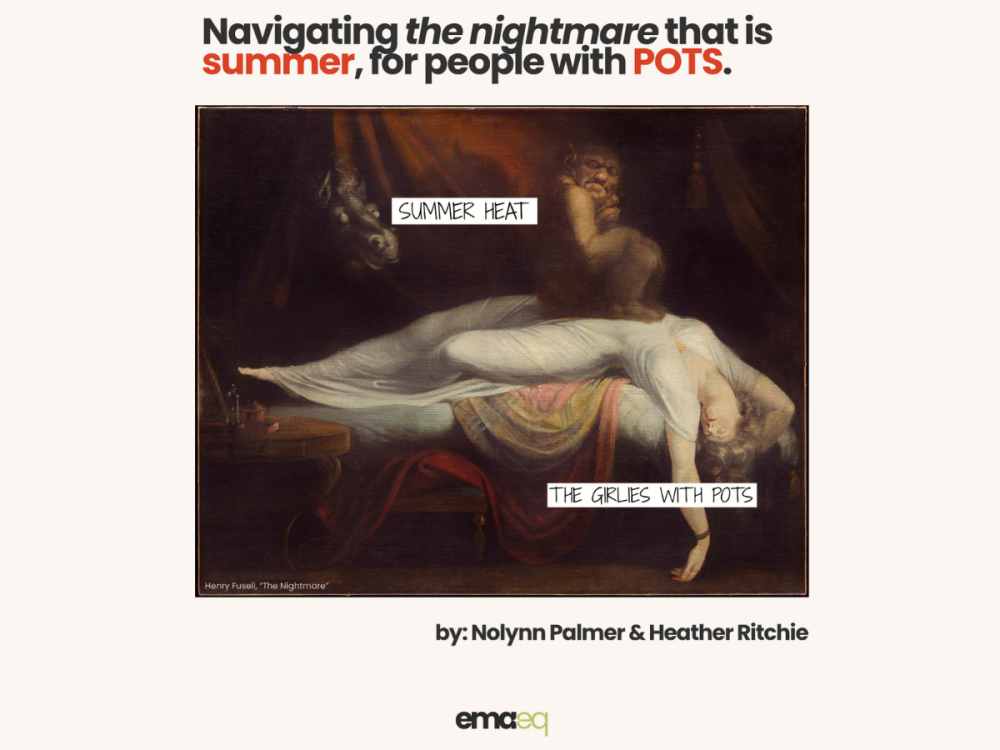
But for people living with Postural Orthostatic Tachycardia Syndrome (POTS), summer’s signature feature, heat, can turn that joy and excitement into something much harder to navigate.

POTS is a form of dysautonomia that disrupts the body’s ability to regulate blood flow when moving from lying down to standing.

Temperature dysregulation and heat intolerance are core symptoms in POTS.

Heat makes symptoms worse: blood vessels dilate, blood pressure drops, and symptoms like dizziness, fatigue, and heart palpitations intensify. What feels like a beautiful day to most can feel like an obstacle course to someone with POTS.

POTS affects an estimated 0.2 per cent to 1 per cent of the North American population, according to a 2020 NIH study; a figure that’s almost certainly undercounted, and one many researchers believe has grown significantly in the wake of COVID-19.

Roughly 75 per cent to 85 per cent of POTS diagnoses are female, and the average time from symptom onset to formal diagnosis is four to six years.

These individuals spend years researching their symptoms, becoming fluent in their own condition long before receiving a diagnosis.

Since launching its first-generation Embr Wave device, Embr has consistently heard from those with POTS looking for a solution for temperature intolerance and the symptoms that result.

Embr Wave’s temperature delivery system, providing immediate wearable cooling relief, maps directly to one of POTS’s most consistent symptoms, heat intolerance.

Embr’s implementation of Tempura, Embr’s app-based AI Assistant, has provided Embr with even more clarity on the impact Embr Wave can have in this statistically small population.

In the last 90 days, nearly 3 per cent of conversations with Tempura have touched on POTS. Relative to population prevalence, that’s a significant overrepresentation, confirming that individuals with POTS are actively seeking tools that are designed for their symptoms.

Embr Wave provides a model for how designing products for one use case, menopausal women managing hot flashes, can be found to have tremendous benefits for other populations.

The influx of advocacy by those with POTS led to a research study published this year that measured the improvement in Quality of Life factors when supported by thermoregulation wearables.

The product design by its nature, and how customers are using and talking about it, has had a snowball effect in the POTS community, amplifying awareness of a safe, always-available solution for this unmet need.

For someone with POTS, temperature isn’t a minor variable but a sizable trigger. Giving someone a way to manage temperature response hands them back a measure of control they didn’t have before.

Those in the Embr community living with POTS describe using their Wave devices both proactively and in-the-moment: some turn on their Wave’s cool-down signals before leaving the house or entering a crowded event, knowing what’s ahead.

Others use it reactively, when they feel their body beginning to respond poorly, and bring themselves back in balance.

Either way, Embr Wave provides its users with a sense of control around something they cannot control, their environment, allowing one to focus on and enjoy the moment.

No one should have to skip the places or events they love because their body can’t handle the heat. The goal is to help people stay in their lives fully, with less friction and more confidence in what their bodies can handle.

Nolynn Palmer holds a Masters of Global Public Health & Policy with a focus in Sexual & Reproductive Health & Rights. As the Science & Partnership Lead at EmaEQ, she leverages her knowledge of health policy and clinical science to advance AI safety and accuracy across the healthcare industry.

Heather Ritchie has a decades-long background in product management, launching enterprise and consumer solutions that improve health and wellness management. At Embr Labs, she serves as COO and leads the user design and market launch of Embr Wave (2nd Gen).

Continue Reading

News

Breast cancer biosensor and low-cost ultrasound startups win women’s health AI competition

Published

on

BACKEER and Netalis Medical have won the Women’s Health × EmbryoNet-AI Startup Competition, an international initiative designed to accelerate the development of artificial intelligence solutions in women’s health.

The two winners will receive technical support worth up to €100,000, along with access to investors, to help them develop and validate their minimum viable products.

In total, the competition attracted 165 teams from Europe, Central Asia, Africa and other parts of the world. The field included early-stage startups, research laboratories and clinical groups applying artificial intelligence to solve women’s health challenges.

“We selected participants based on their potential impact on women’s health, scientific and commercial viability, data availability, alignment with EmbryoNet-AI’s capabilities, programme feasibility, as well as ethical and sustainability considerations. Both winning teams demonstrated outstanding performance across all these criteria,” said Elena Lipilina, co-founder of EmbryoNet-AI.

Kazakhstan-based BACKEER is developing a fibre-optic biosensor platform for the rapid and highly sensitive detection of biomarkers. The technology aims to improve the early diagnosis of breast cancer and increase the accuracy and speed of laboratory testing. The company plans to use the programme’s resources to build the AI-driven platform and interface for the biosensors.

South African startup Netalis Medical is building a solution for ultrasound diagnostics and maternal-fetal health monitoring. The product addresses the shortage of qualified healthcare professionals and diagnostic equipment in underserved regions by offering a more affordable and accessible alternative to conventional ultrasound systems. The company plans to use the support to build an annotated proprietary ultrasound dataset for use in ultrasound diagnostics.

The Women’s Health × EmbryoNet-AI Startup Competition was held in Portugal. It included a Mentor Sprint, where participants worked with experts in technology, marketing and clinical practice to refine their solutions and business models, and culminated in a Live Pitch Day.

The selected teams presented their solutions to investors and industry stakeholders, including femtech strategic advisor Rocsi Chereches; Dr Sabine Seymour, founder of the women’s educational platform Re.punk; Fabien Lanteri, head of health strategy and innovation; Alla Zarifyan, co-founder and head of strategy at Heartgene Science; Evgenia Zaslavskaya, founder and chief executive of communications agency Zecomms; and serial entrepreneur and angel investor Isabel Holguera Vera. They evaluated applications on their potential impact on women’s health, scientific and commercial viability, alignment with EmbryoNet-AI’s capabilities, programme feasibility, and ethical and sustainability considerations.

The winning teams will now enter a build period of eight to 10 weeks, during which EmbryoNet-AI will deliver a fully developed, services-first pilot at no cost. The companies will also gain direct access to investors active in women’s health and AI-driven biotech, as well as enhanced public credibility through investor-ready materials, including pitch decks, and media exposure.

The Women’s Health × EmbryoNet-AI Startup Competition is a first-of-its-kind programme for femtech startups and research labs, bringing together innovators working at the intersection of artificial intelligence and women’s health.

The initiative, launched by the scientific platform EmbryoNet-AI in partnership with FemTech Real Money Talks Media, a European media platform covering innovation in women’s health and femtech, aims to accelerate real-world breakthroughs by transforming early-stage ideas and clinical questions into working AI solutions.

Continue Reading

Trending

Copyright © 2025 Aspect Health Media Ltd. All Rights Reserved.

