Connect with us

Entrepreneur

Applications open for the third W Accelerate with Merck KGaA and M Ventures

Published

on

W Group has opened applications for W Accelerate with Merck KGaA and M Ventures, inviting reproductive and maternal health startups, scaleups and spinouts to pitch for direct access to global pharma partnership and strategic investment.

Selected companies will pitch on 5th October, competing for the chance to accelerate their growth through commercial partnerships, investment, or both.

This is the third time Merck KGaA, a global leader in reproductive health, has partnered with W Group on the programme, which exists to close the innovation and investment gap in women’s health by connecting the sector’s most promising startups directly with the corporates and investors positioned to scale them.

What Merck KGaA and M Ventures are looking for

This year’s call is focused on breakthrough solutions in female infertility, fertility preservation, adenomyosis, endometriosis, polyendocrine metabolic ovarian syndrome (PMOS), ovarian insufficiency, preeclampsia and pregnancy comorbidities.

New for this round, applicants choose between three pathways depending on what they need from the programme:

  • The Partnership Lane, for companies seeking commercial collaborations and strategic relationships
  • The Investment Lane, for founders looking to connect with investors and secure funding to scale
  • The Dual Lane, for innovators pursuing both partnership and investment opportunities

How the Accelerate event works

Selected companies get a 1:1 pitch practice session ahead of time, then a private 30-minute session with Merck KGaA and M Ventures leadership on the day itself, small-group sessions with regulatory and investment strategy experts, an “Ask Merck Anything” roundtable, and a VIP networking reception.

Key dates

  • Open call launches: 8th July
  • Open call closes: 2nd September
  • Notification of successful companies: 11th September
  • Pitch day: 5th October

Applications are open now at wplatform.typeform.com/to/KGzviBQM.

News

Vespexx signs MOU with global femtech network Femtech Across Borders

Published

on

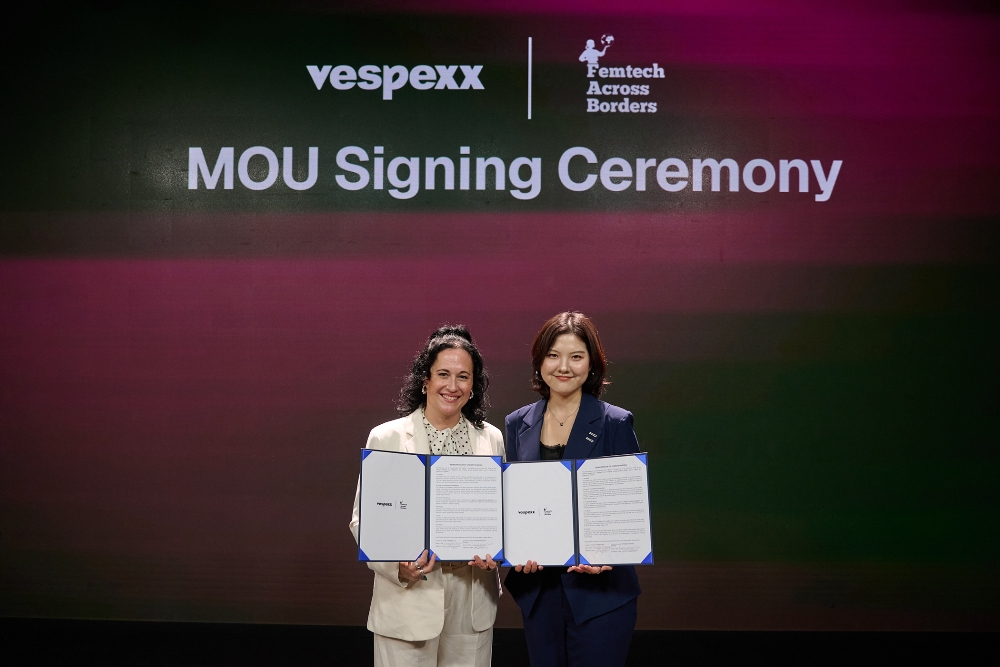
Vespexx, the femtech company behind couples preconception health platform Soonr, has signed a memorandum of understanding (MOU) with Femtech Across Borders, a global femtech network supporting women’s health initiatives across 80 countries.

The agreement was signed on June 30 at Korea Femtech Summit 2026, the first global femtech summit held in Korea, hosted by Vespexx.

Femtech Across Borders is a global femtech community led by founder Rachel Bartholomew, who entered the field after her own battle with cervical cancer.

The organisation connects women’s health innovators, companies, and institutions worldwide, supporting collaboration across borders.

“For Korean femtech to reach the world, connection with the global community matters more than anything,” said Scarlett Joowon Jung, co-CEO of Vespexx.

“Through our collaboration with Femtech Across Borders, we’ll continue to strengthen our role as a bridge between Korea and the global femtech community.”

Through the MOU, the two parties will work to lower the barriers between Korean and global femtech, raising awareness of women’s health, sharing networks, and exploring future opportunities to collaborate.

Vespexx, in particular, intends to serve as a bridge connecting Korean femtech companies with the global community, widening the path for domestic companies to reach international markets.

The agreement builds on Vespexx’s recent global momentum.

On June 30, the company hosted Korea Femtech Summit 2026, bringing together femtech leaders from Korea and abroad, and used the occasion to announce the launch of Femtech Korea, an industry network that brings Korean femtech companies together and connects them with the world.

The partnership with Femtech Across Borders extends that effort outward, linking Korea’s domestic network to the global community.

Learn more about Vespexx at vespexx.com

Continue Reading

Entrepreneur

Korea’s Femtech Industry Goes Global as Vespexx Hosts Korea Femtech Summit 2026

Published

on

From AI embryo analysis in India to couples fertility care launching in the US, Korea’s women’s health startups are going global, and US investors are taking notice.

Vespexx, the femtech company behind couples preconception health platform Soonr, hosted Korea Femtech Summit 2026 on June 30 in Seoul, convening founders, clinicians, and investors from Korea, Singapore, Canada, and Japan to map the global expansion of women’s health technology.

A panel moderated by Kakao Ventures’ Jade Chung, an OB/GYN-turned-investor, captured the summit’s central theme: Korean startups taking on the world. On stage were three companies already building well beyond Korea. Vespexx, led by Co-CEO Scarlett Joowon Jung, is entering the US with Soonr; Kai Health, founded by CEO Hyejun Lee, has deployed its AI embryo-analysis software across more than 120 fertility clinics in India; and Endo Health, represented by the Head of Design Karlie Hyeonjeong Koo, has built Glow, an AI coaching app whose user base is 98% women and which is backed by US investors including a16z. Together they discussed what it takes for Korean startups to compete globally, where AI creates a real edge, and whether “K-femtech” can follow the path of K-beauty onto the world stage.

The program spanned the full arc of women’s health technology. Lindsay Davis, founder of FemTech Association Asia, opened with a look at where Asia’s femtech stands today. Dr. Juhye Lee of Ewha Womans University Mokdong Hospital offered a clinician’s view of how patient needs are shifting, arguing that women’s health is expanding beyond pregnancy and treatment toward care across the entire life course. Boram Bae, Head of Digital Health PM Part at Samsung Electronics spoke to how a consumer platform at global scale can connect women’s everyday health data with life-stage care. And Rimi Lee, head of the Femtech Center at KOSDAQ-listed diagnostics company Sugentech, traced the evolution of hormone testing from results read by eye to AI-assisted analysis, and pointed toward wearable continuous hormone monitoring as the next frontier.

Vespexx Co-CEO Scarlett Joowon Jung presented the company’s “dyadic health” approach on their ‘Soonr’ app, which brings both partners into fertility and preconception care rather than tracking a woman’s data alone, an approach validated by their legacy product, Signaling’s 800,000 users across Asia, as the company prepares for US launch.

The summit also featured Rachel Bartholomew, the Canadian founder of Hyivy Health and Femtech Across Borders, who built her pelvic-health company, and Megumi Kimura of the Japan Women’s Health Innovation Association, who outlined the investment and business models driving Japan’s fast-growing femtech market.

At the summit, Vespexx also announced the launch of Femtech Korea, an industry network intended to connect Korean femtech companies with global markets and partners, and to serve as a bridge for cross-border collaboration.

“Korea has world-class healthcare technology, but femtech has been one of its best-kept secrets,” said Scarlett Joowon Jung, Co-CEO of Vespexx. “The companies on this stage are proof that’s changing. We’re not just building for Korea anymore, we’re building for the world, and we want US partners and investors to be part of that.”

Korea Femtech Summit 2026 was hosted by Vespexx and co-hosted by FemTech Association Asia. The summit was sponsored by Sugentech, with additional support from Innerness and Octolabs.

About Vespexx
Vespexx is a Korean femtech startup and subsidiary of KOSDAQ-listed biotech Sugentech. The company operates Soonr Health, a couples-focused preconception health platform, and its earlier product Signaling has accumulated over 800,000 users. Vespexx is currently expanding into the North American market.

About Femtech Association Asia
FemTech Association Asia is the region’s first and largest specialist advisory and industry network for founders, investors, corporate partners, and ecosystem contributors, with a core focus on improving women’s health through technology solutions.

Continue Reading

Entrepreneur

Xella launches AI-powered precision health platform

Published

on

Xella Health has launched what it calls the first AI precision health platform built for the XX chromosome.

The company says it aims to address a lack of diagnostic precision and clinical research focused on female biology.

Women make up half of the population and account for 80 per cent of consumer healthcare decisions, but research into women’s health has historically received less funding than male-focused studies.

Kelly Lacob, Xella Health co-founder and chief executive, said: “Women have been trapped in a diagnostic dark age experiencing debilitating symptoms like severe period pain, bloating and GI issues, exhaustion, and brain fog, routinely dismissed by the healthcare system.

“This dismissal results in women being diagnosed four years later than men, on average, for the same conditions, and a seven-to-10-year delay for women to receive an accurate diagnosis for conditions like endometriosis.

Stalling necessary care and treatment results in prolonged suffering with chronic pain, heightened infertility risks, and declining mental health.

Xella is here to replace the systemic medical gaslighting women have endured for generations.

We are handing women the evidence and information they need to advocate for themselves and secure faster, accurate diagnoses before early-stage conditions spiral.”

Xella says its AI examines billions of data points from clinical information and multi-omic biomarkers to assess the probability of more than 130 conditions specific to female biology.

Multi-omic data combines information from several biological areas, including genes, proteins and hormones.

The conditions assessed include polyendocrine metabolic ovarian syndrome, or PMOS, formerly known as polycystic ovary syndrome, as well as perimenopause and endometriosis.

Xella was founded by Lacob, Adriana Dantas and Dr Jesus Ching, who developed the concept while working together on molecular diagnostics at Mammoth Biosciences.

The founders say the platform is designed to provide information about possible underlying causes through advanced testing and long-term care of a kind often available only through expensive concierge services.

They drew on personal experiences to build a service intended to identify small changes in a woman’s biological baseline.

Members complete an initial health questionnaire before having blood taken at a local partner laboratory such as Quest or Labcorp.

A phlebotomist can also visit a member’s home for an additional charge.

The company’s AI analyses biomarker data from genomics, proteins and hormones alongside symptoms, lifestyle risks and medical history.

Xella says this information is used to screen for more than 130 female-specific conditions, including PMOS, Hashimoto’s disease, premenstrual dysphoric disorder, endometriosis and perimenopause timelines.

Hashimoto’s disease is an autoimmune condition in which the immune system attacks the thyroid gland.

Premenstrual dysphoric disorder, or PMDD, is a severe form of premenstrual syndrome that can cause significant emotional and physical symptoms.

The results are processed through Xella’s own dry laboratory, which the company says is certified under the US Clinical Laboratory Improvement Amendments and accredited by the College of American Pathologists.

A dry laboratory analyses data using computing and other non-experimental methods rather than carrying out traditional laboratory procedures.

The findings are turned into a personalised healthcare plan and reviewed with a certified telehealth doctor.

The doctor may recommend immediate clinical action, including personalised hormone therapy or referrals to genetic counsellors, pelvic floor physiotherapists and reproductive endocrinologists.

Reproductive endocrinologists are doctors who specialise in hormones, fertility and reproductive health conditions.

Dantas, co-founder and chief operating officer, said: “Women’s health data has historically been treated in isolated silos – a hormone test here, an ultrasound there – but no one was connecting the dots across the entire biology.

“By tracking unique biological patterns longitudinally across cycles and life stages, we aren’t just providing data, but a clear path forward.”

Xella’s clinical advisers include Dr Allison Kurian, director of Stanford Women’s Clinical Cancer Genetics Program and professor of medicine, epidemiology and population health at Stanford.

They also include Dr Lynn Westphal, a reproductive endocrinology and infertility specialist and chief medical officer of Kindbody.

Xella has received US$4.7m in angel and pre-seed funding from Precursor Ventures, Capital F, Ulu Ventures and Swizzle Ventures.

Other funds and angel investors from healthcare, diagnostics and consumer technology also participated.

Margaret Coblentz, co-founder and general partner of Capital F, said: “Women’s health is one of the highest-momentum categories in the market today, driven by a US$15tn female economy.

“Xella represents exactly how Capital F sees women’s health evolving: deep clinical expertise paired with a consumer-first mindset, and a genuine opportunity to unlock the next generation of healthcare.”

Continue Reading

Trending

Copyright © 2025 Aspect Health Media Ltd. All Rights Reserved.