Entrepreneur
Openings in Japan’s femtech sector: more than pink packaging needed
By Alecia Thomson, Tokyo-based femtech specialist at Intralink

As much as we were excited to see Japan’s first big femtech show, we were as struck by what we didn’t see, says Alecia Thomson.
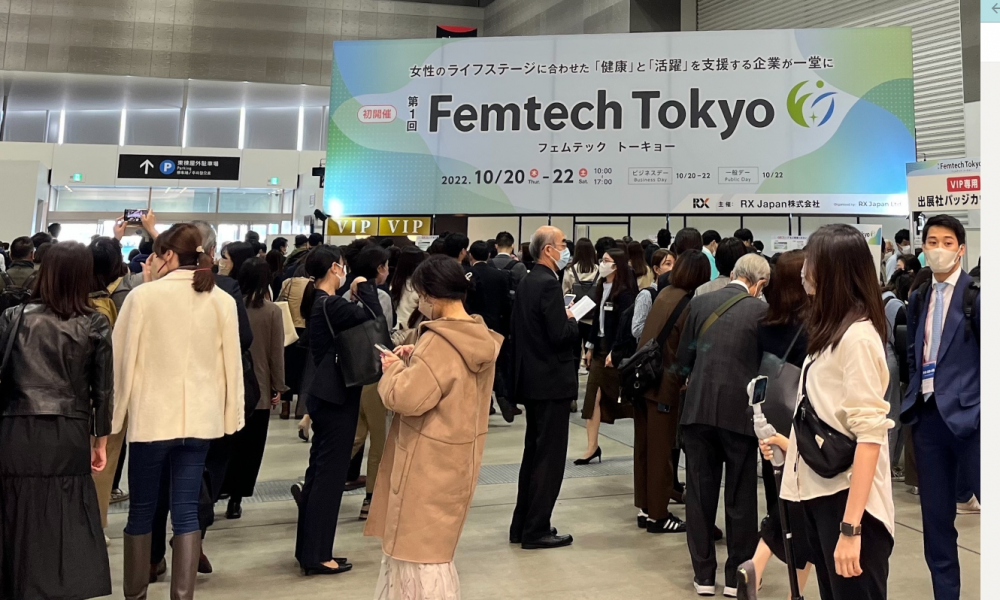
We attended the first Femtech Tokyo expo the other day, at the Tokyo Big Sight convention centre. We’ve seen smaller femtech events in Japan in the last few years, but this was the first of this scale, held at a venue which usually hosts major shows about quantum computing, automotive tech, smart factories and the like.
In this sense, it was a ground-breaking moment to see femtech finally arriving in Japan. But what we found at the event surprised us, and points to significant opportunities for western femtech firms interested in moving into the market.


What we saw – and didn’t …
We walked through the halls and attended conference sessions, including an interesting talk by Seiko Noda, former Minister for Women’s Empowerment and Gender Equality.
But, as much as we were excited to be at Japan’s first big femtech show, we were as struck by what we didn’t see at the event as what we did.
Most items on show were as general as beauty products and supplements, with no hi-tech or digital aspects at all.
Conspicuous by their absence were technologies that address the real problems women face – such as menstrual health, infertility and menopause, as well as breast, ovarian and cervical cancers.
From the video we took, you can see booth after booth of undergarments – from sanitary shorts to night bras and corrective underwear – supplements, herbal teas, Kegel trainers and CBD products.
I would hope there’s much more to femtech than protein powder in pink packaging!
Serious challenges
Conversely, Seiko Noda talked about the serious challenges Japan needs to overcome – including its declining birth rate, an ageing population and the taboo around some women’s health issues.
She was proud to tell the crowd that last year she started the Parliamentary Assembly for the Promotion of Femtech. Through this initiative, she hopes to harness the power of technology to lighten the load for women experiencing complications with menstruation, fertility and menopause.
In fact, she highlighted that Japan is facing many unprecedented challenges where femtech can potentially help. And these are being driven to some extent by the country’s ‘womenomics’ policy to encourage more women into its shrinking work force – a significant shift, as Japan has traditionally enjoyed less female economic participation than other developed countries.
An older workforce tapping into womenomics means Japan needs to think about female employees who may be struggling with women’s health issues, as well as who is now caring for children and elderly parents back at home.
Noda’s parliamentary group is working to address many of these issues, but she called on Japanese corporations to get involved as well. And, to do that, many would benefit greatly from input from western tech firms.
Considerable interest
Not all is doom and gloom for women in Japan, though. Formerly-taboo topics such as infertility treatment and menopause are becoming easier to talk about, according to Noda.
She also spoke about two government programmes recently rolled out: the Ministry of Economics, Trade & Industry (METI) is supporting 20 Japanese femtech startups, while the Ministry of Health, Labour & Welfare (MHLW) has been providing increased reimbursement for infertility treatments since April this year.

And, the expo aside, it’s been heartening for me to see first-hand that there’s considerable interest amongst Japanese corporations in expanding their business in the femtech space.
We’ve recently had several meeting requests from large Japanese companies wanting to learn more about femtech and to explore how western tech firms can help them.
One of our clients that has gained particular traction with Japanese corporations has been Elvie, a British femtech start-up, founded by President Tania Boler, which recently closed a Series C funding round of £70m. We’ve had the privilege of supporting the company in Japan with market research and by initiating conversations with potential partners.
Elvie has gained interest from large retailers, drugstore chains, e-commerce companies and various media outlets. And it was good to see its first product on the Japanese market – its connected pelvic floor trainer – on show at Femtech Tokyo via its Japanese partner Ajuma.
I’ve also recently supported an American/Hong Kong company developing a wearable breast cancer detection device. With breast cancer the most prevalent type amongst Japanese women, this has attracted keen interest from Japanese companies wanting to move into this space, as well as the wider medical community.
In-country partners
Such attention from Japanese companies is key, because western femtech firms really need in-country partners to help them address the unique characteristics of the Japanese market and to access its complex, multi-layered sales channels.
We saw wide recognition of this at Femtech Tokyo, with all but one of the western companies there exhibiting from the booths of their Japanese partners rather than going it alone.
The good news for any western firm eyeing up the market is that, given Japan’s demographic challenges and the appetite for femtech innovation amongst its corporations, the timing could not be better.
The dates for next year’s Femtech Tokyo have now been announced: 5 – 7 October 2023. We’ll be there again. And we look forward to seeing more innovative products next year – hopefully thanks to a good number of cutting-edge western tech firms.
Alecia Thomson is the Tokyo-based femtech specialist at Intralink, an international business development consultancy that helps western tech firms expand in Asia. To find out more email [email protected]

News
Vespexx signs MOU with global femtech network Femtech Across Borders

Vespexx, the femtech company behind couples preconception health platform Soonr, has signed a memorandum of understanding (MOU) with Femtech Across Borders, a global femtech network supporting women’s health initiatives across 80 countries.
The agreement was signed on June 30 at Korea Femtech Summit 2026, the first global femtech summit held in Korea, hosted by Vespexx.
Femtech Across Borders is a global femtech community led by founder Rachel Bartholomew, who entered the field after her own battle with cervical cancer.
The organisation connects women’s health innovators, companies, and institutions worldwide, supporting collaboration across borders.
“For Korean femtech to reach the world, connection with the global community matters more than anything,” said Scarlett Joowon Jung, co-CEO of Vespexx.
“Through our collaboration with Femtech Across Borders, we’ll continue to strengthen our role as a bridge between Korea and the global femtech community.”
Through the MOU, the two parties will work to lower the barriers between Korean and global femtech, raising awareness of women’s health, sharing networks, and exploring future opportunities to collaborate.
Vespexx, in particular, intends to serve as a bridge connecting Korean femtech companies with the global community, widening the path for domestic companies to reach international markets.
The agreement builds on Vespexx’s recent global momentum.
On June 30, the company hosted Korea Femtech Summit 2026, bringing together femtech leaders from Korea and abroad, and used the occasion to announce the launch of Femtech Korea, an industry network that brings Korean femtech companies together and connects them with the world.
The partnership with Femtech Across Borders extends that effort outward, linking Korea’s domestic network to the global community.
Learn more about Vespexx at vespexx.com
Entrepreneur
Applications open for the third W Accelerate with Merck KGaA and M Ventures

W Group has opened applications for W Accelerate with Merck KGaA and M Ventures, inviting reproductive and maternal health startups, scaleups and spinouts to pitch for direct access to global pharma partnership and strategic investment.
Selected companies will pitch on 5th October, competing for the chance to accelerate their growth through commercial partnerships, investment, or both.
This is the third time Merck KGaA, a global leader in reproductive health, has partnered with W Group on the programme, which exists to close the innovation and investment gap in women’s health by connecting the sector’s most promising startups directly with the corporates and investors positioned to scale them.
What Merck KGaA and M Ventures are looking for
This year’s call is focused on breakthrough solutions in female infertility, fertility preservation, adenomyosis, endometriosis, polyendocrine metabolic ovarian syndrome (PMOS), ovarian insufficiency, preeclampsia and pregnancy comorbidities.
New for this round, applicants choose between three pathways depending on what they need from the programme:
- The Partnership Lane, for companies seeking commercial collaborations and strategic relationships
- The Investment Lane, for founders looking to connect with investors and secure funding to scale
- The Dual Lane, for innovators pursuing both partnership and investment opportunities
How the Accelerate event works
Selected companies get a 1:1 pitch practice session ahead of time, then a private 30-minute session with Merck KGaA and M Ventures leadership on the day itself, small-group sessions with regulatory and investment strategy experts, an “Ask Merck Anything” roundtable, and a VIP networking reception.
Key dates
- Open call launches: 8th July
- Open call closes: 2nd September
- Notification of successful companies: 11th September
- Pitch day: 5th October
Applications are open now at wplatform.typeform.com/to/KGzviBQM.
Events
Korea’s Femtech Industry Goes Global as Vespexx Hosts Korea Femtech Summit 2026

From AI embryo analysis in India to couples fertility care launching in the US, Korea’s women’s health startups are going global, and US investors are taking notice.
Vespexx, the femtech company behind couples preconception health platform Soonr, hosted Korea Femtech Summit 2026 on June 30 in Seoul, convening founders, clinicians, and investors from Korea, Singapore, Canada, and Japan to map the global expansion of women’s health technology.
A panel moderated by Kakao Ventures’ Jade Chung, an OB/GYN-turned-investor, captured the summit’s central theme: Korean startups taking on the world. On stage were three companies already building well beyond Korea. Vespexx, led by Co-CEO Scarlett Joowon Jung, is entering the US with Soonr; Kai Health, founded by CEO Hyejun Lee, has deployed its AI embryo-analysis software across more than 120 fertility clinics in India; and Endo Health, represented by the Head of Design Karlie Hyeonjeong Koo, has built Glow, an AI coaching app whose user base is 98% women and which is backed by US investors including a16z. Together they discussed what it takes for Korean startups to compete globally, where AI creates a real edge, and whether “K-femtech” can follow the path of K-beauty onto the world stage.

The program spanned the full arc of women’s health technology. Lindsay Davis, founder of FemTech Association Asia, opened with a look at where Asia’s femtech stands today. Dr. Juhye Lee of Ewha Womans University Mokdong Hospital offered a clinician’s view of how patient needs are shifting, arguing that women’s health is expanding beyond pregnancy and treatment toward care across the entire life course. Boram Bae, Head of Digital Health PM Part at Samsung Electronics spoke to how a consumer platform at global scale can connect women’s everyday health data with life-stage care. And Rimi Lee, head of the Femtech Center at KOSDAQ-listed diagnostics company Sugentech, traced the evolution of hormone testing from results read by eye to AI-assisted analysis, and pointed toward wearable continuous hormone monitoring as the next frontier.
Vespexx Co-CEO Scarlett Joowon Jung presented the company’s “dyadic health” approach on their ‘Soonr’ app, which brings both partners into fertility and preconception care rather than tracking a woman’s data alone, an approach validated by their legacy product, Signaling’s 800,000 users across Asia, as the company prepares for US launch.
The summit also featured Rachel Bartholomew, the Canadian founder of Hyivy Health and Femtech Across Borders, who built her pelvic-health company, and Megumi Kimura of the Japan Women’s Health Innovation Association, who outlined the investment and business models driving Japan’s fast-growing femtech market.

At the summit, Vespexx also announced the launch of Femtech Korea, an industry network intended to connect Korean femtech companies with global markets and partners, and to serve as a bridge for cross-border collaboration.
“Korea has world-class healthcare technology, but femtech has been one of its best-kept secrets,” said Scarlett Joowon Jung, Co-CEO of Vespexx. “The companies on this stage are proof that’s changing. We’re not just building for Korea anymore, we’re building for the world, and we want US partners and investors to be part of that.”
Korea Femtech Summit 2026 was hosted by Vespexx and co-hosted by FemTech Association Asia. The summit was sponsored by Sugentech, with additional support from Innerness and Octolabs.
About Vespexx
Vespexx is a Korean femtech startup and subsidiary of KOSDAQ-listed biotech Sugentech. The company operates Soonr Health, a couples-focused preconception health platform, and its earlier product Signaling has accumulated over 800,000 users. Vespexx is currently expanding into the North American market.
About Femtech Association Asia
FemTech Association Asia is the region’s first and largest specialist advisory and industry network for founders, investors, corporate partners, and ecosystem contributors, with a core focus on improving women’s health through technology solutions.
Insight7 days agoWomen with PMOS should have annual NHS checks, new guidance says
Diagnosis6 days agoTwo “gamechanger” tests set to speed up endometriosis diagnosis on the NHS
Cancer5 days agoThousands of women could avoid painful cancer exam with new AI blood test
Events2 weeks agoKorea’s Femtech Industry Goes Global as Vespexx Hosts Korea Femtech Summit 2026
News1 week agoBreast cancer biosensor and low-cost ultrasound startups win women’s health AI competition
News1 week agoClue spotlights seven women’s health journeys in new campaign
Fertility6 days agoOlder women face lower chance of fertility treatment working, even with donor eggs, study finds
Mental health2 weeks agoThe danger of ‘efficiency culture’ in women’s mental tech


Pingback: Ukrainian femtech entrepreneur wins top award in Kyoto - FemTech World
Pingback: Femtech Tokyo set to return for its second edition - FemTech World