




Mental health
A childhood overshadowed by war inspired Mandana Ahmadi to make a change


After witnessing the war in Iran, Mandana Ahmadi decided to create an app that would help others understand themselves and break free from anxiety
Imagine a world where the war becomes normality. A world where the sound of missiles goes unnoticed and airstrikes become routine. This was Mandana Ahmadi’s life in Iran until she was eight years old.
“That was all I knew,” she remembers. “Then, one day I woke up and I was terrified, because everybody was suddenly so happy that it almost scared me. I didn’t know what was happening until I was told the war was over.”
To say it was hard for an eight-year-old to understand what was going on, would be an understatement. “What struck me the most was how people’s state of mind can influence their lives,” Mandana explains. “They were extremely happy when, in reality, nothing had changed. We were living in the same space, in the same environment, in the same state, with the same people and the same amount of money. But suddenly, everybody was happy. It felt like an alternative universe and it was the very first time in my life when I realised that it doesn’t matter what’s around you. What matters is what you think you can do with your life.”

Mandana spent the first years of her life escaping conflict
That is when Mandana became interested in how the brain works and how our mindset impacts our everyday life. After she experimented with pharmacology, she was introduced to computational neuroscience – a branch of science that involves studying brain function through computer modelling and mathematical analysis. “I realised that was what I was looking for,” she adds. “I was offered a scholarship in Denmark where I did three months of research and then, because I was unable to afford an actual university, I went to a community college in the US.
“But even though I loved doing research, I realised that we were not doing anything with that knowledge. I didn’t want my work to be buried in papers.
“So, there was this turning moment in my head when I was not happy with the status quo and the way people are sometimes left to their own devices,” Mandana adds. “If you’re not lucky to be born into a family, or social background, or even a country where there is some level of understanding, compassion and support, no matter who you are, you will break. If things keep bashing at you, and you’re not valued, at some point, you will break. Nobody is born broken. The environment breaks you.”
Along with her co-founder, she created Alena, an app that aims to bring science closer to people and help them overcome social anxiety. Alena uses simple games to assess the brain’s cognitive processes and based on the results, provides personalised behavioural therapy.
“Social anxiety is an important function in our life,” says Mandana. “We are social creatures and for that reason, it matters that we’re socially aware. But because it is so inherently natural to who we are, people just accept it as it is, and most of the time, it doesn’t occur to them that something might be wrong. We’ve got so used to saying that someone’s an introvert or shy or self-critical when those are very often signs of social anxiety.
“We see more awareness around conditions like depression, but what we don’t realise, is that depression can sometimes be a consequence of untreated social anxiety.
“Think of it like tanning,” she laughs. “If you get tanned people say: ‘Oh, it’s natural’. And unless it becomes cancer, it doesn’t raise awareness.”

Mandana Ahmadi and her team in the office
Studies have shown that socialisation and hormonal differences make women twice as likely as men to experience depression. So how could Alena make a difference?
“I’m hoping that it will give people the support that they need,” the co-founder says. “I met a lot of wonderful people who supported me and believed in my potential, regardless of what I had been through. I want Alena to make people believe in themselves and to bring that level of hope and happiness in their lives by helping them understand themselves.”
If it passes the regulatory approvals, Mandana hopes that the app will be available by summer. “It’s deep science,” she adds. “For that reason, I hope it will have the power to really make a difference.”
To find out more about the app visit alena.com.












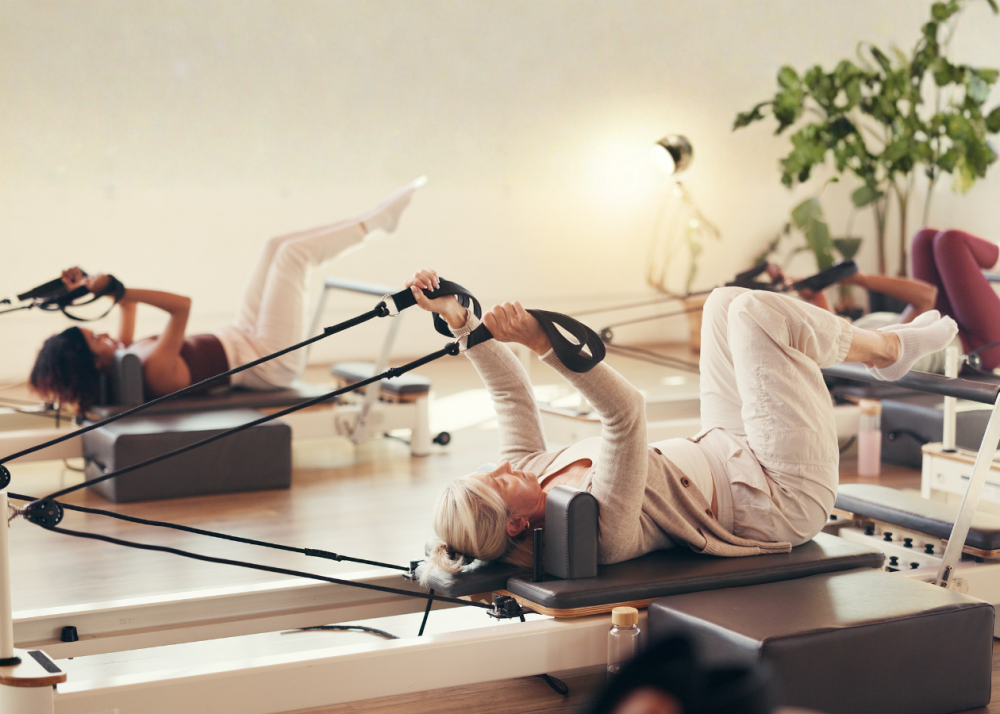
A four-week Pilates programme may improve heart, metabolic and stress measures in previously sedentary women, a small study suggests.
Pilates is a mind-body form of exercise that has been linked to better fitness, balance, posture, muscular endurance, mental wellbeing and quality of life in different groups.
Built around breathing, concentration, control, precision, centring and flow, Pilates is already used in physiotherapy, rehabilitation and preventive health. The new study looked at whether a structured four-week programme could affect cardiovascular, metabolic, body and stress-related measures in sedentary adult women.

The longitudinal study included 30 sedentary women split into two age groups, 30 to 40 and 50 to 60.
All participants completed a standardised, supervised Pilates programme lasting four weeks, with three sessions a week lasting 50 to 60 minutes.
Researchers measured resting heart rate, systolic and diastolic blood pressure, body mass index, abdominal circumference, fasting blood glucose and serum cortisol at the start and end of the programme.
Systolic and diastolic blood pressure are the top and bottom readings in a blood pressure test. Cortisol is a hormone linked to the body’s stress response.
The four-week Pilates programme was linked to improvements in cardiovascular, metabolic, body and neuroendocrine measures, although not every change reached statistical significance within each age group.
In the younger group, significant reductions were seen in heart rate, blood pressure, body mass index and fasting blood glucose after the intervention.
The reduction in blood pressure after the programme was significantly greater in the older group than in the younger group.
Older participants also showed a greater reduction in glucose and cortisol levels after the intervention than younger participants.
Analysis also found significant links between cardiovascular, metabolic and neuroendocrine changes.
In the younger group, this was particularly seen between heart rate and blood pressure responses.
In the older group, it was particularly seen between changes in body mass index and fasting glucose.
The findings suggest Pilates could be a useful multidimensional exercise approach for cardiometabolic health and stress regulation in previously sedentary women.
The researchers said the larger reduction in blood pressure seen in the older group may reflect a higher cardiometabolic burden at the start, leaving more room for improvement after the programme.
The greater reduction in fasting glucose and cortisol in older participants may similarly suggest that people with higher baseline metabolic and neuroendocrine dysfunction could benefit more from structured exercise such as Pilates.
Although Pilates is known to improve body composition through energy use, neuromuscular activation and support for healthier habits, the researchers said the fall in body mass index over four weeks is unlikely to be explained by Pilates alone.
They noted that participants were also told to avoid alcohol, sugar-containing products and sugar-sweetened drinks during the intervention, which may have contributed to the change.
In the younger group, the link between heart rate and blood pressure suggested coordinated cardiovascular responses after Pilates.
The researchers also found that cortisol appeared to be linked to blood pressure and body mass index, suggesting stress-related changes may be tied to cardiovascular and body regulation after the intervention.
In the older group, the link between body mass index and fasting glucose highlighted the relationship between body fat and metabolic regulation.
A positive link between blood pressure and body mass index in this group also suggested that improvements in vascular regulation may be associated with reductions in body mass.
Overall, the findings suggest Pilates-related physiological changes may involve interconnected cardiovascular, body, metabolic and neuroendocrine mechanisms, with different response patterns by age.
The study has important limits. It did not include a non-exercise control group, so it cannot prove Pilates directly caused the changes.
The sample size was also small, which limits how far the findings can be applied more widely.
The authors also noted that cortisol was measured using a single fasting morning sample, which limits conclusions about broader hypothalamic-pituitary-adrenal axis regulation, the system involved in the body’s stress response.
They said larger studies with longer follow-up will be needed to confirm whether Pilates causes these physiological changes over time.
British women are among the angriest in Europe, a global health survey has revealed.
More than 20 per cent of women in Britain said they had experienced feelings of rage for much of the previous day.
British women were also 47 per cent more likely to say they felt angry than a year earlier.

The findings were published in the Hologic Global Women’s Health Index, a yearly league table based on polling of more than 76,000 women and girls aged over 15 worldwide.
Anna O’Sullivan, co-founder of women’s health awareness group CensHERship and founder of the FutureFemHealth news platform, told the Daily Mail: “These figures reflect years of long waiting lists, delayed diagnoses and women’s health being treated as an afterthought.
“We’ve seen a significant increase in awareness and discussion about women’s health over the last few years, but access to care has not kept up with that.
“These findings should be a wake-up call that it’s time for long-term, sustainable investment to ensure women can access timely healthcare, trusted information and earlier diagnosis before conditions become more complex and costly to treat.”
The data suggested anger levels among British women have risen sharply.
Rates across the rest of Europe, however, remained broadly the same.
The survey, which involved more than 140 countries, found three in 10 UK women said they felt sadness, compared with the EU average of 25 per cent.
The data, collected in February 2024 and released this week, also showed that around four in 10 women in both the UK and EU felt worry.
A third of women in the UK reported being in pain, up 10 per cent on the previous year.
Three in 10 women also said they lived with chronic health problems, up seven per cent on the year before.
Chronic health problems are long-term conditions that may need ongoing care or management.
Health experts said women in the UK were increasingly frustrated by the gap between the NHS care they expected and the care they received.
The report took a snapshot of the national mood, with participants asked about the emotions they had experienced “during a lot of the day yesterday”.
The UK placed sixth among 37 European countries for anger.
The highest levels were recorded in Malta, where 26 per cent of women reported feelings of rage, followed by Greece at 25 per cent, the Czech Republic and Albania at 23 per cent, and Spain at 22 per cent.
Ireland ranked at 18 per cent, while Germany, France and Switzerland each reported 17 per cent.
Britain has also slipped in Hologic’s overall global rankings for women’s health.
The UK is now 48th, close to dropping out of the top third of countries worldwide, after ranking 40th out of 142 countries last year.
Taiwan ranked first, followed by Latvia, Japan, Vietnam and Poland. Singapore, Germany and Austria were also among the leading countries.
Tim Simpson, a senior manager at Hologic, said: “Women are telling us they want earlier diagnosis and faster access to care.
“Improving women’s health will take continued commitment from policymakers, the NHS, clinicians and industry working together to deliver the changes women are asking for.”
A separate Hologic survey carried out last month found that almost 70 per cent of women had faced delays seeking NHS care in the past five years.
Two in five said difficulties accessing healthcare had left them feeling frustrated or anxious.
The survey’s findings reinforced official figures showing that Britain has become more anxious since before the pandemic.
The Office for National Statistics said 22.5 per cent of UK adults reported “high anxiety yesterday” between July and September 2024, up from 20.4 per cent in the same period in 2019.
Among women, the figure was 26.3 per cent, compared with 18.5 per cent among men.
A Department of Health and Social Care spokesperson said: “It is unacceptable that the UK continues to lag behind other countries when it comes to women’s health.”











 Menopause3 weeks ago
Perimenopause misinformation ‘putting women at risk’

 Hormonal health4 weeks ago
NHS urged to update website following renaming of PCOS

 News3 weeks ago
Women still being failed when they reach menopause, experts say
 Entrepreneur3 weeks ago
Women’s Health Innovation Summit opens submissions for 2026 Innovation Showcase
 Insight2 weeks ago
British women among angriest in Europe, health survey reveals

 News3 weeks ago
Three menopause innovators shortlisted for Femtech World Award
 Menopause3 weeks ago
Sweden eyes domestic production of oestrogen patches amid menopause treatment shortage

 News4 weeks ago
Low insulin diet and avoiding four food groups may prevent menopause weight gain
2 Comments