




Entrepreneur
Where the smart capital is going: Maternal health innovation


By Theresa Neil, CEO of Femovate
For years we’ve known that maternal mortality remains too high, even in wealthier countries. The data is clear but meaningful change has been slow. Now, there are signs that things may finally be shifting.
New Momentum in Funding
Funding for maternal health is beginning to grow, and it’s coming from a broad mix of sources. Health systems, mission-driven funds, and hospital-backed venture arms are stepping in alongside traditional VCs.
Impact-Driven Investors at the Forefront
Much of the early momentum in maternal health innovation is coming from social impact funds and mission-aligned investors who have stepped in to support solutions where traditional capital has often fallen short.
These investors are not only backing new startups, they are helping reshape how maternal health challenges are identified, explored and solved.
Catalyst by Wellstar, a health system–backed innovation fund, just invested in Armor Medical, a company developing a wearable to monitor for early signs of postpartum haemorrhage.
The technology offers continuous insight during labor and postpartum, enabling faster intervention to help prevent the leading cause of maternal death.
“Catalyst is committed to backing transformative technologies that redefine standards of care,” said Jaimie Clark, Head of Innovation at Catalyst by Wellstar and Director of Innovation and Venture Strategy for Wellstar Health System.
“By investing in solutions that enable real-time detection and intervention, we’re not just funding innovation, we are helping save lives, protecting families, and building a safer future for mothers.”
Laerdal’s Million Lives Fund, based in Norway and the UK, has been investing globally in maternal and neonatal innovation since 2020.
They’ve supported early-stage companies like Novocuff and Ciconia Medical, and partnered with organisations such as MATTER, Walgreens, and University of Chicago Medicine to help startups address the biggest problems in maternal care.
Medicines360’s Innovation Hub continues to focus on advancing maternal health tools with both clinical rigor and patient centric design.
Their portfolio includes PeriPeach, a device designed to reduce severe perineal tearing, which won the 2025 Harvard President’s Innovation Challenge.
SwissHealth Ventures and Zürcher Kantonalbank, along with European Union Horizon 2020 funding, have backed Pregnolia, a Swiss startup developing a diagnostic tool to assess cervical stiffness and support preterm birth prevention.
These investors are filling a critical gap in funding and accelerating the pace of real, evidence-based innovation that supports better maternal outcomes.
Profit-Driven Investment is Gaining Ground
We’re also seeing a shift in who is funding maternal health.
While many early investments came from mission-driven or philanthropic sources, more profit-driven investors are now entering the space.
These ROI-focused backers expect strong returns and see maternal health as an underinvested opportunity. U.S. Venture Partners (USVP) led a $17 million Series A round for Delfina Care, an AI-enabled platform focused on pregnancy care.
TMV (March of Dimes Innovation Fund) and Foreground Capital co-led a $12 million Series A for Millie, a U.S. tech-enabled maternity clinic.
These are meaningful shifts.
They suggest that maternal health is no longer seen as a niche or philanthropic cause, but as a viable and scalable opportunity within the broader healthtech and digital care landscape.
Learning from the Fertility Investment Model
The fertility space shows what’s possible when capital and attention align. Over $10 billion has been invested in conception and IVF over the past decade.
That wave of funding brought new tools to market, expanded access, and improved outcomes. As investment in fertility has grown, attention is beginning to shift toward maternal health.
Turning Momentum Into Lasting Impact
To keep this momentum going, we’ll need continued support for clinical research, scalable product design, and thoughtful integration with care teams and health systems.
Early-stage capital remains essential, along with the infrastructure to help new tools reach the people who need them most.
Support from initiatives like Femovate, Springboard Enterprises, and Tech4Eva, along with investment groups such as Daya Ventures, is helping founders navigate early development, build credibility, and find the partnerships that move their solutions forward.
These networks are turning innovation into real-world impact.
Change is on the horizon.
With coordinated support from funders, founders, accelerators, and care providers, now is the time to reimagine maternal health and deliver better care for mothers and families around the world.














Women’s health has become one of the most searched and shared topics online, from cycle syncing and cortisol management to menopause hacks, supplements, hormone testing and clinician-creator content.
That surge in attention, sometimes dubbed “healthmaxxing,” is changing how women find, evaluate and act on health information, and it is starting to reshape the relationship between patients, clinicians and the companies building products for this market.
For providers, the shift means patients are arriving better informed but also more exposed to unverified claims, putting pressure on clinicians to engage with online narratives rather than dismiss them.
For femtech and pharma companies, it opens a route to reach and educate consumers at scale, but also raises the stakes on credibility: products and messaging that ride the trend without clinical grounding risk eroding the trust the industry has spent years building.
Investors are watching the same dynamic from a different angle.
Attention-driven demand can be a signal of where the next wave of femtech growth will come from, but distinguishing genuine clinical need from viral momentum is increasingly part of due diligence.
The net effect is a widening gap between companies that treat cultural attention as a distribution channel for credible, evidence-based care, and those that risk being swept up in trends with little clinical substance behind them.
How that gap plays out will shape patient trust, clinical relationships and commercial opportunity across the women’s health industry for years to come.
These themes will be explored in more depth in an upcoming webinar, “Women’s Healthmaxxing: The Opportunity & Risks of Cultural Attention for the Women’s Health Industry,” hosted by the Women’s Health Innovation Summit (WHIS), featuring Ellen Wilcox (Listen Ventures), Jessica Bell van der Wal (Frame Fertility), Dr. Tosin Sotubo-Ajayi (NHS, BBC and more) and Nora Lansen (Elektra Health).
Register free for the webinar on 23 July 2026 at https://events.virtualpro.com/womens-health-series-webinar-july-2026/registration


Juno Bio has secured US$3.8m to expand its diagnostics platform for vaginal health and reproductive care.
The funding round was led by Ada Ventures, with participation from Artesian, Entrepreneur First and Illumina Accelerator.
The women’s health startup said the seed funding will support the launch of its first CLIA-certified sequencing laboratory in Oakland, California, and a new clinical vaginal microbiome and STI test for healthcare providers.
CLIA certification refers to US laboratory standards for testing human samples used in diagnosis, prevention or treatment decisions.

Dr Leighton Turner, co-founder and chief scientific officer of Juno Bio, said: “The vaginal microbiome is still one of the least understood systems in the body at a clinical scale.
“With our lab, we’re starting to build a measurement standard that clinicians can actually use.
“We believe the level of detail from this kind of testing can meaningfully improve how vaginal healthcare is provided.”
The company is developing precision diagnostics for vaginal health, where patients can experience recurring symptoms, inconsistent diagnoses and treatments based on trial and error.
Juno Bio said bringing testing in-house gives it greater control over the process, from sample handling to results, while allowing it to refine its technology and build what it says is one of the largest datasets focused on the vaginal microbiome.
The vaginal microbiome is the community of bacteria and fungi that naturally live in the vagina. Changes in this balance can be linked to infections, symptoms and wider reproductive health issues.
Juno Bio’s newly launched clinical test examines the wider vaginal microbiome and screens for four common sexually transmitted infections, or STIs.
Rather than looking for a single cause, the test is intended to give clinicians a broader picture of what may be contributing to symptoms.
Juno Bio says this matters because multiple infections can occur at the same time and microbiome changes may be linked to fertility, menopause or recurrent infections.
Dr Anna Powell of Johns Hopkins said: “Vaginal microbiome testing has the potential to significantly reshape how we understand and manage vaginal health, particularly for patients with recurrent or unexplained symptoms.
“While the field is still evolving, advances in sequencing and data interpretation are moving us closer to a future where more personalised, microbiome-informed care can complement existing diagnostic approaches.”
Check Warner, co-founding partner at Ada Ventures, added: “Juno Bio is setting a new standard for how vaginal health is understood and managed.
“What they’ve built at this stage, with this level of capital efficiency, is exceptional.
“We’re proud to support the team as they scale their clinical infrastructure and continue leading innovation in this critically underserved category.”

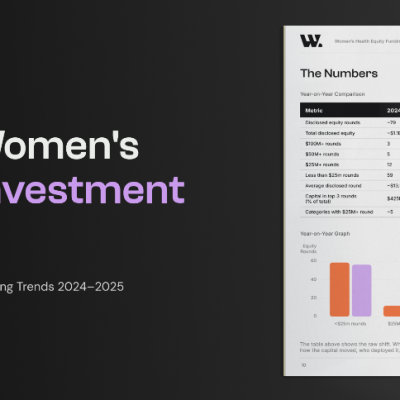
Women’s health companies raised a record $1.55 billion in disclosed equity in 2025, up 41 per cent year on year, according to W Group’s first Global Women’s Health Investment Report, The Road to the Era of Scale.
The report tracks over 500 funding stories and 164 equity rounds across 15 categories and 30+ countries.
Eighty-five companies raised equity in 2025, the highest single-year count on record. But according to the report, the headline figure isn’t the most significant one.
The bigger shift is in where that capital went and how concentrated it was at the top compared to the year before.
The report also points to a brand new investment category that didn’t exist twelve months ago.
SheMed closed a $50 million Series A this year to build a women-specific GLP-1 and metabolic health platform, the first dedicated raise of its kind.
Alongside the momentum, the report identifies one structural risk that could determine whether 2025’s growth holds: a bottleneck at Series A that’s leaving a number of promising seed-stage companies stuck.
Molly Taylor, head of content at W Group, said: “2025 was the biggest year women’s health has ever had, and the most important finding isn’t the headline number.
“It’s that the money has stopped pooling at the top.
“Capital is reaching more companies, more categories and more countries than ever before. The Era of Scale is real. It’s just not finished, and the Series A gap is where it could stall.
“Closing that gap is the highest-leverage move this ecosystem can make in 2026.”
Read the full report: https://wplatform.co/forms/womens-health-equity-funding-trends-report-2026?utm_source=advocacy&utm_medium=ext_email&utm_campaign=2026-q3-health-report-femtech-world










 Diagnosis2 weeks ago
Two “gamechanger” tests set to speed up endometriosis diagnosis on the NHS

 Insight2 weeks ago
Women with PMOS should have annual NHS checks, new guidance says

 News5 days ago
New menopause drug approved for use by NHS in Scotland

 Cancer2 weeks ago
Thousands of women could avoid painful cancer exam with new AI blood test

 Entrepreneur2 weeks ago
Applications open for the third W Accelerate with Merck KGaA and M Ventures

 Fertility2 weeks ago
Older women face lower chance of fertility treatment working, even with donor eggs, study finds

 News2 weeks ago
We built Ema like a nurse: Here’s why that matters

 News2 weeks ago
Experts call for regulation of toxic period product chemicals