




News
Women As One Award winner leads the charge in VESALIUS-CV results

By Women As One
When the VESALIUS-CV trial was conceived in 2018, it began a multi-year effort to answer a critical question in preventive cardiology.
Could evolocumab, marketed as Repatha, a human monoclonal antibody that inhibits PCSK9, reduce major cardiovascular events in patients at high risk but without a prior myocardial infarction or stroke?
The scientific stakes were high. For one of its leaders, Dr Erin Bohula, the journey was also deeply meaningful.
Dr Bohula is a cardiologist at Brigham and Women’s Hospital in Boston and an assistant professor at Harvard Medical School.
She joined the trial early in its development and ultimately became a co-principal investigator.
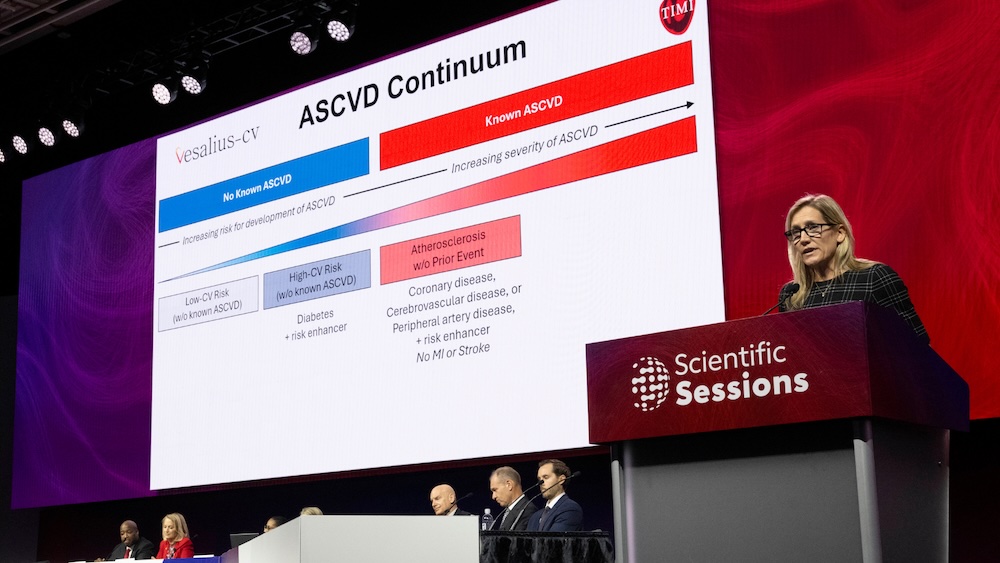
“I started as an investigator and moved up to become co-PI,” she shared in an exclusive Women As One interview at AHA 2025, shortly after presenting the trial’s findings during the Late-Breaking Science session.
“It has been a journey of growth, and to now be part of something that will change practice is incredibly exciting.”
The science and the stage
VESALIUS-CV, supported by Amgen, is one of the largest primary-prevention studies of a PCSK9 inhibitor conducted to date.
The trial enrolled patients with significant cardiovascular risk profiles, including extensive atherosclerotic burden or high-risk comorbidities, but no prior major atherosclerotic event.
Its design sought to determine whether achieving very low LDL levels with evolocumab could meaningfully reduce cardiovascular outcomes long before the first heart attack or stroke occurs.
The trial results delivered an important message.
Earlier and more intensive lipid lowering has the potential to shift the trajectory of disease, not only in those recovering from events but in those who have never had one.
Its scientific impact is matched by the significance of its leadership.
Having a woman guiding a trial of this scale reinforces a growing truth within cardiovascular research.
Women are not only participants in clinical studies. They are shaping the scientific agenda.
As Dr Bohula described the experience of preparing for AHA 2025, her emotion was evident.
“We are very happy that everyone’s effort has paid off to deliver a strong result. What is most rewarding is knowing this data will help patients.”
Why representation in leadership matters
The success of VESALIUS-CV contributes to a larger cultural and clinical reality. Leadership diversity strengthens clinical research.
“Historically, women have been underrepresented in both cardiology and clinical trials,” she noted.
“I truly believe one way to change that is to ensure the leadership team reflects the populations we want to enroll.”
Diverse leadership improves trust, broadens recruitment, and ensures study findings are more generalizable.
“When women see women leading trials, they are more likely to see themselves participating.
“Representation opens doors.”
Mentorship as a catalyst
When asked what advice she would offer early-career women in cardiology, Dr Bohula did not hesitate. Mentorship.
“That has really been the key for me. I have had mentors who appreciated my value and gave me platforms to grow. That is what made the difference.”
She emphasised the importance of both formal mentorship programs and informal supporters who advocate for women behind the scenes.
“Find the people who believe in you. That is what gets you from the back of the room to the podium.”
The role of industry and advocacy
Organisations such as Women As One and intentional efforts from industry sponsors are helping shift the landscape for women in cardiovascular research.
“Women As One gave me an award years ago, and with it came support to attend a major meeting. That one opportunity connected me with people in the field and gave me the chance to be seen and heard.”
She added that industry sponsors have meaningful influence over who receives leadership opportunities.
“Industry has a huge opportunity to be intentional about who they invite into leadership roles, who sits on advisory boards, and who they elevate.
“And I have seen that change happening.”
Why this work matters
VESALIUS-CV is a milestone in preventive cardiology.
It demonstrates the long-term benefits of aggressive LDL lowering in high-risk individuals before events occur.
It also underscores that who leads the science matters just as much as the data itself.
At Women As One, we remain committed to ensuring that more women across all stages of their careers have the mentorship, opportunities, and visibility they need to shape the future of cardiovascular research.
When women lead, the entire field moves forward.
Learn more about Women As One at womenasone.org
















We are excited unveil the three finalists competing for one of the Femtech World Awards’ most coveted honours: the Startup of the Year Award, sponsored by Future Fertility.
This award celebrates an early-stage company making a bold impact in women’s health through innovation, vision and execution.
The winner will be announced at our virtual ceremony on 19 June, with the decision made by a representative from category sponsor Future Fertility.
Congratulations to the shortlist and thank you to everyone who entered or nominated.
Startup of the Year Shortlist

Hello Inside is the first women’s health AI company to turn daily metabolic signals into outcomes women feel and healthcare systems reimburse.
Women’s health has long been under-researched, and current AI benchmarks fail on women’s health questions roughly sixty percent of the time.
Hello Inside built the architecture to close that gap.
Across four years and 12,000+ validated metabolic profiles, three in four women improve at least one symptom within ninety days.
They lose four kilograms in three months, moving from overweight into the healthy range. In a clinical study with Alisa Vitti’s Flo Living, 91.9 per cent reduced PMS burden within sixty days.


U-Ploid is an early-stage biotechnology company tackling one of the most fundamental challenges in fertility care: the sharp, age-related decline in egg quality that limits outcomes across IVF and egg freezing.
While much of the field focuses on improving assessment and selection, U-Ploid is developing a first-in-class therapeutic approach designed to improve egg quality itself by addressing the biological causes of age-related chromosomal errors.
Supported by strong preclinical evidence and now advancing into human studies, U-Ploid combines scientific rigour, regulatory discipline and long-term vision to help redefine what is possible in fertility care.

Gestational diabetes is a strong risk factor for future type 2 diabetes, even in women with normal pre-pregnancy weight, according to a study at the University of Gothenburg.
The researchers call for earlier testing and better follow-up.

“Our results show that gestational diabetes functions as a kind of stress test for the body’s ability to manage blood sugar, and identifies women with a greatly increased risk of future type 2 diabetes”, said Jon Edqvist, PhD and affiliated to research at the University of Gothenburg, and operating room nurse at Sahlgrenska University Hospital.
Gestational diabetes is a special type of diabetes that can affect pregnant women.
The condition is defined as elevated blood sugar levels, without previously known diabetes. Treatment involves self-monitoring of blood sugar, advice on lifestyle habits and, if necessary, medication.
Identifying gestational diabetes is important because the disease increases the risk of complications such as preeclampsia, the need for a cesarean section and high birth weight for the baby.
Those who have had gestational diabetes are also at higher risk of later developing type 2 diabetes.
In the current study, published in eClinicalMedicine, researchers now show that gestational diabetes is a strong indicator of future risk of developing type 2 diabetes, even in women with normal weight before pregnancy.
Elevated risk even with normal weight
The study is based on data from the Medical Birth Registry on just over 1.15 million first-time mothers in Sweden, who gave birth between 1987 and 2019. 16,870 women with confirmed gestational diabetes were compared with age-matched women without the diagnosis. The median follow-up period was nine years.
The results show that women with a BMI of 35 and above, i.e. severe obesity, had an almost tenfold increased risk of developing gestational diabetes compared to women with normal weight.
The risk of subsequent type 2 diabetes also increased with higher BMI, but it was significantly increased even with normal weight, which the researchers describe as particularly worrying.
More follow-up and more studies
The researchers behind the study welcome the recently updated recommendations on gestational diabetes in Sweden, where a higher proportion of pregnant women at increased risk are expected to be offered testing earlier in pregnancy, and if necessary, interventions.
“Diagnostics and care of gestational diabetes have looked very different in different parts of the country,” said Annika Rosengren, professor at the University of Gothenburg.
“There is a need for both improved follow-up after gestational diabetes, and more studies that investigate how such follow-up affects future health and prognosis”











 News4 weeks ago
Women’s digital health market set to reach US$5.28 billion in 2026 – report

 Fertility4 weeks ago
Why the UK’s fertility rate keeps falling – and what it means if you’re trying now
 Wellness4 weeks ago
Women’s HealthX unveils Northwell Health, Corewell Health, Biogen & more to headline Chronic Disease stage

 Opinion3 weeks ago
What Maternal Mental Health Month reveals about where postpartum support actually breaks down

 Fertility4 weeks ago
Toxins and climate harms having ‘alarming’ effect on fertility, research warns

 Insight3 weeks ago
NIH Grant terminations disproportionately impact minority scientists, research finds

 Adolescent health2 weeks ago
WUKA brings Period-Positive Pool Party to London Aquatics Centre to keep girls swimming through puberty

 Fertility4 weeks ago
Researcher explores weight loss jab impact on PCOS
1 Comment