




Opinion
A Women’s Guide to Using Tech to Manage Divorce Financial Settlements


Divorce isn’t just an emotional challenge—it often brings a host of financial questions that can feel overwhelming. From dividing assets to planning for the future, many women find themselves navigating territory that’s entirely new.
While family law solicitors in Eastleigh, Southampton, or wherever you may live, can provide vital legal guidance, technology is increasingly playing a key role in helping women stay organised and in control of their finances.
In this article, we’ll explore how digital tools can support women in tracking expenses, managing budgets, and negotiating fair settlements—offering greater confidence and clarity throughout the divorce process.
Image credit: Pexels
Facing the Numbers Can Feel Daunting
Divorce brings emotional upheaval—but it also brings spreadsheets, statements, and decisions that can affect your financial security for years to come. Many women, especially those who stepped back from managing household finances, may feel overwhelmed by what they don’t know.
This is where tech comes in. Apps and digital platforms can simplify financial tracking, clarify your rights, and support your negotiations. They won’t replace legal advice, but they can make you a stronger partner in the process.
According to MoneyHelper, understanding your financial position is the most important starting point in reaching a fair settlement.
Step 1: Get a Clear View of Your Finances
Start by gathering information about all joint and individual assets, debts, incomes, and expenses. Apps like Emma, Moneyhub, and Snoop connect to your bank accounts and categorise your spending, making it easy to get an overview of your financial picture.
These tools help you:
- Track recurring expenses.
- Identify spending patterns.
- Monitor cash flow across multiple accounts.
By understanding your financial baseline, you’re better equipped to negotiate spousal maintenance, divide property, and plan for independence.

Image credit: Pexels
Step 2: Use Budgeting Tools to Model Life After Divorce
Budgeting apps can be incredibly useful for forecasting your financial needs post-divorce. Platforms like YNAB (You Need a Budget) or PocketSmith let you set goals, allocate funds to different categories, and visualise future income changes.
You can create two versions of your budget:
- One assuming your current lifestyle and expenses.
- One reflecting likely post-divorce income, housing, and childcare costs.
This can help you negotiate fairly, set realistic expectations, and ensure your financial settlement supports your needs.
The SavvyWoman platform also offers free budgeting guides specifically tailored to women and divorce.
Step 3: Track and Secure Financial Documents Digitally
Organising your paperwork is essential. Use cloud-based platforms like Google Drive or Dropbox to safely store digital copies of:
- Bank statements.
- Mortgage details.
- Pension plans.
- Insurance policies.
- Receipts for shared expenses.
Label folders clearly and keep backups. Some co-parenting and legal case management apps also include secure document storage, which can be helpful if you’re sharing access with your solicitor.
Keeping digital records ensures you always have what you need at your fingertips—especially important when deadlines or court requests arise.
Step 4: Understand Pension and Investment Splits
One of the most misunderstood aspects of financial settlement is how pensions are divided. Many women miss out on valuable entitlements simply because they don’t ask.
Use calculators and explainer tools to understand what a fair division looks like.
Also consider using investment apps like Freetrade or Nutmeg to start managing your own financial future—even if it’s just with a small sum initially. The confidence boost from taking control is huge.
Step 5: Secure Your Digital Identity and Financial Access
Divorce can also create digital vulnerabilities. Make sure you:
- Change passwords on all personal and joint accounts.
- Remove shared access to email, banking, and subscriptions.
- Set up two-factor authentication.
- Monitor your credit report using apps like Credit Karma or Clearscore.
You don’t want an ex-partner to have backdoor access to your data, accounts, or financial information. Take these steps early in the process.
Step 6: Use Tech to Communicate More Safely
If conversations about money become difficult or combative, consider using secure messaging apps or co-parenting platforms with communication logs. These can:
- Reduce emotional friction.
- Provide clear records of agreements.
- Help you avoid verbal misunderstandings.
Step 7: Don’t Go It Alone—Find Support Communities Online
The emotional side of managing divorce finances can’t be ignored. Many women feel ashamed, uncertain, or paralysed by financial decisions. But online support communities can be a lifeline.
Groups like Netmums, Mumsnet, and private Facebook groups for divorced or single women offer:
- Encouragement from others in similar situations.
- Tips on handling negotiations.
- Reassurance that you’re not alone.
Some financial apps also have built-in communities or coaching options. Being able to ask questions and get peer support can make a huge difference in your confidence and decision-making.
A Note on AI and Financial Planning
While still emerging, AI-powered tools are beginning to assist with divorce-related finances. Apps can now suggest settlement options, flag suspicious spending, and offer personalised financial insights based on your profile.
Used wisely, these can complement legal advice and help you feel more in control—but they should never replace professional input.
Always double-check any AI-generated insights with a solicitor or financial advisor, especially before agreeing to any legally binding settlements.
Looking forward with AI on your side
Divorce is hard. Financial negotiations can feel overwhelming, especially if you’ve never been the one “in charge” of the money. But technology can be your ally—not just to track numbers, but to rebuild your confidence and independence.
From budgeting and planning to securing your digital life and connecting with others, tech tools are changing the game for women in divorce.
You don’t have to become a financial expert overnight. But by taking small, empowered steps—and letting tech lend a hand—you can make sure your settlement supports not just your present, but your future.
This article is for informational purposes only and does not constitute financial or legal advice. Always consult a qualified solicitor or financial adviser before making decisions regarding divorce settlements or financial planning.

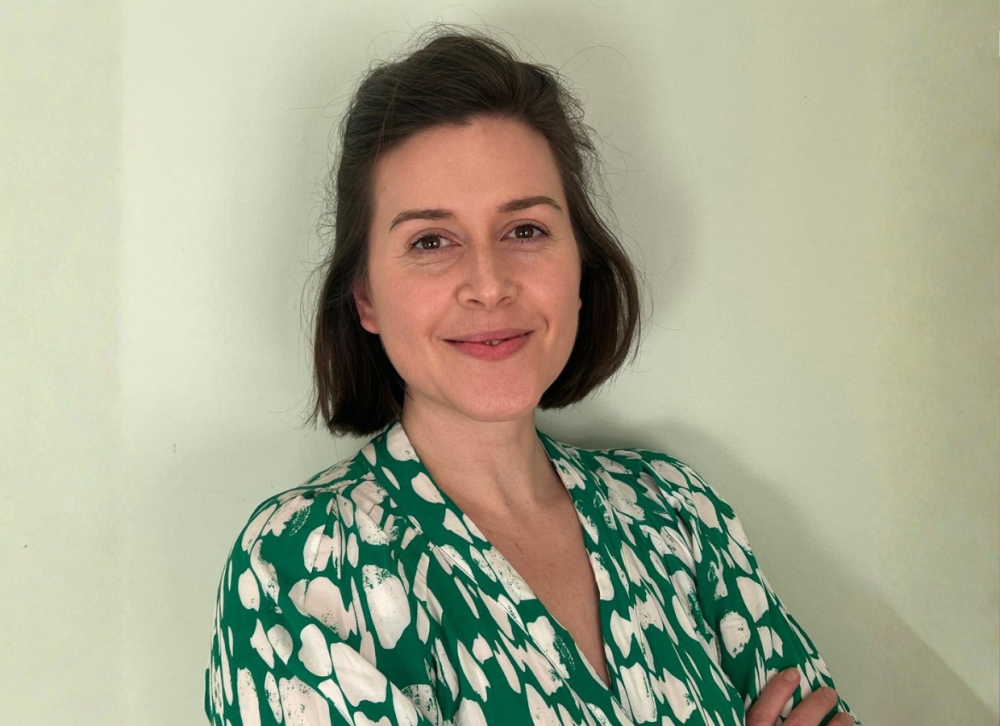
By Dr Fran Conti-Ramsden, clinician at Guy’s and St Thomas’ NHS Foundation Trust, academic at King’s College London, and chief medical officer of MEGI Health.
A woman gives birth. A few days later she goes home, often with a bag of medication for her blood pressure, and then, very often, very little structured follow-up for her heart (cardiovascular) health.
In my clinical work, and through our collaboration with Action on Pre-eclampsia, I see and hear about this postnatal cliff edge again and again, and it still shocks me.
We invest a lot of medical care and attention whilst a woman or birthing individual is pregnant, then, at the very moment emerging evidence suggests we have a window of opportunity to modify long-term health, the support falls away.
That cliff edge is a symptom of a deeper issue: we have come to treat “women’s health” as a synonym for reproductive health. Pregnancy, periods and fertility, important as they are, have crowded out everything else.
Yet the conditions that do most to shorten and limit women’s lives are not reproductive at all.
Cardiovascular disease is the leading cause of death in women worldwide, and it is still too readily thought of as a man’s problem.
Heart disease in women is more likely to be missed and under-treated, in part because for decades women were under-represented in the research that built our knowledge.
Pregnancy makes this vivid.
Conditions such as pre-eclampsia are not only risks to be managed for nine months; they are early warnings about a woman’s future, markers that she is more likely to develop heart disease and high blood pressure in the years to come.
We have the knowledge to act on that. What we mostly do instead is discharge her and look away.
This is exactly the kind of problem better tools should help us solve: spotting risk earlier, supporting women and their clinicians through the vulnerable postnatal window, and providing continuity where the system currently provides a drop due to lack of capacity.
Artificial intelligence and digital health have real potential here; in risk prediction, in monitoring blood pressure at home, and in helping stretched clinicians know who needs attention and when.
And yet this is not where most of the energy is going.
It is far easier to build, fund and scale an app that tracks a cycle than a tool that changes the trajectory of a woman’s heart.
So, innovation clusters at the lighter, lower-risk end of innovation, while the conditions that actually kill and disable women, and moments like the postnatal cliff, stay under-served.
Closing the women’s health gap could add at least a trillion dollars to the global economy each year, the World Economic Forum estimates, but the bigger prize is women living longer, healthier lives.
None of this means technology is a cure in itself. It is a tool, and a tool built carelessly can do harm.
Because women have been under-represented in medical data, systems trained on that data can quietly carry the same blind spots forward, deepening inequalities rather than closing them.
Responsible innovation, with clinical-grade evidence, privacy and equity designed in from the start, and tools built around real clinical pathways rather than bolted on afterwards, is not a brake on progress.
It is the only version of progress worth having.
I am optimistic, because a serious community is forming around exactly these questions and the appetite to get it right is real.
It is why, at MEGI, we are bringing clinicians, researchers, founders, regulators and investors together for our AI × Women’s Health summit on 25 June.
If we keep our focus on the conditions that matter most to women’s lives, and build the tools to meet them responsibly, the postnatal cliff edge could become something else entirely: the moment the system finally catches her and delivers preventative healthcare.
AI × Women’s Health: Innovation, Challenges and Opportunities summit is taking place on Thursday 25 June 2026 at the London Institute for Healthcare Engineering. The event is free and is fully booked and operating a waiting list. Join the waiting list here.
About Dr Fran Conti-Ramsden
Dr Fran Conti-Ramsden is a UK Obstetrics and Gynaecology registrar and Chadburn Clinical Lecturer at KCL passionate about transforming women’s health through technology and innovation.
Combining NHS clinical experience with an MRC-funded PhD, recent NHS Clinical AI fellowship and commercial role as Chief Medical Officer at Megi health, she works at the intersection of clinical medicine, data science, technology and AI.
Her current programme of research focuses on the intersection of healthcare and technology; leveraging advances such as smartphone based vital signs capture and large language models to drive forward scalable innovation in maternal cardiovascular care.
She has published over 20 peer-reviewed manuscripts (See gScholar, h-index 12), including award-winning work recognized by Hypertension Journal.
She was awarded an AI visionary award in 2025 by Health Innovation KSS was the recipient of the 2024 International Society for the Study of Hypertension in Pregnancy Zuspan prize.



By Women As One
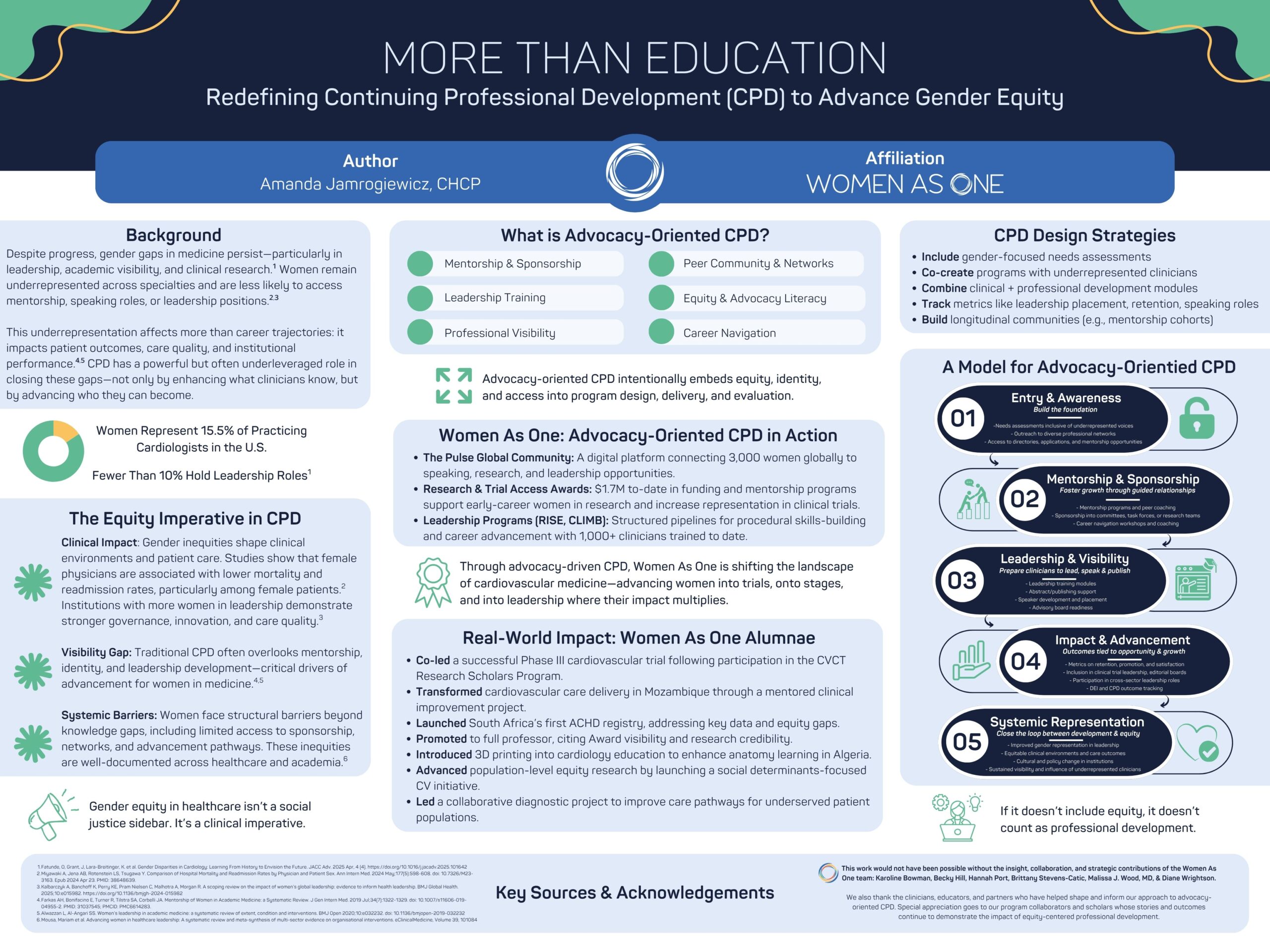
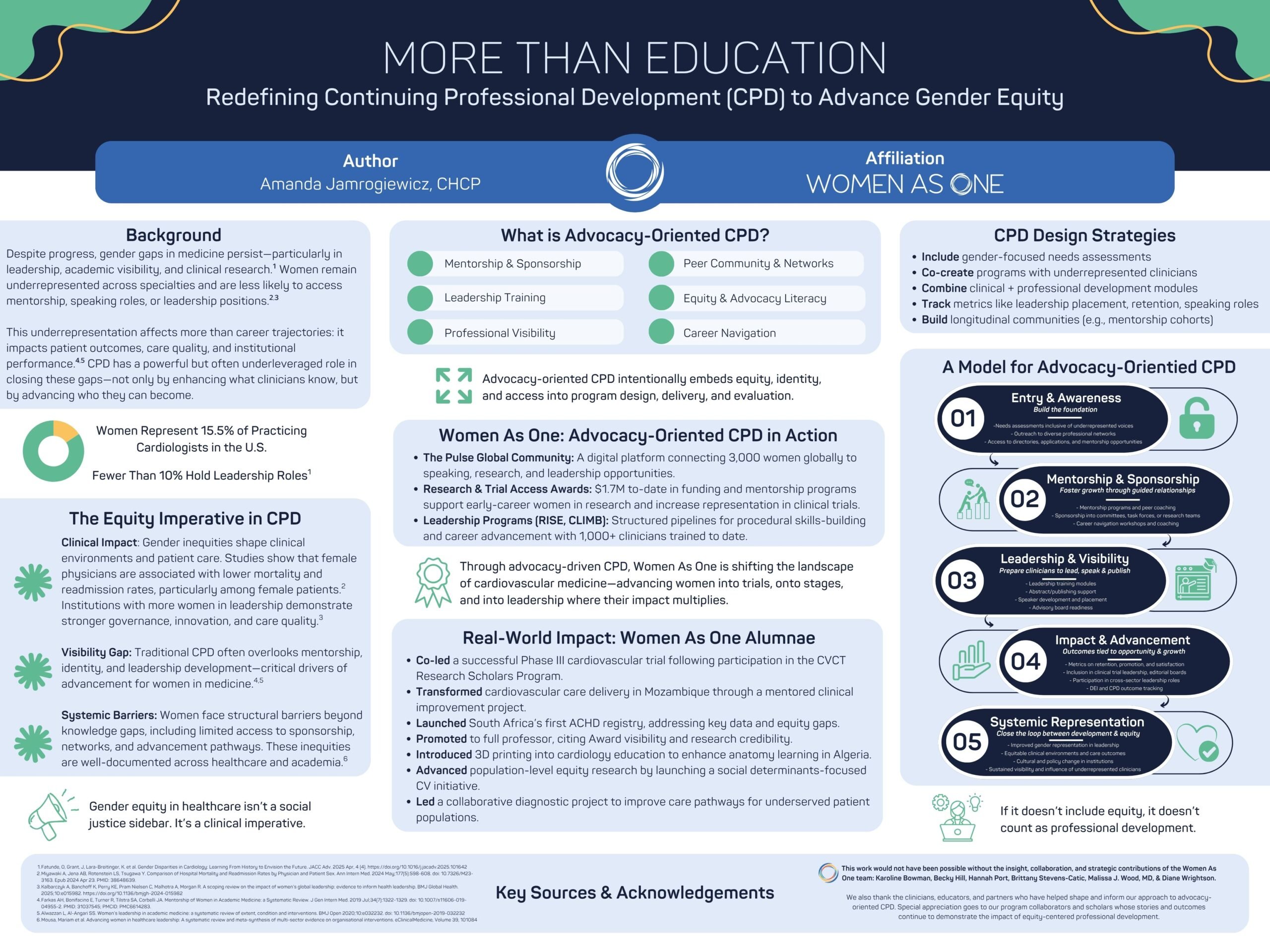
At the 2026 Alliance Annual Conference, Women As One presented a poster that asked a powerful question: What if continuing professional development (CPD) did more than teach clinical knowledge— and instead helped shape the future of the workforce itself?
For decades, professional education in medicine has focused primarily on what clinicians know and how they practice. That work remains essential.
But persistent gender gaps across cardiology—from leadership positions to research participation and speaking opportunities—demonstrate that knowledge alone is not enough to ensure equitable advancement.
To truly strengthen the field of cardiology, professional development must also support who clinicians become, the opportunities they access, and the voices that shape the future of cardiovascular medicine.
Our poster, More Than Education: Elevating Equity and Identity Through CPD, explores how a new model of advocacy-orientated CPD can help close these gaps.
Advocacy-orientated CPD expands the traditional model of professional education. In addition to building clinical expertise, it intentionally supports the structural elements that shape career advancement—mentorship, sponsorship, leadership development, visibility, and professional networks.
By integrating these elements into professional education, CPD can become a powerful engine for advancing equity—and ultimately improving patient care.
Why this matters
Gender inequities in medicine are not simply workforce issues. They influence research priorities, clinical trial representation, leadership decision-making, and ultimately the care patients receive.
When women clinicians have equitable opportunities to lead, research, and shape clinical practice, the entire healthcare system benefits.
Yet structural barriers remain. Women physicians often have less access to mentorship, sponsorship networks, and leadership pathways—factors that are critical for career advancement.
This is where advocacy-orientated CPD comes in.
By intentionally designing programs that foster mentorship, build leadership skills, create visibility, and support long-term professional growth, organizations can help ensure that the next generation of cardiovascular leaders reflects the diversity of the patients they serve.
Turning opportunity into impact
Since its founding, Women As One has supported thousands of women cardiologists across more than 100 countries, expanding access to mentorship, research opportunities, and leadership development.
Through programs like CLIMB, RISE, Mentorship Awards, and our global digital community, The Pulse, thousands of women cardiologists have gained mentorship, leadership training, and opportunities that accelerate their careers and expand their influence.
Today, the outcomes of these programs are shaping the field in tangible ways:
- Women As One alumnae are leading clinical trials and advancing cardiovascular research
- Clinicians supported through our programs are building registries, launching new care models, and expanding access to specialized care
- Women cardiologists are gaining greater representation on speaker panels, advisory boards, and leadership pathways
- A global community of more than 3,000 women cardiologists is strengthening collaboration, mentorship, and visibility across the profession
These outcomes demonstrate what becomes possible when professional development goes beyond traditional education to intentionally support leadership, identity, and community.
A call to the cardiovascular community
Advancing equity in cardiology is not the responsibility of one organization—it requires a collective effort across the entire ecosystem of clinicians, educators, institutions, and industry partners.
For women cardiologists, this means engaging in the programs, mentorship networks, and leadership opportunities that help shape the future of the field. Whether through CLIMB, RISE, research initiatives, or participation in The Pulse community, your involvement strengthens a growing movement dedicated to advancing women in cardiology.
For our partners and supporters, this work demonstrates the powerful impact that strategic investment in equity-focused professional development can have on the workforce and the patients we ultimately serve.
Together, we can redefine what professional development looks like in medicine—not just as a pathway for learning, but as a catalyst for leadership, opportunity, and lasting change.
Explore the poster
We invite you to explore the poster below (click here to download it) to learn more about the evidence, framework, and real-world impact behind this work—and to join us in continuing to expand what professional development can achieve for the future of cardiovascular medicine.
Learn more about Women As One at womenasone.org
Mental health
What Maternal Mental Health Month reveals about where postpartum support actually breaks down


By Morgan Rose, chief science officer at Ema, and Lauren Scocozza, vice president of product at Willow
May is Maternal Mental Health Month, and every year it surfaces a familiar set of statistics: 1 in 5 new mothers experiences postpartum depression or anxiety, most go unscreened, and the majority who are screened don’t receive adequate follow-up care.
The conversation is important. But the numbers obscure something that anyone who has worked in this space knows to be true: postpartum mental health distress rarely arrives with a label.
It arrives as exhaustion. As “I’m not sure I’m doing this right.”
As a question about supply, pumping, whether it’s okay to feel this disconnected from something you were supposed to love immediately.
Willow integrated Ema, AI built for women’s health, with the goal of closing the maternal care and data gap.
The pattern mentioned above appears consistently in Ema’s conversational data through the Willow app.
A mother reports mastitis symptoms.
Ema walks her through the clinical presentation, confirms she should keep pumping, and then she questions if she is using her pump correctly. In the same thread, within a few exchanges, she says she’s “feeling too sad.” Then: “I don’t know. I think I’m depressed. I am not enjoying my postpartum.”
She did not come to the app to talk about her mental health.
She came about a breast infection. The mental health disclosure came through the already-opened door.
The Weight Underneath the Technical Question
New motherhood involves an enormous amount of problem-solving at a time when cognitive and emotional reserves are depleted. The pump has to work. The baby has to eat. The body has to recover.
Work comes back. Sleep doesn’t. Feeding their babies requires skill, and the learning curve sits atop it all.
What Ema’s conversation data shows is that the emotional load of navigating these challenges is not separate from mental health. It is mental health.
When a mother writes, “I’m postpartum and overwhelmed and tired,” and then, in the same breath, asks about flange sizing, she is telling us what the postpartum experience actually feels like from the inside.
The technical question and the emotional state are one and the same.
Breastfeeding carries particular weight here.
The desire to breastfeed, the guilt when it doesn’t go as planned, and the identity questions that come with feeding choices are not peripheral to the postpartum mental health conversation.
In our conversations, women navigating supply concerns often reveal deeper anxieties: about whether they are good mothers, whether their bodies are “working,” and whether the difficulty they are experiencing means something about them.
These are the signals worth asking about.
What Screening Looks Like in Practice
Ema is trained on the Edinburgh Postnatal Depression Scale and is equipped to offer the EPDS when a conversation warrants it.
The value is being present for the moment when a woman is ready to name what she’s feeling.
That moment rarely comes as a direct request for mental health support. It comes when someone is already in a conversation about something else, and something shifts.
A woman dealing with mastitis says she feels sad. A woman worried about supply says she doesn’t feel like herself. A woman managing the logistics of going back to work with a wearable pump says she’s not sure she can keep up with it all — and the “it all” isn’t about the pump.
Ema is designed to hear that. She doesn’t stay on the clinical or technical track when the conversation moves. She follows the person.
And when the moment is right, she offers the screening as a natural next step.
In one exchange, a woman was offered the EPDS after disclosing depressive feelings. She declined.
Ema acknowledged that and asked if she wanted to talk about something else. That’s the right response. The offer was made without pressure. The door stays open.
Sometimes what matters most is that someone asked at all.
The Continuity Problem
One of the most persistent structural failures in maternal mental health care is fragmentation.
A woman sees her OB at six weeks postpartum for a brief screening. She may get a call from a nurse. She may be given a referral she never follows up on because she doesn’t have the capacity to navigate a new care relationship while managing a newborn.
The clinical touchpoints are too few, too far apart, and too often siloed from one another.
The postpartum period lasts far longer than the six-week checkup implies. Mental health symptoms can emerge weeks or months after delivery, shift in character over time, and interact with physical challenges in ways that don’t fit neatly into any single provider’s lane.
A lactation concern becomes an anxiety spiral. A supply drop triggers a grief response. A difficult return to work surfaces a postpartum depression that wasn’t fully recognized at six weeks.
Ema sits inside these moments because she’s embedded in the platform women are already using. She doesn’t require a separate appointment, a referral, or the cognitive bandwidth to seek out a new resource.
She’s in the Willow app that mom is already using multiple times a day to manage her pump.
When Ema identifies a woman who may need more support than she can provide, she routes to the right resource — whether that’s a SimpliFed lactation consultant for feeding-related concerns or a clinical professional for mental health follow-up.
The conversation leads to the handoff with someone who can do more.
What the Month of May Means for the Rest of the Year
Maternal Mental Health Month is a useful moment of attention. The awareness campaigns, the social media posts, and the statistics shared in newsletters matter.
But the gap in postpartum mental health care is not really an awareness problem.
Most people in the perinatal space and beyond know the statistics. The problem is access, timing, and continuity.
AI doesn’t close that gap on its own.
What it can do is be present in the spaces where women already are, at the times when they need something, and attentive enough to recognise that a conversation about a pump, a clogged duct, or a supply concern is also a conversation about how someone is doing.
The question behind the question is often the more important one.
For Willow, the conversation data Ema generates is a map of where mothers are struggling, what they reach for when they need help, and when they are ready to say more than they came to say.
That information, used well, shapes better resources, better onboarding, and a more connected experience across the full arc of the postpartum year and beyond.
Building the infrastructure to support maternal mental health is a year-round project.
Willow is doing one part of that, and the conversations happening on the Willow platform every day are evidence that women want support that meets them where they are… in their app, in their moment, without having to ask for it twice.
About the authors
Morgan Rose is Chief Science Officer at Ema, an AI platform for women’s health. Ema partners with healthcare organisations and femtech companies to deliver clinically grounded AI support across the perinatal journey.
Lauren Scocozza is the Vice President of Product at Willow Innovations, Inc. For women by women, Willow is building a maternal care platform to address the interconnected challenges of postpartum.











 Insight3 weeks ago
British women among angriest in Europe, health survey reveals

 Menopause4 weeks ago
Women still being failed when they reach menopause, experts say

 Menopause3 weeks ago
Apple Health adds menopause and perimenopause tracking
 News2 weeks ago
Femtech World Awards 2026: Winners revealed
 News4 weeks ago
Three menopause innovators shortlisted for Femtech World Award

 News3 weeks ago
Menopause workplace toolkit launched to help UK employers support staff

 Features3 weeks ago
Elation Health acquires EHR startup Aster
 News3 weeks ago
Endometriosis documentary profiles stars including Marilyn Monroe and Amy Schumer