




Special
The 6 best period tracking apps of 2024
Whether you’re looking for a way to monitor your ovulation or you simply want to map your periods, look no further than these five apps

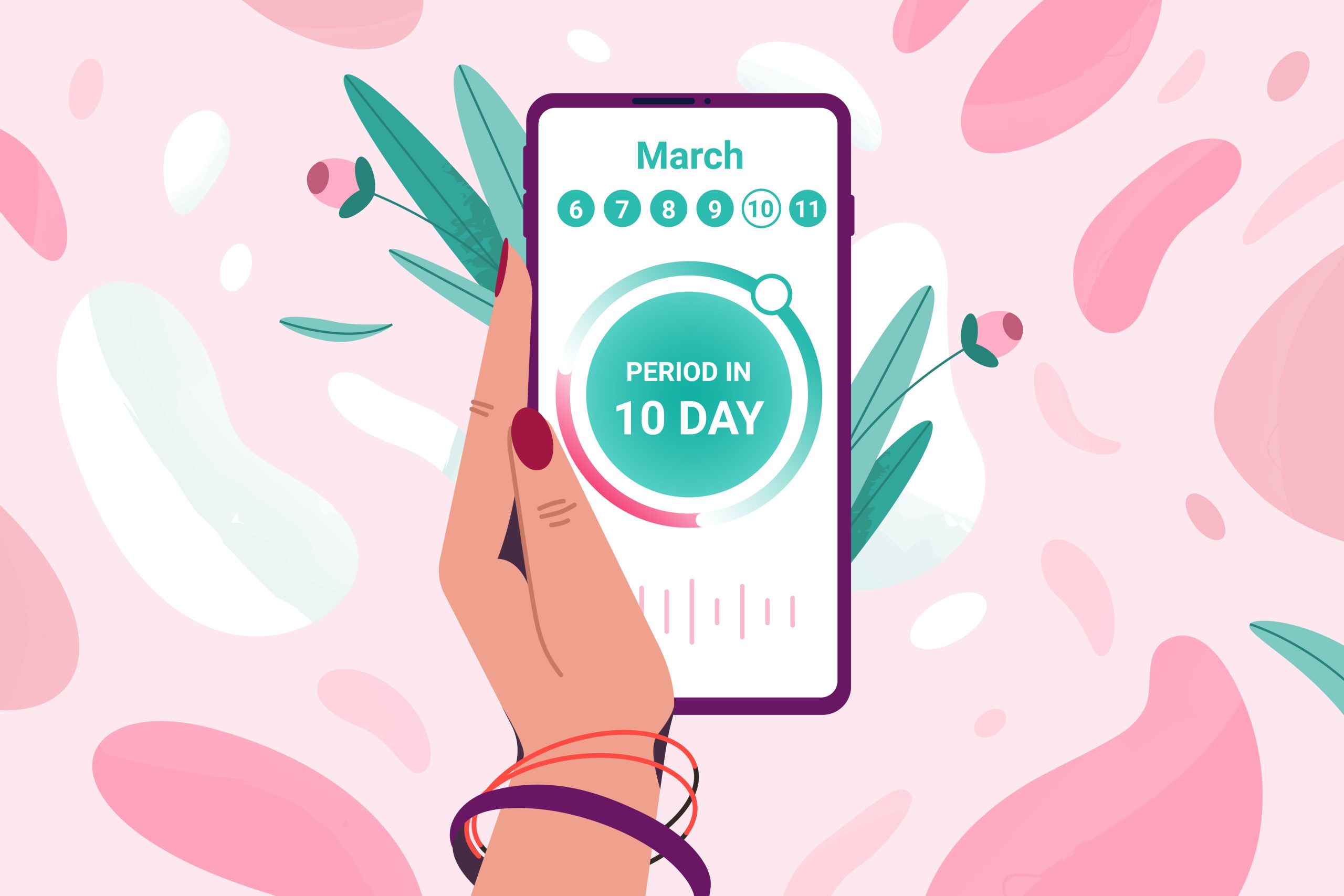
Period tracking apps have gained significant popularity in recent years. As awareness around menstrual cycles has increased, so has the demand for tools to help monitor and manage them.
Data suggests that more than 50 million women worldwide use apps to track their menstruation. But is an app really necessary? Can’t a reminder on your phone’s calendar do the same thing?
Well, tracking your menstrual cycle is crucial for several reasons. Firstly, it helps you better understand your body and aids in predicting and managing fertility. Knowing when you’re ovulating can be invaluable if you’re trying to conceive or avoid pregnancy.
Secondly, it can help you manage your menstrual symptoms. Many women and girls experience fluctuations in mood, energy levels and physical symptoms throughout their cycle. By tracking how you feel, you can anticipate when symptoms might arise and identify patterns, which in turn will help you take proactive steps to manage them.
Tracking your menstrual cycle can also provide insights into your overall health. Irregularities in the menstrual cycle could be indicative of underlying health issues such as hormonal imbalances, thyroid disorders, or polycystic ovary syndrome (PCOS).
We know choosing which app to download can be overwhelming. That’s why we’ve put together a list of six of the best ones we’ve come across.
Note: all are free to download, but some charge extra for premium features.
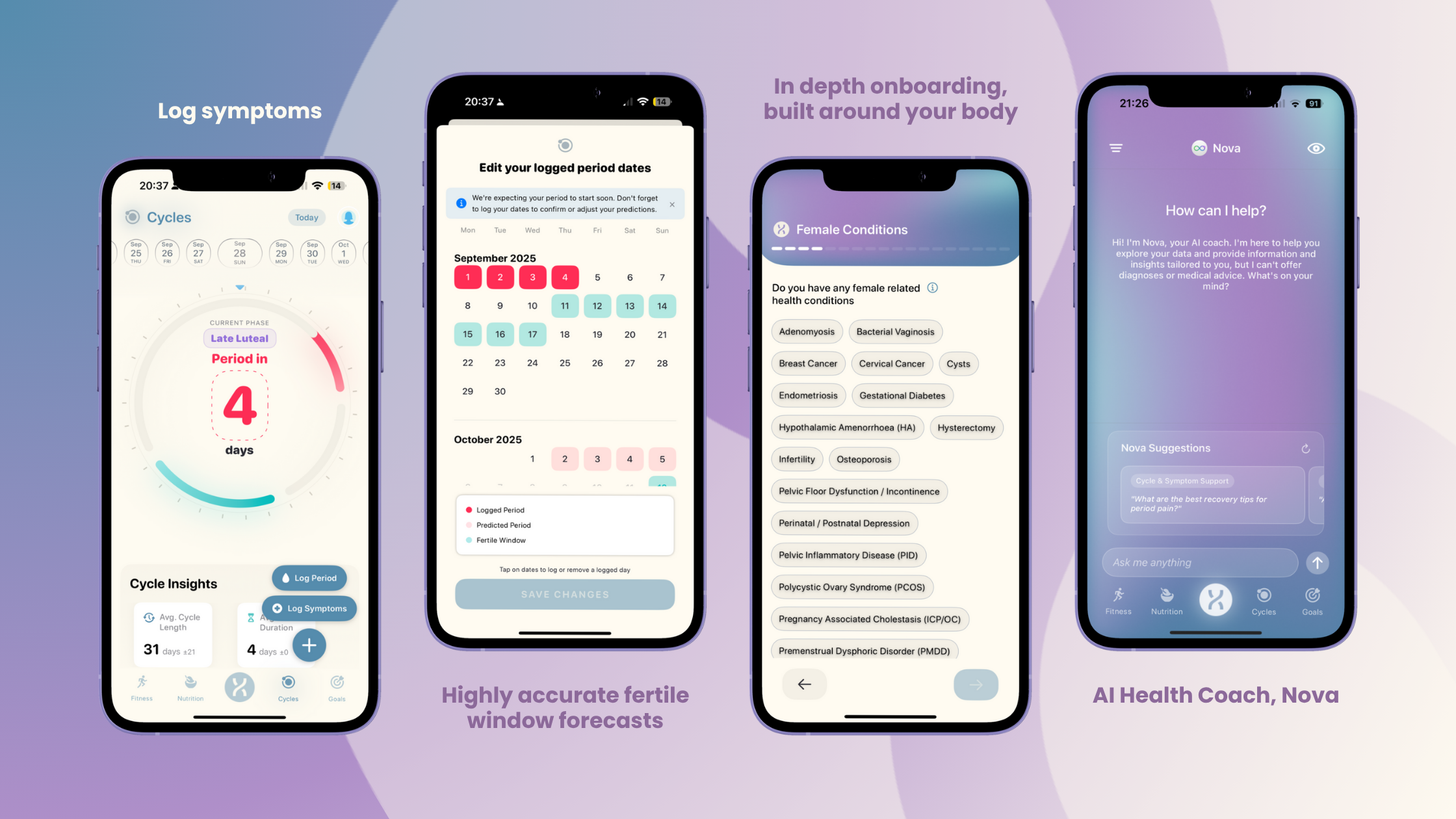
Nexus isn’t just a cycle tracker, it’s a holistic women’s health coach which includes a cycle tracker but also nutrition, exercise and more to give you a more comprehensive experience when engaging with Nova, your AI coach
Nexus bridges this gap with a female-specific onboarding process offering over 50,000 unique combinations of personalised wellness insights.
With Nova, users also have access to an AI coach that truly knows them, offering adaptive, actionable guidance grounded in science and tailored to each woman’s unique physiology and life stage.
The vision behind Nexus is to give women control over their own health data, using it to improve conversations with healthcare providers, reduce medical gaslighting and accelerate diagnosis times through advocacy and education.
At the heart of Nexus lies a proprietary large language model (LLM) and peer-reviewed health database, built specifically for women. This architecture blends medical research, clinical guidelines and user data to generate precise recommendations, far surpassing the capabilities of off-the-shelf AI systems.
- Built by medical professionals and scientists. Our team of experts have built, reviewed and tested this product.
- AI-powered health coach Nova, built from scratch to handle the bias and hallucinations for women’s health with AI
- Personalized experience: Nexus adjusts predictions and recommendations to each user’s unique cycle and health characteristics.
- Nexus is free with no upsales or features behind the pay wall.
- 5* reviews in the App Store.
- Your data is private. We don’t share your personal data with the AI model or any 3rd parties.
Nexus is only available on the UK Apple app store currently. You can download the app here or join the international / Android waitlist here. Coming early 2026.
Flo
Flo’s mission is to build a better future for female health by helping to harness the power of body signals. Flo’s team of 100+ doctors and health experts create evidence-based medical articles, tips and recommendations designed to improve your health.
The app uses AI so you can easily know when you ovulate, track your period and view future cycles. In Flo, you can track more than 70+ symptoms and events for more personalised tips, relevant content and even more precise cycle and ovulation predictions.
Flo also offers Pregnancy Mode which provides you with the information you need during pregnancy. You will be able to receive insight each day into how the baby is developing, what happens in your body as a mum-to-be, which supplements and foods you should include in your diet and which you should avoid, how to recognise the approaching labour, what you could expect from the postpartum period and much more.
Within the app you can also discuss sensitive topics, questions and get support from other Flo community members anonymously.
Flo ensures that your data is safe with end-to-end encryption, secure access (Face or touch ID), anonymous mode (no name or email) and control over what you share. Your data won’t be shared with third parties.
Clue
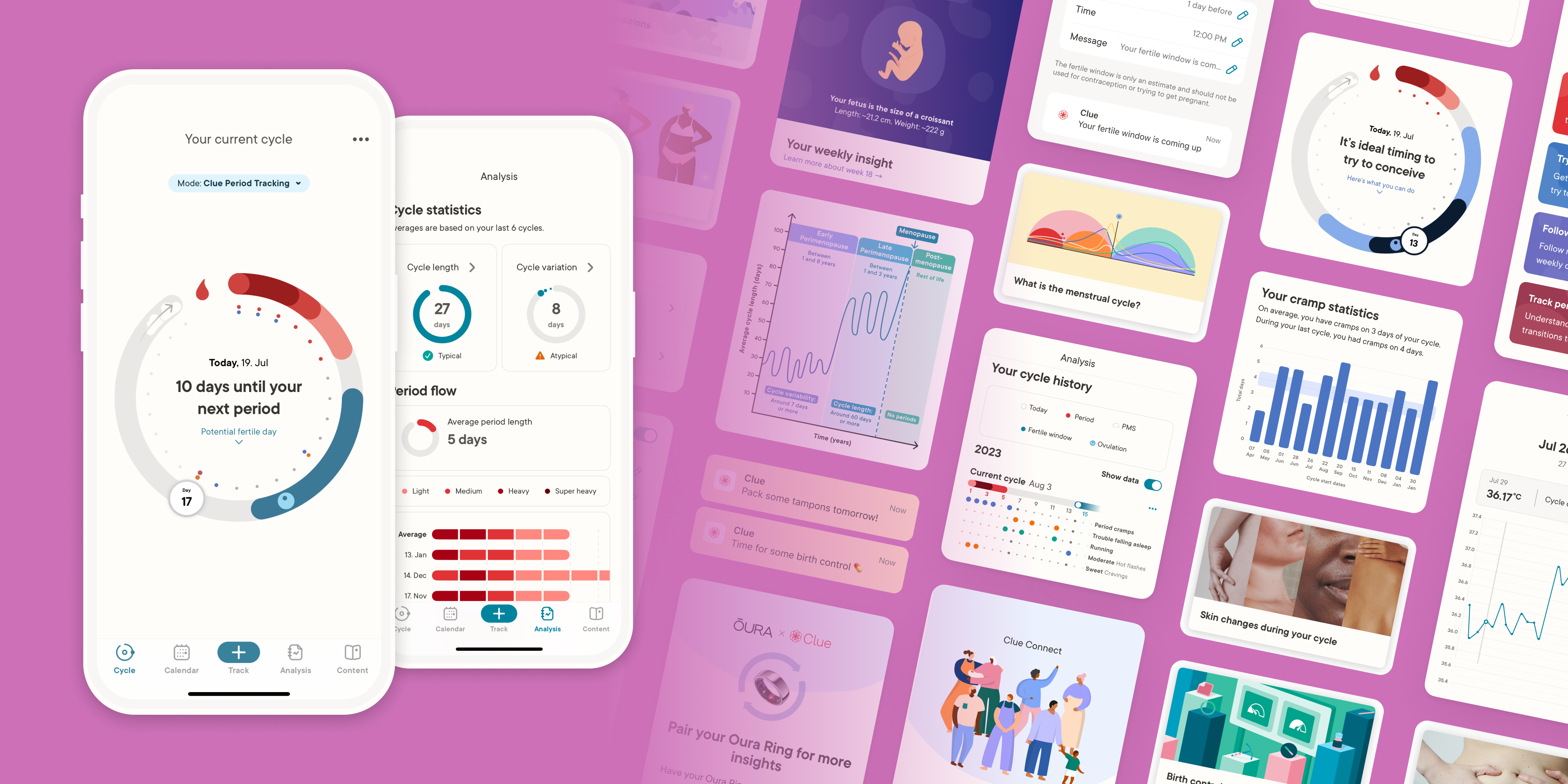
Clue is a Berlin-based, women-led menstrual and reproductive health app that harnesses the power of full cycle intelligence to help you understand your body’s inner workings, beyond bleeding.
What do people who use Clue love the most? No pink. No myths. And no taboos. Clue is an intuitive, science-based, data-driven cycle health tracker with 100+ different tracking options and a powerful algorithm to help you live a life more in sync with your full cycle – not just to predict your period (although it does that too!).
Loved by over 10 million monthly active users across 190+ countries, and available in 20+ languages, the Clue app intuitively guides you through each cycle, change, and choice. From general cycle health awareness and education to fertility, pregnancy, and even navigating perimenopause.
New in 2024, is Clue’s My Health Record feature which uses de-identified data for good, to help close the diagnosis gap for female health conditions.
You can enter confirmed diagnoses for up to 21 different health conditions including endometriosis, polycystic ovary syndrome (PCOS), premenstrual dysphoric disorder (PMDD), uterine fibroids, bleeding disorders, anxiety disorders, and more. With this feature, the Clue community is collectively building an unprecedented dataset linking confirmed diagnoses and tracked cycle data to enable impactful research on the most commonly misdiagnosed and under-researched female health conditions.
The Clue app is free to download and you can unlock deeper insights and additional personalised modes like Clue Conceive, Clue Pregnancy, and Clue Perimenopause with the premium subscription, Clue Plus.
For more, visit helloclue.com.
luna
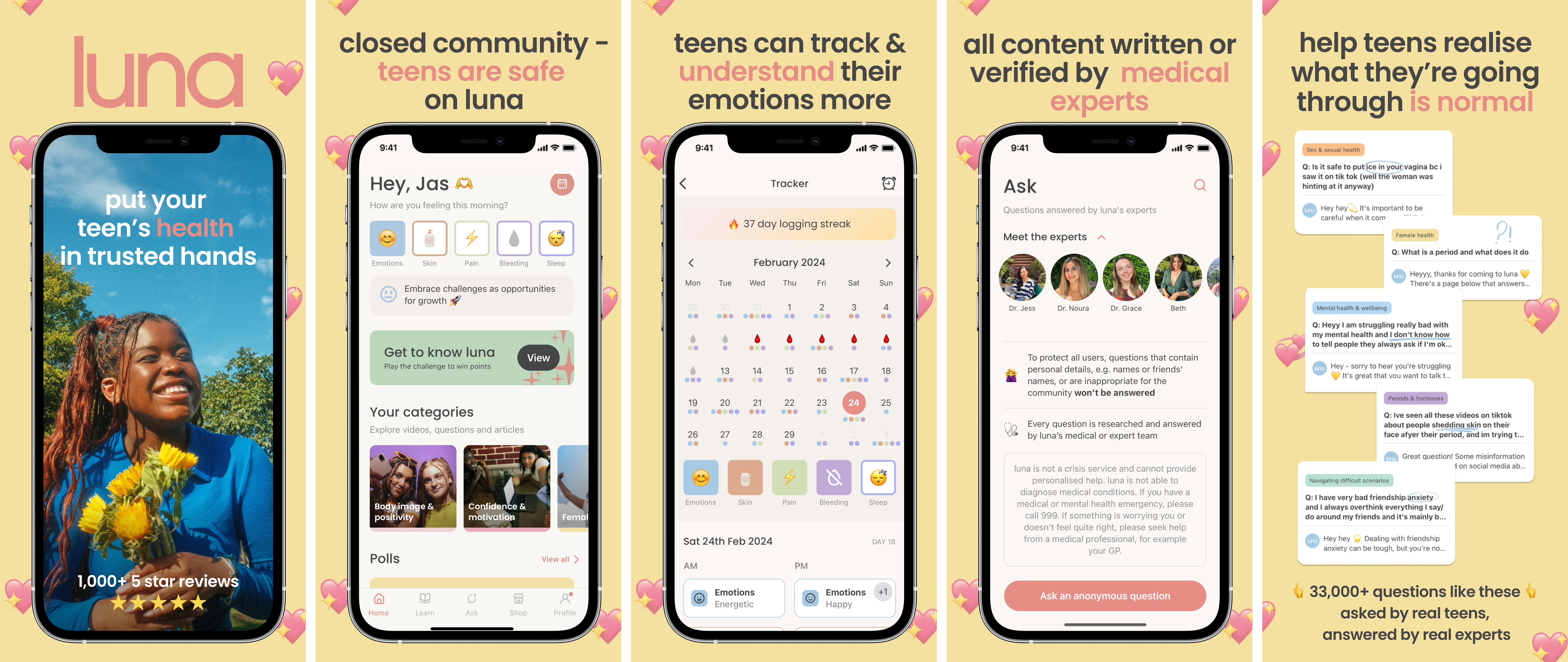
luna is on a mission to be the go to digital health and wellbeing resource for teens.
Taking a holistic approach to health and wellbeing, luna’s objective is to educate, empower and support teens in all the tricky situations they find themselves in – from period leaks to skin problems and toxic friendships.
On luna (‘we are luna’ on the App Store), teens can track their periods, moods, skin, sleep and pain symptoms, and they’ll receive personalised insights and recommendations based on that.
Alongside period tracking, teens can ask anonymous questions, and learn about topics tailored to them. Behind the articles, videos and answers to questions is a team of doctors and safeguarding experts, who make sure content is medically accurate and appropriate for a teenage audience – there’s no user generated content on luna, so parents know their teen is in safe hands.
This app is designed to help teen girls own and understand their cycles, ensuring they know what steps to take when they feel something isn’t normal for them personally – luna equips them with the right tools to open lines of communication with parents, and seek support when they need.
There are also lots more features designed to spark joy and keep the app sticky – whether that’s a mood-boosting quote based on what members log, quizzes to help cement learning, or polling on topics they might want to share their thoughts on.
All of these features mean luna is much more than just a teen-friendly period tracker and is an app that parents and daughters alike will love.
For more, visit weareluna.app
Premom

Premom blends period tracking with powerful ovulation and hormone insights—ideal for anyone who wants to get in sync with their body or planning for pregnancy.
Going beyond basic period trackers, Premom uses real data like ovulation tests and basal body temperature (BBT) to personalise predictions and help you better understand your fertile window.
With a digital ovulation test reader, auto BBT-charting, and an intuitive period calendar, tracking is simple and accurate.
Developed by the creators of Easy@Home ovulation tests, Premom helps you visualize your cycle and spot changes month to month.
Whether you’re tracking your period or planning a pregnancy, the app adapts to you. Over 1 million users have gotten pregnant using Premom*.
FastPass™ to Pregnancy offers a clear, guided path to conceive faster with smarter predictions, weekly expert check-in videos, and tailored cycle tips, all backed by your data.
The app’s algorithm builds a personalized fertility timeline that adjusts to your cycle patterns and gets more accurate the more you log.
Need help interpreting your cycle? Use Premom’s Fertility AI Pro for health insights based on your unique data patterns and symptoms—so you can get guidance whenever questions come up.
Already expecting? Premom seamlessly switches to Pregnancy Mode offering weekly updates, symptom tracking, and expert tips to support you through every trimester.
For deeper insights, Premom Premium unlocks advanced reports, expert-led webinars, and extra tools to help you feel more confident with every cycle.
The Premom app is free to download, with the option to upgrade for even more support on your reproductive health journey.
Learn more at www.premom.com.
*Over 1 million users logged pregnancy or positive pregnancy test results while using the Premom App 2023
WomanLog
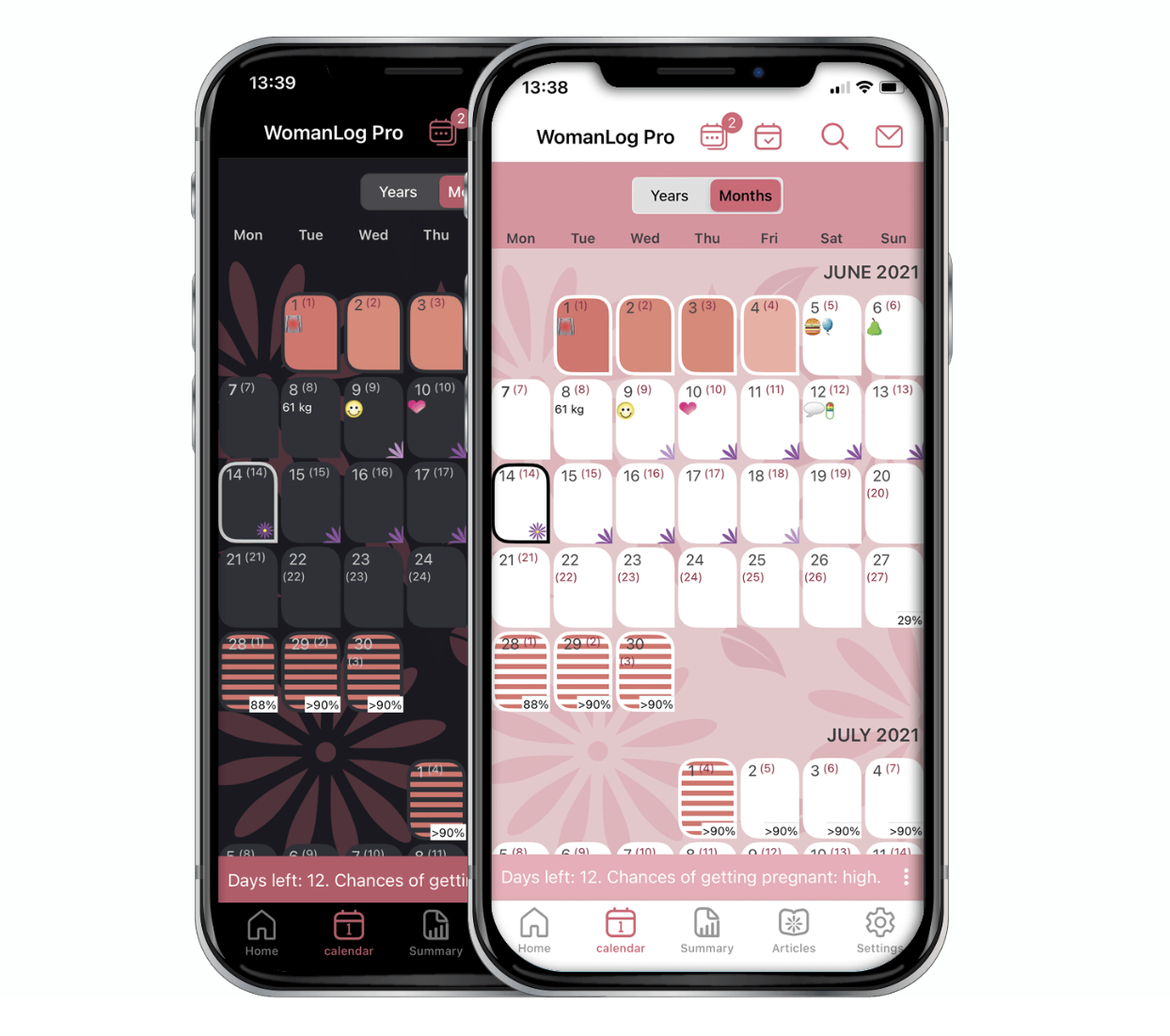 There are dozens of complex processes that take over a woman’s body every day. Why not be aware of them and be prepared for everything?
WomanLog is an easy-to-use period tracker app that helps you do just that. With an encyclopedia of more than 200 symptoms that may occur during a woman’s menstrual cycle, it is much more than a digital calendar that tracks menstruation cycle, sex life and contraception.
The app has three modes: period tracker, pregnancy and menopause mode. WomanLogBaby app helps to track every step of baby’s daily activities while “Intelligent Assistant” with cutting-edge Artificial Intelligence and Machine Learning technology offers even more detailed analysis.
WomanLog also provides an extensive library of articles on sexual wellbeing, menstruation, the ins and outs of pregnancy and other health-related issues.
The Latvia-based start-up is among the leaders in the global market for more than 10 years. Translated into 30 languages, it has more than one and a half million monthly active users worldwide and more than 20 million installs.
Data safety in the key point of every app, and WomanLog is the leader with the highest security level that meets all the GDPR standards.
Moreover, the web version of WomanLog, available without even signing-in, features online calculators that count the days left until your next period or fertility windows within seconds.
For more, visit womanlog.com.








Former US first lady Dr Jill Biden visited Imperial College Healthcare NHS Trust and Imperial College London to explore work on women’s health and antimicrobial resistance.
The visit was hosted by professor the Lord Darzi of Denham, who chairs the Fleming Initiative and directs Imperial’s Institute of Global Health Innovation.
Dr Biden, chair of the Milken Institute’s Women’s Health Network, spoke about the impact scientists, clinicians, innovators and investors can have on improving women’s healthcare.

Dr Biden stressed the importance of “collaboration, prevention and education” in improving women’s health globally.
At the museum, Dr Biden and Esther Krofah, executive vice-president of health at the Milken Institute, heard about the worldwide significance of the discovery and the contribution of women who, during wartime Britain, grew penicillin in bedpans to support early experimentation.
The discussion also explored how AMR is a key women’s health issue, with women disproportionately affected in low and middle-income countries, and in high-income settings where women are more likely than men to be prescribed antibiotics.
Dr Biden was shown an architectural model of the Fleming Centre in Paddington, which will bring together research, policy and public engagement to address AMR worldwide.
The second part of the visit brought together Imperial clinicians, researchers and innovators for a roundtable on women’s health priorities, including improving diagnosis, equity in maternity care and support during the menopause transition.
Participants highlighted wide variation in the quality of care for conditions affecting women and called for fairer access to services, with the postcode lottery named as a priority to address.
Professor Tom Bourne, consultant gynaecologist and chair in gynaecology at Imperial’s Department of Metabolism, Digestion and Reproduction, described how AI could improve diagnostic accuracy for conditions such as endometriosis.
Equity emerged as a central theme.
Professor Alison Holmes, professor of infectious diseases at Imperial College London and director of the Fleming Initiative, highlighted persistent gaps in women’s representation in clinical trials, including antibiotic studies, which limits the ability to optimise care and treatments.
Dr Christine Ekechi, consultant obstetrician and gynaecologist at Imperial College Healthcare NHS Trust, drew on national maternity investigations to underline the importance of valid data, meaningful engagement with affected communities and rebuilding trust.
Menopause and midlife health were also identified as priorities for clinical research.
Professor Waljit Dhillo, consultant endocrinologist and professor of endocrinology and metabolism in Imperial’s Department of Metabolism, Digestion and Reproduction, described a new treatment for hot flushes, including for women unable to take hormone replacement therapy, such as those with a history of breast cancer.
The discussion then turned to bringing innovation into health systems. Innovators shared how data and technology are being used to close gaps in women’s health, while noting challenges in accessing funding to grow and scale.
Dr Helen O’Neill and Dr Deidre O’Neill, co-founders of Hertility Health, described predictive algorithms using self-reported data to help diagnose gynaecological conditions at scale.
Embedded into clinical workflows, the technology could reduce waiting times, identify conditions earlier and improve outcomes. They noted how “we have cures for the rarest genetic conditions but don’t even have the answers to common women’s health issues.”
Dr Lydia Mapstone, Dr Tara O’Driscoll and Dr Sioned Jones, co-founders of BoobyBiome, outlined work creating products that harness beneficial bacteria found in breast milk to support infant health.
By isolating and characterising key microbial strains, BoobyBiome has created synbiotics, combinations of beneficial bacteria and the food that nourishes them, to make these benefits accessible to all babies.
Speakers throughout the visit stressed the need to reduce variation in care quality and outcomes for women, strengthen prevention and education, and address power and equity in women’s health.
Professor the Lord Ara Darzi said: “It was a privilege to welcome Dr Biden and the Milken Institute to Imperial to meet some of the outstanding researchers, clinicians and innovators advancing women’s health.
“Imperial’s unique combination of clinical excellence and world-leading research positions us at the forefront of tackling the biggest health challenges facing society and the UK’s ambition for innovation demands nothing less.
“For too long, the health needs of women and girls across their life course have not received the attention they deserve.
“By working together across borders and disciplines, we can transform equitable access to care, accelerate the detection and treatment of disease, and ultimately improve health outcomes for millions of women in the UK and around the world.”











 Hormonal health4 days ago
Major UK study could be a ‘game-changer’ for heavy periods and endometriosis

 Fertility2 weeks ago
Chelsea FC Women to launch first-of-its-kind player fertility fund
 Menopause5 days ago
Quarter of women miss work due to menstual symptoms, survey finds

 Opinion2 weeks ago
anna perimenopause app launches across 39 markets
 Sponsored Content1 week ago
The perfect ‘period pair’: WUKA launches first-ever Teen Starter Kit in Tesco

 Insight6 days ago
Study to tackle years-long delays in endometriosis diagnosis

 Fertility4 days ago
One week left to apply: W Accelerate with Merck KGaA and M Ventures

 Hormonal health2 weeks ago
Coffee linked to healthier body composition and distinct sex hormone changes – study
51 Comments