




Entrepreneur
Can a holistic approach change the way we treat endometriosis? This start-up thinks so
It affects 190 million women around the world, yet endometriosis remains hugely misunderstood


Abdominal pain, heavy bleeding, fatigue and depression are all too well known to those living with endometriosis.
The condition, which the World Health Organization estimates affects one in 10 women and girls globally, can have enormous implications, affecting anything from women’s mental health and quality of life to their education, productivity and relationships.
The impact of it is compounded by a lack of treatment options and knowledge among medical professionals which can lead to repeated surgeries and sometimes infertility.
A study by Aston University found that GPs often lack knowledge about endometriosis, with some saying they’d had scant training in medical school about the condition.
“Endometriosis manifests in the body in a similar way to cancer. There are oncologists who specialise in cancer, but there’s no such thing as an endometriosis doctor,” says Brittany Hawkins, co-founder and CEO of virtual chronic care platform ELANZA Wellness.
“The training a lot of medical professionals have haven’t equipped them properly to allow them to diagnose and treat patients with endometriosis early enough. It’s a failure of the system rather than doctors not caring that much.”
The standard first-line treatment for women with endometriosis is hormonal, specifically progestin-based therapy.
However, research shows the management of endometriosis requires a more holistic approach focused on reducing overall inflammation, increasing detoxification, and attenuating troublesome symptoms.
“It’s not just the public research supporting this holistic approach when it comes to endometriosis,” says Hawkins.
“Top academic centres of excellence in the world use a multimodal approach. However, accessing these centres is very expensive and it’s something most women couldn’t afford.”
Wanting to shake up the treatment and management of endometriosis, Hawkins and her co-founder, Catherine Hendy, launched the first virtual endometriosis centre to help women and assigned female at birth individuals learn about different treatments, meet with specialist care providers and better understand the condition.
The platform, called EverythingEndo, aims to provide patients with a personalised symptom management plan that combines scientific research, individual data and specialist support.
“For too long the majority of people have had their symptoms dismissed or normalised and over 70 per cent of sufferers are now left with unmanaged pain,” explains Hendy.
“Currently, there’s no space to knit together the full and balanced options for people to be able to hear not only clinically, but also in terms of wider lifestyle, and relationships, things they can do to limit and minimise the impact of endometriosis on their lives.
“Our aim is to simplify everything and give patients the tools they need at every stage of their journey.”
But the duo’s mission goes beyond improving endometriosis care. Hawkins says a big part of their work at ELANZA is centred around restoring trust in healthcare and addressing financial barriers to treatment.
“We know many women are gaslit, ending up not wanting to set foot into a medical office and, in some cases, getting their prescriptions from random sources, which can be very dangerous. We want them to have trust in the care they are given.
“In the future, we are also planning to look at different comorbidities. A lot of women [with endometriosis] end up seeing a psychologist if they have depression symptoms, then they would see a gynaecologist and possibly a gastroenterologist but actually, the condition itself is not being addressed as a whole-person issue. This is something we would like to go into.”
While some investors understand the issue, Hendy says many of them still see it as “niche”.
“It’s definitely a challenge to educate people about endometriosis and how under-diagnosed and under-researched it is,” she adds.
“What we often see in the VC space is that if endometriosis is not something that affects the investors themselves or their wives or daughters, they don’t understand it. It’s along the lines of ‘If this hasn’t affected me personally, I don’t think it’s a problem.’
“It’s definitely a harder road than we expected. Fortunately, the right investors do fit with us eventually. It just takes time.”
EverythingEndo is accessible from any device and works either standalone or in complementary tandem with in-office surgical and medical treatments.








Juno Bio has secured US$3.8m to expand its diagnostics platform for vaginal health and reproductive care.
The funding round was led by Ada Ventures, with participation from Artesian, Entrepreneur First and Illumina Accelerator.
The women’s health startup said the seed funding will support the launch of its first CLIA-certified sequencing laboratory in Oakland, California, and a new clinical vaginal microbiome and STI test for healthcare providers.
CLIA certification refers to US laboratory standards for testing human samples used in diagnosis, prevention or treatment decisions.

Dr Leighton Turner, co-founder and chief scientific officer of Juno Bio, said: “The vaginal microbiome is still one of the least understood systems in the body at a clinical scale.
“With our lab, we’re starting to build a measurement standard that clinicians can actually use.
“We believe the level of detail from this kind of testing can meaningfully improve how vaginal healthcare is provided.”
The company is developing precision diagnostics for vaginal health, where patients can experience recurring symptoms, inconsistent diagnoses and treatments based on trial and error.
Juno Bio said bringing testing in-house gives it greater control over the process, from sample handling to results, while allowing it to refine its technology and build what it says is one of the largest datasets focused on the vaginal microbiome.
The vaginal microbiome is the community of bacteria and fungi that naturally live in the vagina. Changes in this balance can be linked to infections, symptoms and wider reproductive health issues.
Juno Bio’s newly launched clinical test examines the wider vaginal microbiome and screens for four common sexually transmitted infections, or STIs.
Rather than looking for a single cause, the test is intended to give clinicians a broader picture of what may be contributing to symptoms.
Juno Bio says this matters because multiple infections can occur at the same time and microbiome changes may be linked to fertility, menopause or recurrent infections.
Dr Anna Powell of Johns Hopkins said: “Vaginal microbiome testing has the potential to significantly reshape how we understand and manage vaginal health, particularly for patients with recurrent or unexplained symptoms.
“While the field is still evolving, advances in sequencing and data interpretation are moving us closer to a future where more personalised, microbiome-informed care can complement existing diagnostic approaches.”
Check Warner, co-founding partner at Ada Ventures, added: “Juno Bio is setting a new standard for how vaginal health is understood and managed.
“What they’ve built at this stage, with this level of capital efficiency, is exceptional.
“We’re proud to support the team as they scale their clinical infrastructure and continue leading innovation in this critically underserved category.”

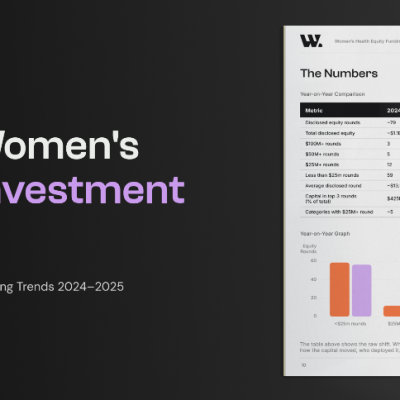
Women’s health companies raised a record $1.55 billion in disclosed equity in 2025, up 41 per cent year on year, according to W Group’s first Global Women’s Health Investment Report, The Road to the Era of Scale.
The report tracks over 500 funding stories and 164 equity rounds across 15 categories and 30+ countries.
Eighty-five companies raised equity in 2025, the highest single-year count on record. But according to the report, the headline figure isn’t the most significant one.
The bigger shift is in where that capital went and how concentrated it was at the top compared to the year before.
The report also points to a brand new investment category that didn’t exist twelve months ago.
SheMed closed a $50 million Series A this year to build a women-specific GLP-1 and metabolic health platform, the first dedicated raise of its kind.
Alongside the momentum, the report identifies one structural risk that could determine whether 2025’s growth holds: a bottleneck at Series A that’s leaving a number of promising seed-stage companies stuck.
Molly Taylor, head of content at W Group, said: “2025 was the biggest year women’s health has ever had, and the most important finding isn’t the headline number.
“It’s that the money has stopped pooling at the top.
“Capital is reaching more companies, more categories and more countries than ever before. The Era of Scale is real. It’s just not finished, and the Series A gap is where it could stall.
“Closing that gap is the highest-leverage move this ecosystem can make in 2026.”
Read the full report: https://wplatform.co/forms/womens-health-equity-funding-trends-report-2026?utm_source=advocacy&utm_medium=ext_email&utm_campaign=2026-q3-health-report-femtech-world



Onto Health has acquired Levy Health, a fertility software company providing precision diagnostics and patient intake for reproductive medicine.
The acquisition, fuelled by Onto Health’s US$20m Series A fundraise in April, supports its plan to build scalable, tech-enabled infrastructure for reproductive medicine.
Onto founder Roohi Jeelani, MD, called it the first of several moves in the company’s expansion strategy in a LinkedIn post, adding that there was “more coming soon”.
She said: “This isn’t just an acquisition, it’s proof of how we’re building Onto: physician-led, tech-enabled, and built to scale without losing the personal touch fertility patients deserve.”
Headquartered in Chicago, Onto Health combines evidence-based fertility care with artificial intelligence-driven diagnostics, clinical automation and longevity science.
AI-driven diagnostics use software to analyse patient information and support clinical decision-making, rather than replace clinicians.
Levy Health, founded in Berlin with US offices in San Francisco, helps medical providers identify endocrine disorders more quickly and helps clinics streamline fertility workups.
Endocrine disorders affect the body’s hormone system, which can influence ovulation, menstrual cycles and fertility.
Co-founder Caroline Mitterdorfer said joining Onto would expand Levy Health’s fertility care tools to more clinics and patients, helping physicians focus on patient care.
Onto opened its first clinic in Chicago in February, with plans for three more in the greater Chicago area.
The company said in April that it would use its new funding, led by Artis and Humania, to support additional operations in the US and expand into the Gulf Cooperation Council.
The Gulf Cooperation Council includes six Arab states bordering the Persian Gulf.










 Diagnosis2 weeks ago
Two “gamechanger” tests set to speed up endometriosis diagnosis on the NHS

 Insight2 weeks ago
Women with PMOS should have annual NHS checks, new guidance says

 Menopause4 days ago
New menopause drug approved for use by NHS in Scotland

 Cancer2 weeks ago
Thousands of women could avoid painful cancer exam with new AI blood test

 Entrepreneur1 week ago
Applications open for the third W Accelerate with Merck KGaA and M Ventures
 Fertility2 weeks ago
Older women face lower chance of fertility treatment working, even with donor eggs, study finds

 News1 week ago
We built Ema like a nurse: Here’s why that matters

 News2 weeks ago
Experts call for regulation of toxic period product chemicals