




Diagnosis
New meta-analysis further supports low re-excisions and high placement accuracy with the Magseed marker

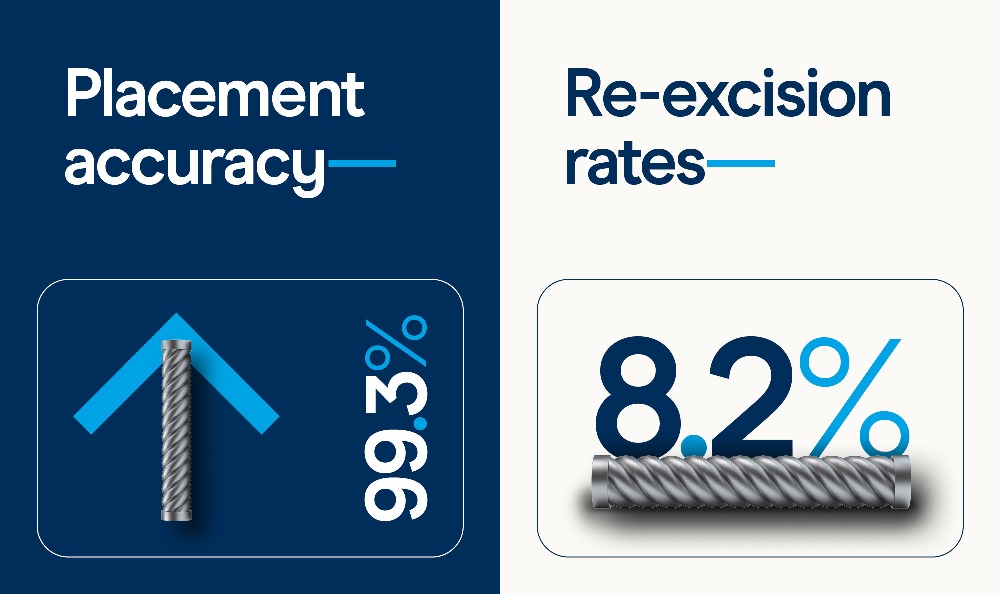
An independent meta-analysis from January 2026, pooling 2,117 patients and 2,176 Magseed marker placements, has reported low re-excision rates (8.2%) and low positive margins (7.6%) when the marker is used to localise non-palpable breast lesions prior to breast‑conserving surgery (BCS).
Al Darwashi et al. (2026) pooled 16 studies to evaluate safety and efficacy outcomes when the Magseed marker was used for preoperative localisation of non-palpable lesions prior to BCS.
The authors reported high placement accuracy, reliable intraoperative retrieval and low rates of positive margins, re-excisions and complications.
In a cohort cited by the review, Moreno‑Palacios et al. (2024) also observed that Magseed marker facilitates less extensive resections compared to guidewires, promising improved cosmetic outcomes while maintaining oncological efficacy.
The key findings
Low re-operation burden: Positive margins occurred in just 7.6% of cases, and only 8.2% required re-excision across the included series.
High placement accuracy: The success rate for Magseed marker placement showed 99.3% positioned within 10 mm of the lesion.
Of note, 96.6% of Magseed markers were placed within an even stricter 5 mm radius.
Reliable retrieval: The pooled intraoperative retrieval success was 99.6% for the Magseed® marker.
“This meta-analysis demonstrated Magseed as a safe and effective preoperative localisation technique for BCS in the management of selected non-palpable breast lesions.” Al Darwashi et al. (2026)
Ready to find out more about the Magseed marker and the Sentimag system?
→ Speak to a Magseed marker expert
Magseed® is a trademark of Hologic, Inc. or its subsidiaries in the United States or other countries. Intended for medical professionals and use in the U.S., UK and the EU only.















Xella Health has launched what it calls the first AI precision health platform built for the XX chromosome.
The company says it aims to address a lack of diagnostic precision and clinical research focused on female biology.
Women make up half of the population and account for 80 per cent of consumer healthcare decisions, but research into women’s health has historically received less funding than male-focused studies.

Kelly Lacob, Xella Health co-founder and chief executive, said: “Women have been trapped in a diagnostic dark age experiencing debilitating symptoms like severe period pain, bloating and GI issues, exhaustion, and brain fog, routinely dismissed by the healthcare system.
“This dismissal results in women being diagnosed four years later than men, on average, for the same conditions, and a seven-to-10-year delay for women to receive an accurate diagnosis for conditions like endometriosis.
Stalling necessary care and treatment results in prolonged suffering with chronic pain, heightened infertility risks, and declining mental health.
Xella is here to replace the systemic medical gaslighting women have endured for generations.
We are handing women the evidence and information they need to advocate for themselves and secure faster, accurate diagnoses before early-stage conditions spiral.”
Xella says its AI examines billions of data points from clinical information and multi-omic biomarkers to assess the probability of more than 130 conditions specific to female biology.
Multi-omic data combines information from several biological areas, including genes, proteins and hormones.
The conditions assessed include polyendocrine metabolic ovarian syndrome, or PMOS, formerly known as polycystic ovary syndrome, as well as perimenopause and endometriosis.
Xella was founded by Lacob, Adriana Dantas and Dr Jesus Ching, who developed the concept while working together on molecular diagnostics at Mammoth Biosciences.
The founders say the platform is designed to provide information about possible underlying causes through advanced testing and long-term care of a kind often available only through expensive concierge services.
They drew on personal experiences to build a service intended to identify small changes in a woman’s biological baseline.
Members complete an initial health questionnaire before having blood taken at a local partner laboratory such as Quest or Labcorp.
A phlebotomist can also visit a member’s home for an additional charge.
The company’s AI analyses biomarker data from genomics, proteins and hormones alongside symptoms, lifestyle risks and medical history.
Xella says this information is used to screen for more than 130 female-specific conditions, including PMOS, Hashimoto’s disease, premenstrual dysphoric disorder, endometriosis and perimenopause timelines.
Hashimoto’s disease is an autoimmune condition in which the immune system attacks the thyroid gland.
Premenstrual dysphoric disorder, or PMDD, is a severe form of premenstrual syndrome that can cause significant emotional and physical symptoms.
The results are processed through Xella’s own dry laboratory, which the company says is certified under the US Clinical Laboratory Improvement Amendments and accredited by the College of American Pathologists.
A dry laboratory analyses data using computing and other non-experimental methods rather than carrying out traditional laboratory procedures.
The findings are turned into a personalised healthcare plan and reviewed with a certified telehealth doctor.
The doctor may recommend immediate clinical action, including personalised hormone therapy or referrals to genetic counsellors, pelvic floor physiotherapists and reproductive endocrinologists.
Reproductive endocrinologists are doctors who specialise in hormones, fertility and reproductive health conditions.
Dantas, co-founder and chief operating officer, said: “Women’s health data has historically been treated in isolated silos – a hormone test here, an ultrasound there – but no one was connecting the dots across the entire biology.
“By tracking unique biological patterns longitudinally across cycles and life stages, we aren’t just providing data, but a clear path forward.”
Xella’s clinical advisers include Dr Allison Kurian, director of Stanford Women’s Clinical Cancer Genetics Program and professor of medicine, epidemiology and population health at Stanford.
They also include Dr Lynn Westphal, a reproductive endocrinology and infertility specialist and chief medical officer of Kindbody.
Xella has received US$4.7m in angel and pre-seed funding from Precursor Ventures, Capital F, Ulu Ventures and Swizzle Ventures.
Other funds and angel investors from healthcare, diagnostics and consumer technology also participated.
Margaret Coblentz, co-founder and general partner of Capital F, said: “Women’s health is one of the highest-momentum categories in the market today, driven by a US$15tn female economy.
“Xella represents exactly how Capital F sees women’s health evolving: deep clinical expertise paired with a consumer-first mindset, and a genuine opportunity to unlock the next generation of healthcare.”
Women with endometriosis or painful periods were four to five times more likely to receive an STI diagnosis, a large Japanese study found.
Endometriosis occurs when tissue similar to the lining of the womb grows outside the womb. Although not strictly a menstrual disorder, it can cause pain, irregular periods and infertility.

The study was led by researchers at the University of Yamanashi and funded by Rohto Pharmaceutical Co.
The analysis examined health insurance claims from more than 3.4m women aged 40 or younger who had at least one healthcare visit during 2023.
Around 260,000 women, or 7.5 per cent of those included, had been diagnosed with endometriosis, dysmenorrhoea or both.
Dysmenorrhoea is the medical term for painful periods or menstrual cramps.
Women with endometriosis, dysmenorrhoea or both were four to five times more likely to have a recorded diagnosis of a sexually transmitted infection, or STI, than women without the conditions.
Diagnoses were significantly more common across every category examined, including chlamydia, gonorrhoea, trichomoniasis, genital herpes and other STIs.
Chlamydia was recorded in 3.5 per cent of women with menstruation-related conditions, compared with 0.7 per cent of those without them.
This represented a fivefold increase and the largest difference in prevalence between the two groups.
Gonorrhoea was diagnosed in 0.9 per cent of women with the conditions, compared with 0.2 per cent of those without them, also representing an increase of about five times.
Trichomoniasis, genital herpes and other STIs were diagnosed four to five times more often in women with endometriosis, dysmenorrhoea or both.
Women with endometriosis had the highest STI diagnosis rates overall.
Almost five per cent had a recorded chlamydia diagnosis, making it the most common STI in this group and more than seven times as prevalent as among women without menstruation-related conditions.
Women with dysmenorrhoea also had higher diagnosis rates for every STI included in the analysis.
The study found little evidence that hormonal treatments, including low-dose oestrogen-progestin therapy, affected STI diagnosis rates.
Differences between women who used hormonal treatment and those who did not were generally less than one percentage point.
Researchers suggested several possible explanations for the association between menstruation-related conditions and STI diagnoses.
One likely explanation is that women with endometriosis and dysmenorrhoea attend healthcare appointments more often.
As many STIs cause only mild symptoms, women seeking care more frequently for these conditions may be more likely to have infections detected.
Biological and behavioural factors may also play a part.
Menstruation-related conditions, particularly endometriosis, are associated with inflammation, pain during sex and sexual dysfunction, which could influence contraceptive practices and susceptibility to infection.
However, the authors said these possible explanations “remain speculative.”
They cautioned that differences in healthcare-seeking behaviour make it difficult to determine whether women with menstruation-related conditions acquire more infections or are simply more likely to receive a diagnosis.
The authors concluded that the findings underline the importance of STI screening and reproductive health education for women with endometriosis or painful periods.

WID-easy, the only non-invasive triage test for endometrial cancer in routine use in a European public health system, has been cited in Germany’s highest-tier clinical guidance; a marker that non-invasive detection is reaching clinical maturity.
The vaginal-swab test designed to spare women unnecessary invasive procedures has been referenced in the updated German S3 Guideline on Endometrial Cancer, its maker Sola Diagnostics has announced.
The Austria-based women’s-health diagnostics company behind the WID-easy Test, said the test now features in the recommendations-supporting background text of the guideline’s latest version (v4.0, May 2026; AWMF 032-034OL), in Section 4.3.
The S3 designation is the highest evidence- and consensus-based tier in the German clinical guideline system, broadly comparable in standing to NICE guidance in the UK, and is widely drawn on in clinical practice, reimbursement and liability assessments.
In Section 4.3, the guideline cites four peer-reviewed validation studies of the WID-easy Test and credits it with a sensitivity of more than 95 per cent and a negative predictive value of at least 99.7 per cent.
It describes a fall in invasive workup from 19 to two dilatation-and-curettage (D&C) procedures per cancer detected when compared with transvaginal ultrasound alone, assuming a realistic 3.4 per cent cancer prevalence in women with postmenopausal bleeding, and states that the test has the potential to improve the diagnostic workup of women with peri- and post-menopausal bleeding by cutting the rate of invasive procedures.
A growing burden, an imperfect standard
Endometrial cancer is the most common gynaecological cancer in high-income countries, and its incidence is rising, driven by ageing populations and increasing obesity, making it one of the fastest-growing cancer burdens in women’s health.
A number of groups are now developing non-invasive tests for earlier detection. The current standard, transvaginal ultrasound, is an imperfect triage tool: it misses serous carcinomas and performs especially poorly in black women, a group with disproportionately high endometrial-cancer mortality.
WID-easy has been validated prospectively across multiple cohorts, including a dedicated cohort of black women in Ghana (Ken-Amoah et al., 2025).
Adopted in routine care
WID-easy is the only endometrial-cancer triage test in Europe with real-world adoption in a public health system. It is UKCA-marked and in use across NHS pilot sites in England and Scotland, and is delivered through commercial laboratory partners across the DACH region of Austria, Germany and Switzerland. Its UK pivotal study, EASY-CARE, is funded by a competitively awarded NIHR i4i grant.
The postmenopausal bleeding pathway has been singled out for change across three UK Government strategy documents published in 2026 — the National Cancer Plan for England (DHSC), the renewed Women’s Health Strategy for England (DHSC) and the National HealthTech Access Programme (NICE).
The NICE initiative names speeding up access to better tools for detecting endometrial cancer in women with unexplained bleeding as one of only four priority areas.
WID-easy is the only non-invasive endometrial-cancer triage test that is UKCA-marked and commercially available for NHS use today, with no competing molecular test yet on the market.
“Seeing WID-easy referenced in a guideline of this standing confirms that the science behind non-invasive endometrial cancer detection has reached clinical maturity,” said Prof Martin Widschwendter, founder and member of the scientific advisory board at Sola Diagnostics.
“Our goal has always been to spare women unnecessary invasive procedures without missing the cancers that matter — and to do so equitably, across all populations.”
The WID-easy Test detects and triages endometrial cancer from a vaginal swab using DNA methylation. It is built on the WID-qEC biomarker, exclusively licensed from University College London Business and complemented by Sola’s own patent portfolio. The same methylation platform underpins a pipeline of further tests in cervical, ovarian and breast cancer.











 Mental health3 weeks ago
British women among angriest in Europe, health survey reveals

 News4 weeks ago
Women still being failed when they reach menopause, experts say

 Menopause3 weeks ago
Apple Health adds menopause and perimenopause tracking

 News2 weeks ago
Femtech World Awards 2026: Winners revealed

 News4 weeks ago
Three menopause innovators shortlisted for Femtech World Award

 News3 weeks ago
Menopause workplace toolkit launched to help UK employers support staff

 News3 weeks ago
Elation Health acquires EHR startup Aster

 News3 weeks ago
Endometriosis documentary profiles stars including Marilyn Monroe and Amy Schumer