



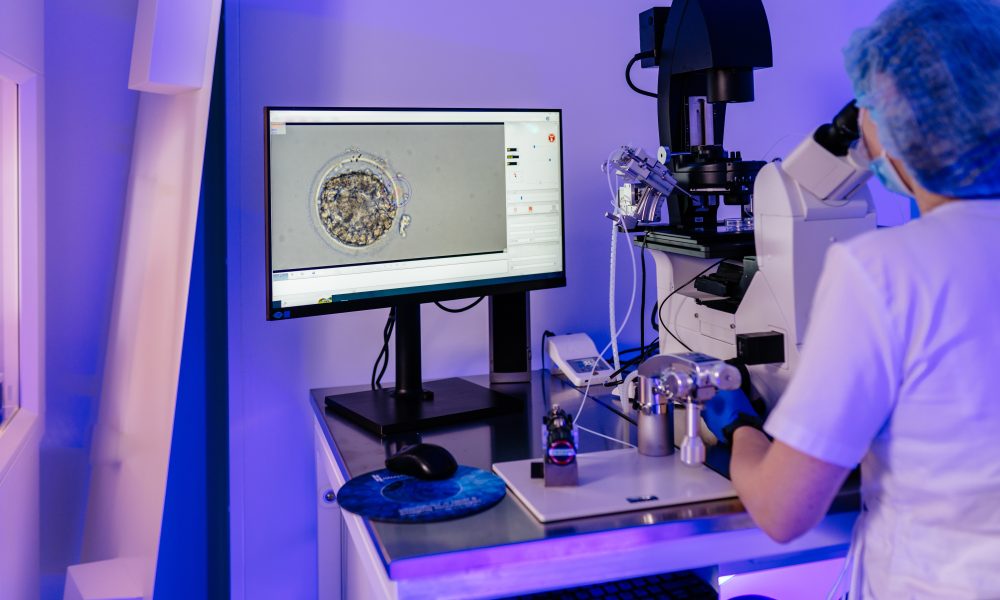
Fertility
Partnership to pilot ‘cutting-edge’ embryo selection tool
The partnership is hoped to streamline laboratory operations with the potential future benefit of optimising the embryo selection process

The US fertility technology company Alife Health has teamed up with a network of laboratories to pilot an AI technology for embryo image capture and cataloguing.
The company’s partnership with Ovation Fertility aims to focus on streamlining laboratory operations with the potential future benefit of optimising the embryo selection process.
The technology could enable future “AI-powered” embryo selection.
Alife’s Embryo Assist software promises to help embryologists to create digital records of every embryo, with the added benefit of using the start-up’s clinical decision support algorithm to determine the best embryo for transfer.
Paxton Maeder-York, founder and CEO of Alife, said: “We are thrilled to join forces with Ovation, a leading laboratory network in the country, to showcase the transformative impact of Alife’s technology.
Through this partnership, we aim to demonstrate how Alife’s advanced technology, powered by AI, can not only optimise clinic workflow, but also set a new standard in the precision and consistency of embryo selection.
“We look forward to contributing to Ovation’s commitment to excellence in fertility care.”
Matthew VerMilyea, vice president of scientific advancement at Ovation, added: “At Ovation, we strive to discover and leverage the most state-of-the-art technologies available to us in order to better improve patient outcomes.
“The Alife Embryo Assist software provides our laboratories with a structured digital approach to a rather manual and cumbersome process.
“I believe that by implementing Alife’s technology, we will see an improvement in lab efficiency and performance, which ultimately will help our network provide the best possible outcomes for every individual hoping to grow their family.”
The Embryo Assist software claims to allow embryologists to capture images of each embryo and streamline the embryo reporting process by eliminating the need to manually transcribe information between systems.
Alife expects the tool to “elevate” laboratory quality-control measures by providing an activity and audit trail for every embryo, viewable in real time.
To receive the Femtech World newsletter, sign up here.
Entrepreneur
Applications open for the third W Accelerate with Merck KGaA and M Ventures

W Group has opened applications for W Accelerate with Merck KGaA and M Ventures, inviting reproductive and maternal health startups, scaleups and spinouts to pitch for direct access to global pharma partnership and strategic investment.
Selected companies will pitch on 5th October, competing for the chance to accelerate their growth through commercial partnerships, investment, or both.
This is the third time Merck KGaA, a global leader in reproductive health, has partnered with W Group on the programme, which exists to close the innovation and investment gap in women’s health by connecting the sector’s most promising startups directly with the corporates and investors positioned to scale them.
What Merck KGaA and M Ventures are looking for
This year’s call is focused on breakthrough solutions in female infertility, fertility preservation, adenomyosis, endometriosis, polyendocrine metabolic ovarian syndrome (PMOS), ovarian insufficiency, preeclampsia and pregnancy comorbidities.
New for this round, applicants choose between three pathways depending on what they need from the programme:
- The Partnership Lane, for companies seeking commercial collaborations and strategic relationships
- The Investment Lane, for founders looking to connect with investors and secure funding to scale
- The Dual Lane, for innovators pursuing both partnership and investment opportunities
How the Accelerate event works
Selected companies get a 1:1 pitch practice session ahead of time, then a private 30-minute session with Merck KGaA and M Ventures leadership on the day itself, small-group sessions with regulatory and investment strategy experts, an “Ask Merck Anything” roundtable, and a VIP networking reception.
Key dates
- Open call launches: 8th July
- Open call closes: 2nd September
- Notification of successful companies: 11th September
- Pitch day: 5th October
Applications are open now at wplatform.typeform.com/to/KGzviBQM.
Fertility
Older women face lower chance of fertility treatment working, even with donor eggs, study finds

IVF success declines with age even when women use young donor eggs, with a marked fall from around 49, research suggests.
The findings challenge the idea that donor eggs can fully “reset” the reproductive clock, although researchers said they should not discourage older couples from trying.
Dr Beatrice Crestani, from an assisted reproduction medical institute in Italy, said reproductive ageing had traditionally been seen mainly as an issue involving the ovaries.
She said replacing older eggs with younger donor eggs was often believed to “reset” the reproductive clock.
Dr Crestani added: “Our findings suggest the picture is more complex.”
The study followed 1,774 women undergoing in vitro fertilisation, or IVF, using donated eggs. IVF involves fertilising an egg in a laboratory before transferring an embryo to the womb.
Women in their mid to late 30s had a 54 per cent chance of becoming pregnant after treatment, compared with around 43 per cent among those aged 49 or older.
Live birth rates fell from 46 per cent to 32 per cent, while miscarriage rates rose from 24 per cent to 38 per cent.
Women aged 49 and older had twice the risk of miscarriage compared with those aged 35 to 40.
Researchers believe changes to the endometrium with age may help explain the difference. The endometrium is the lining of the womb where a fertilised egg or embryo implants and grows.
Although the thickness of the womb lining was similar across the age groups, its condition declined with age.
Researchers said future work might find ways to predict, prevent or improve uterine ageing.
Dr Crestani said: “These findings should not discourage women from pursuing donor-egg treatment, because success rates remain meaningful even at advanced ages.
“However, patients should be counselled that donor eggs cannot completely eliminate the effects of reproductive ageing, particularly beyond 49 years.”
Among women who transferred all their available embryos, the live birth rate was around 80 per cent for those aged 35 to 40 and 62.5 per cent for those aged 49 or older.
Experts stressed that the health of the womb and ovaries differs between women.
There is no legal upper age limit for IVF in the UK, unlike some European countries. Greece has an upper limit of 54.
Women in the UK can donate or share their eggs up to the age of 36.
Regulators ask private UK clinics to assess the welfare of any resulting child and whether the recipient can safely carry a pregnancy.
NHS guidelines recommend offering three IVF cycles to women up to the age of 40 and one cycle to women up to the age of 42.
Patients using donor eggs usually have to fund that part of the treatment themselves.
People conceived using sperm, eggs or embryos from donors registered after 1 April 2005 can request identifying information about their biological donor parent once they turn 18.
The findings are being presented at the European Society of Human Reproduction and Embryology.
Professor Borut Kovacic, chair-elect of the society, said researchers were trying to better understand the “cross-talk” between an implanting embryo and the womb lining. This refers to the biological signals exchanged during implantation.
He said the age threshold associated with the beginning of a loss of uterine function was unlikely to be absolute.
Professor Kovacic added: “It provides important information for patients and offers a valuable foundation for future research aimed at identifying novel biomarkers of uterine ageing.”
Dr Ippokratis Sarris, chair-elect of the British Fertility Society, called for more research.
He said pregnancies could carry greater risks for older women and recommended thorough health checks and counselling for couples beginning fertility treatment.
Insight
Women with PMOS should have annual NHS checks, new guidance says

Women with PMOS should receive annual NHS checks to spot related health risks sooner, according to new draft guidance.
Polyendocrine metabolic ovarian syndrome (PMOS) is a complex condition that can have wide-ranging effects across the body.
It affects around one in eight women and was formerly known as polycystic ovary syndrome. It was renamed in May to better reflect its broader effects.
Draft guidance from the National Institute for Health and Care Excellence (NICE) calls for quicker diagnosis and better monitoring.
Marie Anne Ledingham, consultant clinical adviser for women’s and reproductive health at NICE, described the recommendation for a “simple” annual review as an “important step”.
She said: “This new guideline will help improve consistency of care, increase awareness of the condition, and support earlier diagnosis and management.”
PMOS is a major cause of female infertility. Symptoms can include irregular or absent periods, difficulty becoming pregnant, excessive facial or body hair, weight gain, hair loss, oily skin and acne.
An estimated three million to four million women have the condition in the UK, but NICE says it remains underdiagnosed and inconsistently managed.
The proposed annual reviews would cover current symptoms and longer-term health risks linked to the condition, including diabetes and heart disease.
NICE says lifestyle changes and treatment could help prevent more serious illness.
There is no cure for PMOS, but NHS treatments can help manage its symptoms. These include hormone support and fertility drugs.
The draft guideline does not recommend laser or light therapies for hair reduction because of the cost.
Many women report difficulty understanding the possible cause of their symptoms or experience delays before receiving a diagnosis.
When doctors suspect PMOS, they may use blood tests to assess hormone levels and ultrasound scans to look for the multiple follicles often seen on the ovaries of those affected. Follicles are small, fluid-filled sacs in which eggs develop.
The draft guideline sets out when healthcare professionals should suspect the condition and how women should be assessed and diagnosed.
It also says PMOS should not be ruled out in women who have been through the menopause.
The condition is thought to be more common among black, Asian and mixed-ethnicity women. NICE says healthcare professionals should consider this when assessing symptoms.
PMOS can also have a significant effect on mental health and quality of life, with depression and anxiety described as common among women with the condition.
Women planning a pregnancy should receive advice on weight, diet, nutrition, exercise, sleep and mental health, according to the guidance.
The draft guideline is open for consultation from 1 July to 11 August 2026, with feedback invited from healthcare professionals, patients and the public.
The final guideline is expected to be published in December 2026.
Cancer2 days agoThousands of women could avoid painful cancer exam with new AI blood test
Insight4 days agoWomen with PMOS should have annual NHS checks, new guidance says
Diagnosis3 days agoTwo “gamechanger” tests set to speed up endometriosis diagnosis on the NHS
Entrepreneur1 week agoKorea’s Femtech Industry Goes Global as Vespexx Hosts Korea Femtech Summit 2026
Fertility2 weeks agoImmunotherapy may temporarily restore fertility in premature menopause
News1 week agoBreast cancer biosensor and low-cost ultrasound startups win women’s health AI competition
News2 weeks agoDon’t miss HTW’s upcoming deep dive into health AI
News1 week agoClue spotlights seven women’s health journeys in new campaign


11 Comments
