




News
Abortion drug shows promise in reducing cancer risk


Mifepristone, widely used in medical abortions, may also lower breast cancer risk in women more likely to develop the disease.
Doctors and scientists say stigma surrounding mifepristone is deterring pharmaceutical firms from examining its use as a preventive drug, even though three studies suggest it can slow cancer cell growth.
They argue the drug’s link with abortion, along with restrictions in some countries, is blocking research that could have major public health benefits.

Mifepristone is one of two drugs, along with misoprostol, that women in the UK can use to end pregnancies up to 10 weeks.
Women take a mifepristone tablet, wait 24–48 hours and then take misoprostol. It works as a selective progesterone receptor modulator, meaning it blocks progesterone – a hormone known to drive cell growth in breast cancer.
“It is deeply disappointing that the successful application of mifepristone in one area of clinical medicine is hindering more extensive research into other indications that could benefit public health,” the eight co-authors wrote in The Lancet Obstetrics, Gynaecology and Women’s Health.
“The time is long overdue to give mifepristone the opportunity it deserves to be investigated as a non-surgical option for primary prevention.”
The authors, specialists in reproductive health and cancer, are based in London, Edinburgh, Stockholm and Erbil, Iraq.
Breast cancer kills about 670,000 women worldwide each year, according to the World Health Organization.
Mifepristone could prove particularly useful for women with BRCA1 or BRCA2 gene variants, who currently face limited choices beyond mastectomy or what the authors describe as “low efficacy” drugs.
Three small studies carried out in 2008, 2022 and 2024 showed the drug reduced progesterone’s effect on breast tissue cell growth.
UK cancer charities have joined calls for further research.
Dr Simon Vincent, chief scientific officer at Breast Cancer Now, said: “More risk-reducing treatment options for women with a high risk of developing breast cancer, that also protects their quality of life, are desperately needed. And we need to explore all avenues, including existing drugs, to achieve this.
“So early research into mifepristone is an important step forward and we need further studies to understand if these drugs are safe and effective.”
Dr Marianne Baker, Cancer Research UK’s science engagement manager, pointed to the UK’s 57,900 annual breast cancer cases as evidence that “it’s vital we invest in research exploring new ways to prevent the disease”.
She added: “Cancer develops when cells grow uncontrollably. Early studies showed that mifepristone slowed down cell growth in breast tissue, so it might be useful in delaying or preventing cancer.
“But we need more research to understand whether it’s effective, how it works and who would benefit most from it.”
Prof Kristina Gemzell Danielsson, the lead author and head of the department of women’s and children’s health at the Karolinska Institute in Stockholm, said: “Stigma around mifepristone used for abortion is describing part of why mifepristone is not more extensively researched for prevention of breast cancer.
“Taken together, our data support the use of mifepristone for prevention of poor prognosis breast cancer. All studies were randomised controlled trials using a low dose of mifepristone for two or three months.”













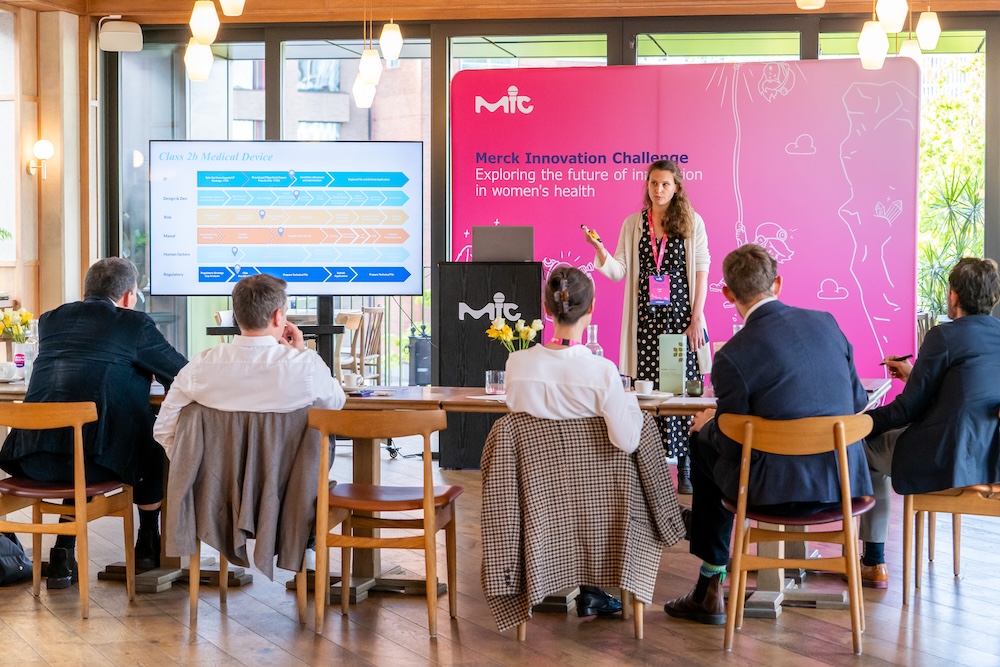
Applications close 2 September at 12pm BST for W Accelerate with Merck KGaA and M Ventures, a fast-track programme offering startups, scaleups and spinouts in reproductive and maternal health direct access to decision-makers at one of the world’s leading reproductive health companies.
With a single application, innovators connect with Merck KGaA’s partnership team and investment professionals from M Ventures, Merck’s corporate venture arm.
Selected companies will be notified on 11 September and invited to pitch at W Accelerate in London, at One Hundred Shoreditch, on 5 October.
During the event, they will receive a private 30-minute session with Merck and M Ventures leadership, small-group guidance from regulation and investment specialists, an “Ask Merck Anything” roundtable, and access to a VIP networking reception.
Applications are open to companies working on breakthrough solutions across reproductive and maternal health, including fertility, endometriosis, adenomyosis, ovarian health, preeclampsia and pregnancy comorbidities.
Applicants can choose one of three lanes, depending on whether they’re seeking strategic collaboration, investment, or both: Partnership Lane, Investment Lane, or Dual Lane. Direct-to-consumer and over-the-counter products are outside the programme’s scope.
Thang Vo-Ta, CEO & co-founder of Calla Lily Clinical Care and participant of a previous edition of W Accelerate with Merck Healthcare and M Ventures, said: “The opportunity to pitch directly to senior leadership at Merck and M Ventures sparked conversations that became the foundation of relationships leading to our eventual strategic collaboration with Merck. I’ve yet to see another event run with this level of excellence.”
For more information, visit W Group’s website: wplatform.co
Applications close 2nd September 2026, 12pm BST
W Accelerate event: 5th October 2026 at One Hundred Shoreditch, London (travel and accommodation not provided)
Apply here


The Women’s Health Innovation Summit (WHIS), the event uniting the global women’s health ecosystem, has just announced 18 new speakers joining the agenda for its 2026 summit, taking place October 13–15 at Encore Boston Harbor.
The latest additions bring further depth across pharma, clinical research, health systems, venture, and policy, reinforcing WHIS’s role as the only platform where the full women’s health ecosystem convenes under one roof.
Newly confirmed speakers include:
- Kelle Moley, MD – VP, Women’s Health Early Phase Clinical Development, Cardiometabolic Research, Eli Lilly & Company
- Justine Levin-Allerhand – Executive Partner, Chief Corporate Development Officer & COO, Flagship Labs, Flagship Pioneering
- Sebnem Yildirimoglu, MD, PMP – Executive Director, Women’s Health Strategy, Premier Research
- Terri Stewart – Head of Global Healthcare & Government Affairs, EMD Serono
- Dr. Morag Grassie – Executive Director, Blavatnik Fund for Innovation, Yale
- Sandra Butler – Director, Design Impact, Mass General Brigham
- Zhenya Lindgardt – Chief Executive Officer, Sera Prognostics
- Sadie Morahan – Head of US Revenue, Withings Health Solutions
- Angela Drew, PhD – Vice President, Regulatory Strategy, Premier Research
- Dr. Stephanie Lahr – CMIO, Aqurio
- Michelle Andrews – Contributing Writer, KFF Health News
- Charlotte Williams – CEO, My Bump Hub
- Clint Dart, MS – Director, NIH Women’s Health Data Coordinating Center, Premier Research
- Cass Sanford – US Venture Advisor, FemTech Lab
- Megan Mukuria – Founder & CEO, ZanaAfrica
- Tiffany Inglis, MD, FACOG – Chief Medical Officer, Sera Prognostics
- Angelean Hendrix, PhD – Vice President, Pharmacometrics and MIDD, Premier Research
- Amanda Ducach – CEO & Co-founder, EmaEQ
“WHIS is where the women’s health industry comes together to take action,” said Poppy Howard-Wall, Event Director at WHIS.
“This latest wave of speakers reflects exactly the kind of cross-sector expertise our attendees expect – from global pharma and clinical research leadership to venture, health systems, and grassroots innovation.
“It’s this breadth that makes WHIS the room where things actually move forward.”
Bringing the Full Ecosystem Together
These additions join a growing 2026 agenda spanning four content tracks that reflect the full lifecycle of healthcare innovation, from early-stage research and development through to patient delivery, system transformation, and commercial scale.
Attendees can expect over 1,000 senior decision-makers, 120+ expert speakers, four dedicated stages, and more than 10 hours of curated 1:1 meetings.
Full speaker and agenda details are available at whisusa.com/speakers-2026.
About WHIS
The Women’s Health Innovation Summit is the only platform uniting the full women’s health ecosystem – providers, payers, employers, pharma leaders, investors, and innovators -to increase deal flow, expand reimbursement, improve access, and deliver better outcomes for women at every stage of life.











 Entrepreneur2 weeks ago
Applications close August 18 for Women’s Health Innovation Summit 2026 Innovation Showcase

 Menopause2 weeks ago
Third of women unaware of perimenopause mental health impact

 Fertility1 week ago
Chelsea FC Women to launch first-of-its-kind player fertility fund

 Menopause2 weeks ago
Menopausal hormone therapy may lower dementia risk, study suggests

 Opinion1 week ago
anna perimenopause app launches across 39 markets

 Hormonal health2 weeks ago
We are wrapping our children in plastic and calling it care

 Pregnancy2 weeks ago
Chemicals in plastics may be linked to high blood pressure during pregnancy

 News2 weeks ago
Women with endometriosis face 46% higher risk of type 2 diabetes – study