




AI is entering its next frontier: Our health. But was it built to understand women?
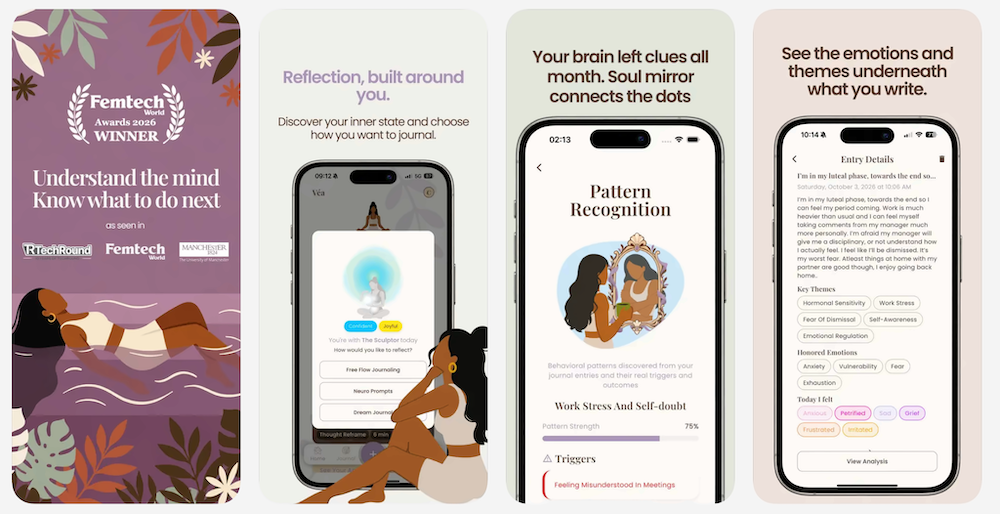
Introducing Véa: building a more responsible, women-informed future for AI and mental wellbeing.
Artificial intelligence is entering a new chapter.
We’re moving beyond chatbots that answer questions into an era where AI agents are becoming increasingly embedded in our everyday lives.
One of the most interesting frontiers is health. AI health coaches are beginning to change how we think about personalised care, with technology moving towards a deeper understanding of the individual.
But as we give AI a greater role in our health and wellbeing, there’s a question we need to ask.
How can we build technology that truly understands women when so much of the research behind it has historically overlooked them?
It’s a question at the heart of Véa, a new women’s mental wellbeing app bringing together artificial intelligence, neuroscience and women’s health research.
Our belief is simple. If technology is going to play a greater role in our emotional wellbeing, it needs to be informed by the people it’s designed for.
The research gap we can’t afford to carry into AI
For decades, women were underrepresented in medical research.
In 1977, the US Food and Drug Administration recommended excluding women of childbearing potential from early-stage drug trials. It wasn’t until 1993 that the inclusion of women in NIH-funded clinical research became a legal requirement.
These decisions contributed to gaps in our understanding of women’s health that researchers are still working to address.
Mental wellbeing makes this particularly important.
According to the World Health Organization, depression affects approximately 6.2% of adult women compared with 4.1% of adult men globally, based on 2023 estimates.
Yet there’s still much to understand about the relationship between women’s physiology and mental health. Hormonal changes can influence emotional wellbeing, although experiences vary significantly between women.
Then there’s the invisible mental load. The constant planning, anticipating and emotional responsibility that often goes unnoticed.
As AI becomes more involved in our health, we have an opportunity to build differently rather than carry historical research gaps into the next generation of technology.
What makes Véa different?
We didn’t want to build another journaling app that simply asks how you’re feeling and leaves you with a blank page.
We wanted to create something that helps women understand what’s happening in their minds, recognise emotional patterns and learn how to respond using techniques grounded in research.
At Véa, women’s physiology is part of the conversation. We recognise that emotional wellbeing doesn’t exist in isolation from the body and that hormonal transitions can influence how women experience stress and mood.
We’re also making neuroscience more accessible.
Take affect labelling, the process of putting feelings into words. Neuroscience research has shown that naming emotions can influence activity in brain regions involved in emotional processing and regulation.
Through emotional check-ins and guided reflection, Véa encourages women to become more aware of their internal experiences.
Our ritual library, developed with input from our clinical advisory board, introduces practices such as breathwork and somatic exercises to support emotional regulation.
But perhaps most importantly, women remain in control of what they share.
Some days that might mean writing about everything on your mind. Other days, a quick check-in is enough.
There’s no pressure to journal perfectly or disclose more than you’re comfortable with.
Véa offers a private space to reflect at your own pace, with AI-assisted insights that help surface recurring themes over time.
We don’t believe AI should tell women who they are. We believe it should help them understand themselves better.
Because wellbeing doesn’t happen in isolation
One of the most important parts of Véa happens outside the app.
It happens around dinner tables, during workshops and in conversations between women who may have arrived as strangers.
Alongside the technology, we’ve been building a real-life community through supper clubs, retreats and events exploring women’s health and emotional wellbeing.
Because while AI can support self-reflection, it cannot replace the value of human connection.
We believe women need both: a private space to understand themselves and a community where they can share experiences with others.
These conversations also shape how we build Véa, helping us understand what women actually need rather than making assumptions on their behalf.
Building responsible, women-informed AI
As AI agents and digital health coaches become more sophisticated, the conversation needs to move beyond what technology can do towards what it should do.
For us, responsible, women-informed AI means building on credible research while acknowledging where evidence is incomplete.
It means recognising the importance of female physiology without assuming every woman’s experience is the same.
It means respecting privacy, giving women control over their personal reflections and being transparent about the limitations of AI.
Véa isn’t therapy, nor do we believe technology should replace professional mental healthcare.
Our longer-term vision is to explore how emotional reflections might connect with wider women’s health data to create more contextual, personalised insights.
But that future needs to be built responsibly, with women helping shape the technology from the beginning.
Responsible AI shouldn’t simply learn about women – it should be informed by women.
The next frontier should include women from the beginning
We’re entering an exciting period for AI and health but more intelligent technology doesn’t automatically mean better wellbeing.
At Véa, we’re bringing together neuroscience-informed tools, women’s health research and AI-assisted reflection, while creating space for genuine human connection.
Our ambition isn’t to give women another thing to track or optimise.
It’s to help them better understand the experiences they’re already having.
Today, we’re officially launching Véa on the App Store.
It’s the beginning of our ambition to build a more thoughtful, responsible and women-informed approach to mental wellbeing.
Because the next frontier of AI isn’t just about making technology more intelligent.
It’s about making sure women are part of the intelligence we’re building.
The Véa Team
Véa is a self-reflection and wellbeing app, not a medical or therapeutic service.

Newsletter
Sign up for free weekly updates
The latest femtech news, research and investment, straight to your inbox.




