




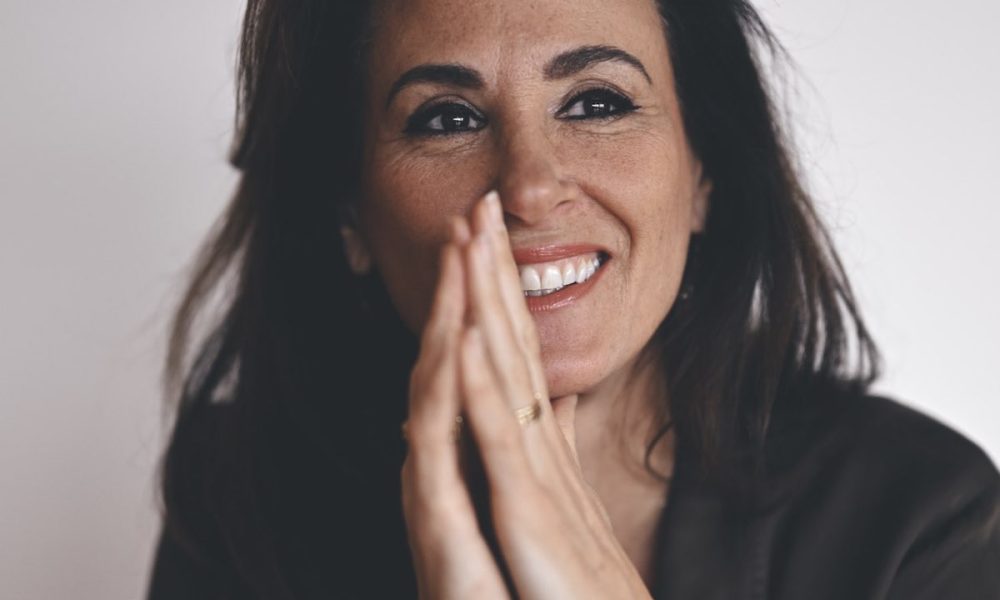
With her latest venture, the founder of the globally-renowned ‘Pregnancy+’ app, Amber Vodegel, is on a mission to address inequity in women’s health.
After building one of the world’s biggest women’s health apps—and selling it to one of the world’s biggest tech companies— Amber Vodegel thought about retiring and spending her days playing tennis.
“I’ve definitely thought about slowing down, but I couldn’t walk away knowing how much still needs to change in women’s health,” she tells Femtech World.
“Tennis can wait.”


Vodegel began building Pregnancy+ in 2012 as a side-hustle, while continuing in her day job at an advertising agency. She bootstrapped the business for five years, investing back into developing and improving the app, eventually reaching 10 million users before being acquired by Phillips in 2017.
During her time at Philips, she continued to expand Pregnancy+’s user base to over 150 million users in more than 100 countries. With two million daily active users globally, it has become the number one pregnancy app in almost all countries. In the UK it serves 70 per cent of first-time mums.
“Building Pregnancy+ taught me the true value of trust and showed me how technology, when designed thoughtfully, can meet people exactly where they are in their lives,” she says.
“But being in mobile app development for nearly 15 years, also revealed how many people are still excluded from basic health education. In menstrual health, it’s even more apparent.”
She continues: “After building Pregnancy+ and seeing the impact that trusted, accessible digital tools can have, it became clear to me that the menstrual health space was failing millions of women and girls globally.”
“The scale of inequity”
A total of 800 million people menstruate each day, yet many are unable to access even the most basic products and education. Even in the UK, 17 per cent of women and girls lack essential menstrual health information, according to evidence from the Women’s Health strategy in 2022.
While tech can educate and empower women by giving them more insight into their health—over 100 million women are using period trackers every month—many apps are paywalled, and some have been linked to privacy and data handling concerns.
Research from 2023 found that 59 per cent of women and girls have concerns about the use of their health data in existing apps, and many have come across age and culturally-insensitive content.
Having had the opportunity, and experience, that comes with building global platforms, Vodegel says she feels a sense of responsibility to address some of these inequities.
“This is personal, and it’s urgent,” says Vodegel.
“Once you see the scale of inequity, you can’t unsee it. Health information and support should not be a privilege, but for many, it still is. I’ve had the opportunity to build global platforms before, and I feel a duty to use that experience to create something that serves people who’ve been underserved for far too long. It’s about fairness, but also about what’s possible when we design with care.
“People talk about how the future of health, powered by AI, is going to be incredible. They point to integrations with expensive wearables like smart watches and the Oura ring. But who is that future really for? Most women can’t afford a £400 ring or a £50 annual app subscription. So, my question is this: who’s looking after the other 80 percent? Who is serving the 12 year old girl, or the women in lower and middle income countries, the neurodiverse, or just those who simply can’t afford a subscription?”
Redefining how women access health education
This has become the driving force behind her new venture, 28X, preparing to launch later this year. With 28X, she is striving to create not just a women’s health app, but an impact venture which could redefine how women access information about their health.
“28X is my way of using everything I’ve learned to build something that truly serves women and girls who are being left behind,” says Vodegel.
“Especially by the current period apps that store user data on external cloud servers and charge expensive subscriptions, which most women and girls can’t afford.”
28X is a global period tracking app that is free-at-the-point-of-use and privacy-safe, putting women in control of their health and data, Vodegel says.
It uses on-device AI to process and store data, which unlike traditional cloud-based processing, ensures that sensitive user data never leaves the device. To avoid data-sharing with third parties, it will use fine-tuned open-source GenAI models with suitable guardrails, such as on-device Tiny Language Models in combination with a headless CMS.
Set to be available in more than 100 countries, and 33 languages, the app automatically adapts its educational content to suit the linguistic, neurodiverse, cultural, and educational needs of its user base.
Meanwhile, its circular business model will see revenues flow back into social impact foundations, ensuring that profits are reinvested into education, clinical research, and women’s health equity. A partnership with Biograd, the company behind Europe’s first women’s health-focused research tissue bank, will also see 28X contribute to much-needed menstrual health research which aims to advance innovation and treatments in immunotherapy, regenerative medicine, and diagnostics.
Building the blueprint
Vodegel’s aim is for this to become a blueprint for other tech companies, showing that it is possible to be scalable and sustainable, without compromising on ethics, but also making the back-end technology open-source to allow other health-related app developers to use and build on it.
“Our aim is not just to build the largest women’s health app, but to demonstrate a new way forward. We’re creating a privacy-first, inclusive, clinically trusted solution that proves you don’t need to compromise ethics to scale,” she says.
“We’re showing that it’s possible to prioritise the user, protect their data, and still be sustainable. If that encourages others to rethink how they build, we’ll have achieved more than just our own mission.”
Passionate about women’s health, inclusion and ethical innovation?`
Vodegel is looking for those with shared values to help shape the long-term vision, impact and governance of 28X, including impact investors with an interest in becoming founding members. Other ways to get involved at this stage, include as an ambassador helping connect 28X with communities such as schools and youth organisations or clinical teams, sharing with your network, or participating in its user research and testing programme.
“We are looking for people who share our values,” she says.
“People who believe in access, trust, privacy and equity in health. People who believe we can do better, and who want to be part of building something that serves, not excludes.”
She adds: “[We want to] ensure we are building with, not just for, our community. If you are passionate about women’s health, inclusion and ethical innovation, there is a place for you in this movement.”
To learn more about how you can support 28X email [email protected]


Newsletter
Sign up for free weekly updates
The latest femtech news, research and investment, straight to your inbox.




