




Diagnosis
Psychiatrists challenge FDA panel on antidepressants in pregnancy


Leading psychiatrists say a US panel promoted false claims about antidepressants in pregnancy, including that they are ineffective and linked to autism or birth defects.
The meeting on Monday featured 10 panellists, several of whom rejected the prevailing medical view on the safety of antidepressants during pregnancy.
They raised concerns about conditions such as autism, miscarriage and birth defects, and in some cases claimed depression resolves without treatment.

Three of the experts were based outside the US, while another runs a clinic that supports people stopping psychiatric medication.
Much of the discussion centred on selective serotonin reuptake inhibitors (SSRIs) such as Lexapro, Prozac and Zoloft, which boost serotonin levels in the brain to help improve mood.
Dr Joseph Goldberg is clinical professor of psychiatry at the Icahn School of Medicine at Mount Sinai in New York City.
He said: “They were really rousing concerns about safety that are not evidence-based or established and not at all balanced with concerns about the risks of untreated depression.”
Goldberg, a past president of the American Society of Clinical Psychopharmacology who has previously consulted for pharmaceutical companies, said he was invited to join the FDA panel but declined because the invitation suggested it would not be a fair discussion.
Dr Jennifer Payne, director of the Reproductive Psychiatry Research Programme at the University of Virginia, said: “I’m disappointed that the FDA brought people in from outside of the United States when there’s so many experts here in the United States who truly know this [medical] literature inside and out.”
The general medical consensus is that continuing SSRIs during pregnancy is often safer than stopping, particularly because untreated depression can lead to thoughts of self-harm or low birth weight.
Babies may sometimes show temporary symptoms such as irritability or jitteriness after birth – known as neonatal adaptation syndrome – which typically pass quickly.
While some studies have suggested a slightly higher risk of miscarriage, there is no solid evidence linking SSRIs with autism or birth defects.
“Well-controlled studies continue to not find an association,” said Payne.
Women with a history of depression are also at risk of recurrence during pregnancy, which carries its own potential harms.
One panellist, David Healy – a fellow of the Royal College of Psychiatrists in the UK – claimed: “It’s been said that SSRIs help people who are severely depressed. They don’t.”
Goldberg called that statement “simply untrue”, adding: “You can say the moon landing was faked. Conspiracy theories abound in our world. But there is not a doubt about whether SSRIs work.”
Psychologist Roger McFillin, who hosts a podcast critical of mainstream psychiatry, suggested depression is not an illness but an intense emotional state, particularly in women.
He also claimed, without evidence, that many women are pressured into taking antidepressants during pregnancy.
“I have never, ever, ever, ever heard of a third party pushing a prescription in pregnancy,” Goldberg said.
He added that some obstetrician-gynaecologists unfamiliar with SSRIs have wrongly advised patients to stop taking them.
The American College of Obstetricians and Gynecologists described the panel as “alarmingly unbalanced”.
In a statement, it said: “On a panel of 10 experts, only one spoke to the importance of SSRIs in pregnancy as a critical tool, among others, in preventing the potentially devastating effects of anxiety and depression when left untreated during pregnancy.”
That panellist was Dr Kay Roussos-Ross, a psychiatrist and obstetrician-gynaecologist at the University of Florida College of Medicine, who repeatedly questioned the panel’s conclusions.
“All of us can find a study that agrees with exactly what we think,” Roussos-Ross told the panel.
“But we need to look at the data very objectively.”
An FDA spokesperson defended the panel, saying Commissioner Martin Makary “has an interest in ensuring policies reflect the latest gold standard science and protect public health” and calling criticism of the event “insulting to the independent scientists, clinicians, and researchers who dedicate their expertise to these panels.”
The event followed Health and Human Services Secretary Robert F. Kennedy Jr’s call for a review of antidepressant use.
His “Make America Healthy Again” report warned of “potentially major long-term repercussions” from childhood use of the medications.














Women’s health medical device company Ark Surgical has secured further institutional backing from JNF and the Israel Innovation Authority (IIA) as it accelerates the US commercial expansion of its surgical tissue containment technology.
Both organisations have previously backed Ark, making the renewed support a significant vote of confidence in the company’s technology, leadership team and commercial strategy as it moves into its next stage of growth.
The new backing comes alongside Ark Surgical’s ongoing Series A financing round, which has also attracted investment from physicians and experienced medical device executives, adding further industry validation as the company builds its US commercial presence.
The Israel Innovation Authority, Israel’s public agency supporting technological innovation, selected Ark Surgical for additional non-dilutive funding following an extensive evaluation process.
The assessment examined the unmet clinical need addressed by Ark’s technology, its clinical results, business and US go-to-market strategy, Israeli and US teams, execution against milestones and future product pipeline.
JNF, which supports economic development and community-building initiatives in Israel, has also increased its previous backing of Ark Surgical.
The relationship has particular significance given Ark’s roots in northern Israel. The company is headquartered near Nazareth in the Galilee and plans to continue strengthening its manufacturing capabilities in the region as its commercial presence in the US grows.
Together, the continued institutional support and investment from experienced healthcare leaders reflect growing confidence in Ark’s technology and its strategy for US expansion.
Stav Tori, CEO of Ark Surgical, said: “Having organisations that already know Ark, our technology and our team choose to support us again is particularly meaningful.
“It reflects our ability to consistently achieve the clinical, regulatory and commercial milestones we set and gives us additional resources to accelerate our expansion in the US.
“Our ambition goes beyond bringing another medical device to market.
“We want to help establish a higher standard of surgical safety for women undergoing minimally invasive procedures.”
Addressing an overlooked risk in women’s surgery
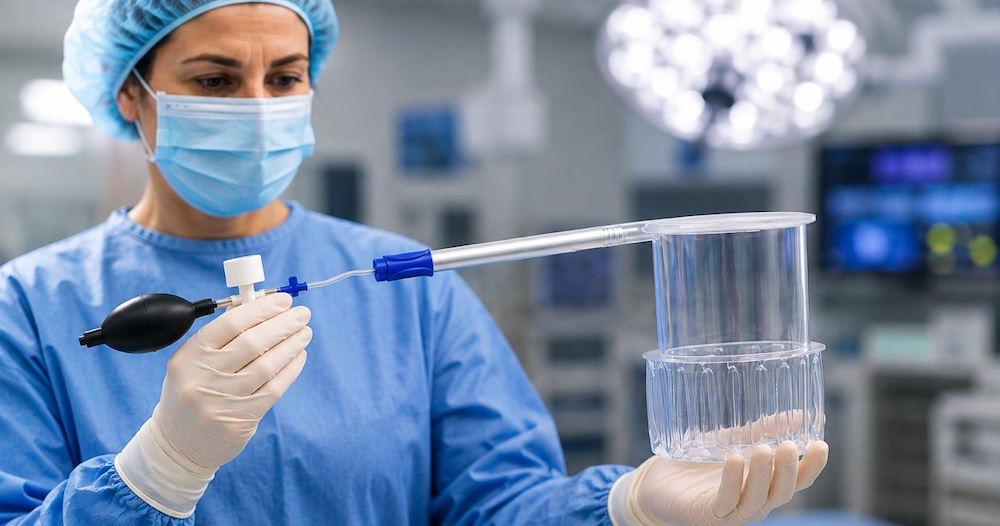
At the centre of Ark’s expansion is LapBox, the company’s FDA-cleared dual-wall tissue containment system developed to address an important safety challenge in minimally invasive gynecologic surgery.
Procedures such as hysterectomy and myomectomy can require large uterine specimens or fibroids to be divided into smaller pieces so they can be removed through small laparoscopic incisions.
This process, known as morcellation, carries a risk of disseminating tissue within the abdominal cavity.
In rare cases where an unsuspected malignancy is present, morcellation can spread malignant tissue and potentially worsen a patient’s prognosis.
But the risk is not limited to cancer.
Even benign uterine tissue can implant elsewhere in the abdominal cavity and grow, potentially resulting in complications such as parasitic fibroids and the need for additional treatment.
LapBox was developed as a dual-wall, bag-in-bag containment system that creates a secured chamber for tissue extraction. The device is FDA-cleared for use with both manual and power morcellation.
From clinical innovation to US adoption
Ark Surgical is now moving beyond its clinical and regulatory milestones to focus on broader commercial adoption.
LapBox™ has already been used in hundreds of procedures, while Ark has been expanding its presence within US hospitals and building relationships with leading minimally invasive gynecologic surgeons.
The latest institutional backing will support the next stage of that strategy, including additional hospital partnerships, key opinion leader engagement, sales leadership and clinical support.
Joseph LaBruzzo, President and CEO of U.S. Operations at Ark Surgical, said: “Ark has reached an important point in its development.
“We have the regulatory clearance, growing clinical experience and increasing engagement from US surgeons and hospitals.
“The focus now is execution and scale.
“What makes this continued backing particularly meaningful is that these are organizations that have followed Ark’s development and seen the team deliver against its objectives.
“Their decision to support the company again provides further validation as we build the commercial and clinical infrastructure needed for broader US adoption.”
That growing adoption is also being reflected in the experience of surgeons using LapBox.
Dr Ramon Yera, a minimally invasive gynecologic surgeon with more than 35 years of experience, said: “Once surgeons use LapBox, they realize this is the bag they should be using for their bread-and-butter procedures.”
Yera believes this reflects a broader shift in expectations around tissue containment in gynecologic surgery.
“Containment is no longer optional. It is an expectation.”
Ark Surgical is continuing its Series A financing round, with additional capital intended to support the next phase of US commercial expansion and development of its broader product pipeline.
Further information for prospective investors is available at ark-surgical.com/investment












 Hormonal health2 weeks ago
Major UK study could be a ‘game-changer’ for heavy periods and endometriosis
 Entrepreneur7 days ago
KOVE Medical raises €1.7 million to improve safety of foetal surgery

 Fertility2 weeks ago
One week left to apply: W Accelerate with Merck KGaA and M Ventures

 Pregnancy1 week ago
UK study aims to transform maternity care for high-risk pregnancies

 Menopause2 weeks ago
Quarter of women miss work due to menstual symptoms, survey finds

 Mental health2 weeks ago
PMDD after SSRIs or hormones: Why the brain may be the missing treatment target

 Diagnosis2 weeks ago
Ark Surgical secures further institutional backing to accelerate US expansion

 Menopause5 days ago
Menopause hormone treatment may ease brain fog, study suggests