



Health visitor support helps new mothers stay smoke-free, study finds
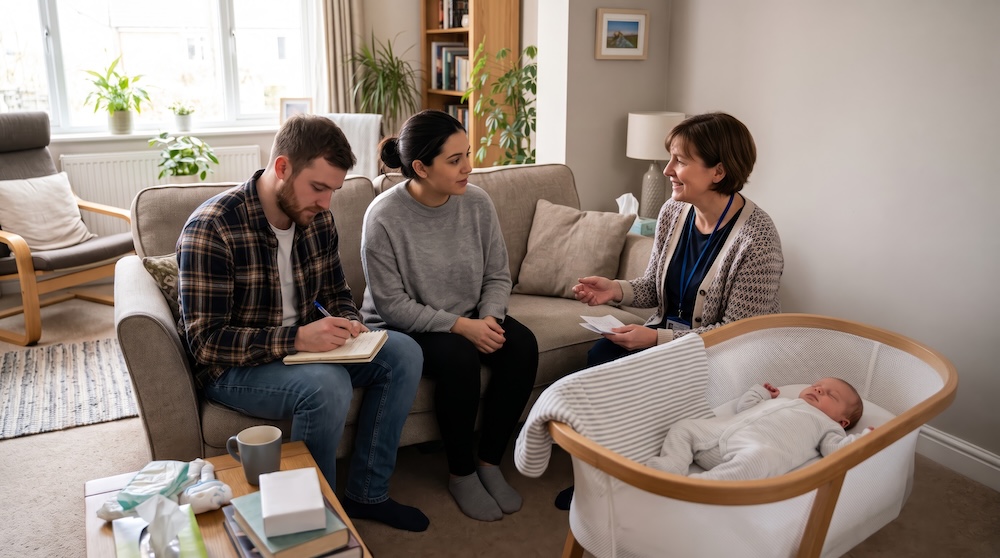
Health visitor support may help women who quit smoking during pregnancy remain smoke-free after giving birth, research suggests.
The BabyBreathe programme was designed to help women who stopped smoking before or during pregnancy avoid returning to smoking after childbirth.
The programme was funded by the National Institute for Health and Care Research and tested by a team led by the University of East Anglia.
Professor Michael Ussher of the University of Stirling’s Institute for Social Marketing and Health was a senior investigator on the study and led recruitment at two trial sites.
Ussher said: “This study is the first to show that an intervention focussing on support from a health visitor may help women avoid returning to smoking.
“These findings are important as many women stop smoking in pregnancy but then return to smoking soon after their baby is born.”
BabyBreathe provides one-to-one support from trained health visitors alongside digital tools, text message support, a dedicated website and app and a relapse-prevention kit sent to families after birth.
Women who received the intervention as intended, with support from trained health visitors, were significantly more likely to remain smoke-free 12 months after giving birth than those without health visitor support.
A total of 886 women from England and Scotland who had successfully stopped smoking before or during pregnancy took part in the large-scale randomised controlled trial.
Participants were randomly assigned to receive either BabyBreathe or usual care, which offered no advice or support aimed at preventing smoking relapse.
BabyBreathe was not delivered as intended to around one in five participants because of health visitor workforce pressures, missed appointments or administrative problems.
Health visitors provided tailored one-to-one advice and support to women in the intervention group towards the end of pregnancy and immediately after their baby was born.
The support included advice on alternatives women could try if they experienced urges to smoke again, as well as advice for partners and family members and access to digital resources including the BabyBreathe app and website.
A relapse-prevention kit was also posted to women immediately after their baby was born.
Support continued for up to 12 months after childbirth during routine health visitor appointments.
The intervention followed more than a decade of research and development involving women, families, health professionals and researchers who worked together to design, develop and test the support package.
Among participants who received the intervention as intended, 57.6 per cent remained smoke-free after 12 months, compared with 49.9 per cent of those receiving usual care.
Researchers said the findings suggest health visiting services could play a significant role in providing consistent relapse-prevention support and helping more mothers remain smoke-free after giving birth.
Lead researcher Professor Caitlin Notley, professor of addiction sciences at UEA’s Norwich Medical School, said: “Women of childbearing age who quit and stay non-smoking can reduce their risks of developing a smoking-related disease to almost the same level of risk as non-smokers.
“There are also great benefits for babies and children brought up by parents who do not smoke in avoiding exposure to second-hand smoke, and in helping to prevent the next generation from taking up smoking.
“Until now, health visitors had no training on smoking relapse prevention.
“This meant that when women had made the extremely important and difficult health behaviour change of quitting smoking during pregnancy, no one picked up on this and gave them positive praise and support.
“This new approach extends the intensive support for initially quitting smoking that pregnant women are offered, going one step further to help women to stay smokefree in the long term.”
Researchers noted several limitations that affected the primary analysis, including incomplete delivery of BabyBreathe and low engagement with some parts of the programme.
The participant group was also more highly educated and less socioeconomically deprived than the wider population, which may have affected the programme’s overall effectiveness and limit how broadly the findings can be applied.
The Institute of Health Visiting worked with UEA on the BabyBreathe study.
Vicky Gilroy, director of innovation and research at the Institute of Health Visiting, said: “Health visitors and their teams are uniquely placed to support women in preventing smoking relapse as part of their universal offer.
“It has been a privilege to contribute to the BabyBreathe study and help develop the evidence of the importance of their role. The findings reinforce the need for all health visitors to receive training in this important area.”



Newsletter
Sign up for free weekly updates
The latest femtech news, research and investment, straight to your inbox.



