




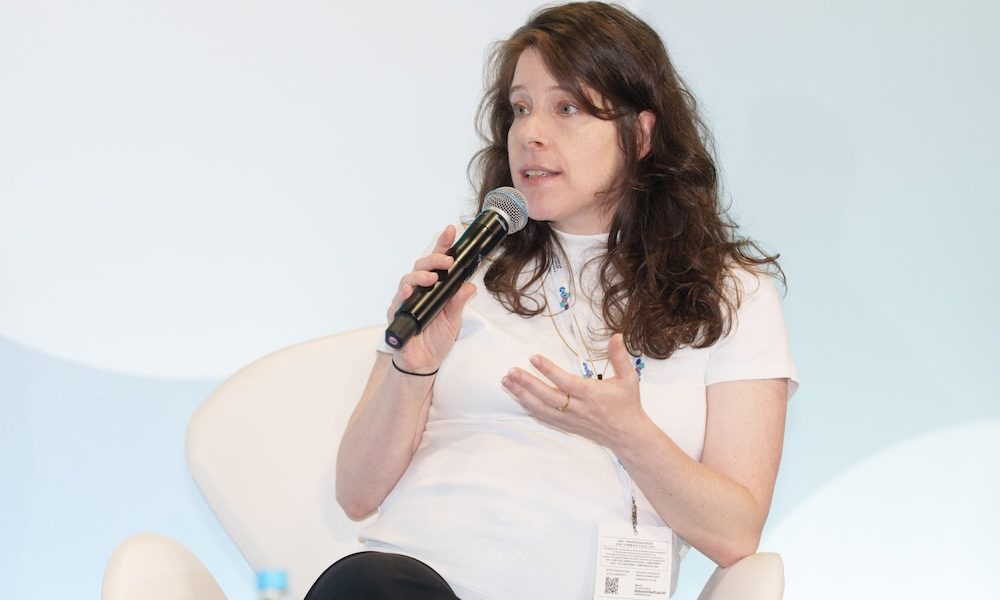
As founding director of Femtech Israel (IL), Shelly Bloch is working to strengthen the femtech ecosystem in Israel and beyond. Here she tells Femtech World about the trends, challenges and opportunities she sees in women’s health innovation, and her hopes for the future.
“My personal passion is women,” Shelly Bloch tells Femtech World on the sidelines of the vast Asia Summit on Global Health in Hong Kong.
The trip, and her speaker slot on stage in front of hundreds of international health innovators is part of her mission to advance femtech awareness, collaboration and progress.
“I did my thesis on the participation of women in the workforce, so this has always been my personal passion.”

With a background in demography and urban planning, Bloch founded FemTech IL in 2021 to address a dearth of both awareness and data in women’s health in Israel.
The organisation provides tools for industry professionals, networking events and conferences and training opportunities.
Bloch’s role puts her at the heart of the femtech ecosystem; a vantage from which she sees “data gaps”, “funding issues” and “male-dominated decision-making” as overriding barriers holding back progress in women’s health innovation.
With increased awareness and collaboration, however, Bloch is optimistic for the future amid strong growth in numbers and engagement within the femtech community.
“I’m drawn to solving inequalities in all kinds of forms,” she says. “When I moved into the tech industry, it was natural for me to go into product management and UX user research.
“As I was looking for a femtech company to work for, I realised that femtech wasn’t known at all – even companies working in the space wouldn’t describe themselves using that term. So I started writing about it and creating connections. Then I understood the need, and femtech became a mission in itself.
As for the scale of the femtech community in Israel, the number of companies and level of investment, sadly, I don’t have that data. There simply isn’t enough research or data collection in this field. One reason is how companies are categorised.
“Some might technically be femtech, but are labelled differently, and so they aren’t counted. Because femtech still isn’t widely recognised, the data we do have doesn’t reflect the full picture.
“I can say, however, that when I started and said ‘femtech’, no one knew what I was talking about. Now, many people do. Organisations are starting to understand what it means, and how to talk about the potential and the challenges. Although I still plan to map the Israeli ecosystem more thoroughly, the environment has definitely changed.”
Bloch says individuals in the FemTech IL network – including entrepreneurs, PhD students, hospital staff, and NGOs – are facing common challenges.
“The first major challenge is research,” says Bloch. “There’s been a persistent data gap for years, and that affects what we know about women’s needs and what we’re able to develop.
“The second is that decision-making in most relevant fields such as investments, academia, and hospitals, is still very male-dominated.
“That’s not to say men can’t do great femtech work. I have many excellent male colleagues, and collaboration is crucial. When teams aren’t diverse, however, it’s much harder to understand the potential, the importance, or even to feel comfortable promoting these kinds of issues.
“The third issue is lack of funding,” she adds.
Collaboration, Bloch believes, is a key factor in fostering more femtech successes that can improve women’s health outcomes.
“You can’t rely on the entrepreneur to be a rock star, the best research, the best product, the best marketing, none of that alone will carry an idea forward.
“Building a startup really does take a village. You need regulation on your side, and often the support of the medical system itself – which means the government and policymakers need to trust you and actively encourage you.
“It’s so important to create those connections. And again, it ties back to funding, male dominance in decision-making, and a lack of awareness. It’s still very hard to find champions who are truly supportive.”
With a focus on growing the femtech ecosystem in Israel, Bloch says the country affords ample opportunity for companies in the sector due to its public healthcare system, with both pros and cons for the sector.
One pro that Bloch highlights is that Israel’s small size means you people connect more easily. Conversely, it’s a relatively small market, so most Israeli startups must think globally from day one.
“That opens the door to solutions that can be highly accessible, whether through research or by incorporating femtech into public services,” says Bloch.
“I’m not saying everything’s perfect, or that I don’t have my criticisms, but when you combine that public healthcare system with strong awareness of women’s rights, among both women and men, and the broader startup ecosystem we already have, it really is very fertile ground.
“Our size means you can connect more easily. You can reach out directly to hospitals or attend physical events without huge barriers. That’s actually still really valuable, even in the age of Zoom.
“For me, as the manager of FemTech IL, it’s feasible to organise in-person events and have meaningful engagement. Israelis tend to be very direct and proactive culturally, which helps a lot when it comes to promoting and building things, even within a small market.”
Considering the bigger femtech picture and the ongoing efforts to close the gender health gap internationally, Bloch says: “Some of the biggest challenges, I think, go beyond direct medical issues.
“For example, think about car safety. Crash test dummies are typically based on the average male body. That means women are 17 per cent more likely to die in a car accident. And depending on the severity of the crash, whether the injury is mild, moderate or severe, women are also more likely to be injured.
“That’s not a medical issue in itself, technically speaking, but it directly leads to health consequences. It’s not just cars. Women carrying babies, for example, have added risks in vehicles or work environments not designed for them. These are design biases, safety regulations and standards based on male bodies, and they have real-world impacts on women’s health.
“My point is that there’s a lot of bias before we even get to the health conditions themselves.
“In developing countries you might see more obvious issues like a lack of access to hygiene products. But even in so-called developed countries, there are huge knowledge gaps. For instance, I recently learned about high rates of diabetes or heart disease in parts of Asia that aren’t widely discussed.
The femtech industry often focuses on clear, direct health issues, and that’s important, but we mustn’t forget the systems and environments that contribute to health outcomes much earlier on.
Femtech World met Shelly Bloch at the Asia Summit on Global Health, facilitated by the Hong Kong Trade Development Council (HKTDC).

Newsletter
Sign up for free weekly updates
The latest femtech news, research and investment, straight to your inbox.




