




News
Stockport NHS Foundation Trust ends the “silent era” with CardMedic roll-out

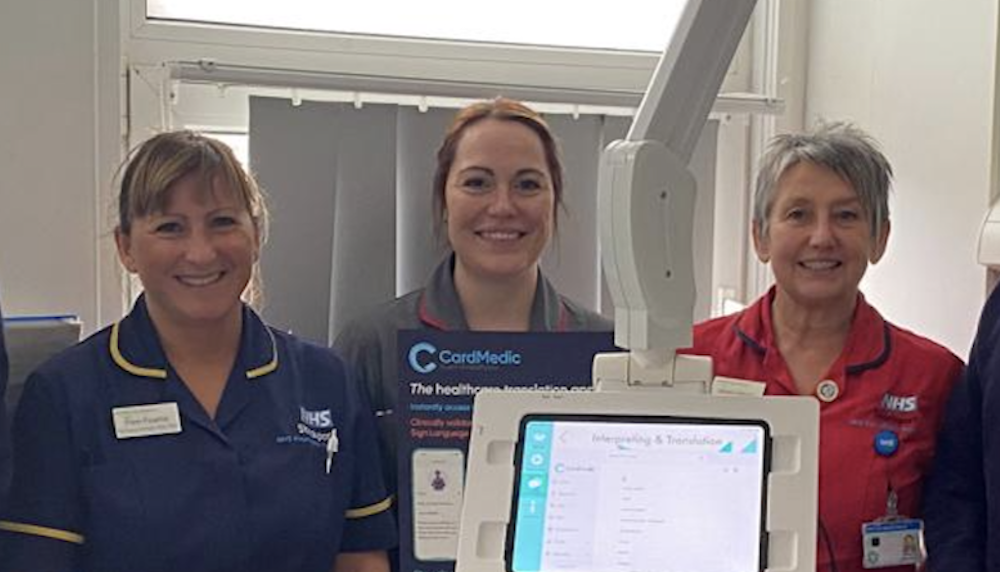
Stockport NHS Foundation Trust has gone live with CardMedic across the organisation, enabling its 6,300-strong workforce to communicate more clearly and confidently with patients who face language or communication barriers.
CardMedic is a digital healthcare communication platform that allows staff and patients to communicate safely and effectively irrespective of language barriers, cognitive impairment or literacy.
The platform provides instant access to live interpreters in 200+ languages via Language Line, alongside thousands of clinically validated scripts in multiple languages and formats, including British Sign Language (BSL), Easy Read, and Read Aloud.
It also supports health literacy for same language patients by explaining information in plain language, clearly and succinctly.
The Trust provides acute and community health services to a population of around 300,000 people across Stockport.
Pam Fearns, Chief Nursing Information Officer at Stockport NHS Foundation Trust, led the project’s implementation.
“CardMedic will enable patients to voice their needs where previously they may have struggled to communicate them,” she said.
“All conversations — such as asking whether someone wants a cup of tea, explaining a procedure, or offering reassurance — play a vital role in ensuring inclusivity.
“CardMedic enables equality across our services.”
With a diverse community, reliance on face-to-face interpreting has led to rapidly increasing annual costs, and communication barriers have increasingly impacted patient experience and safety.
Introducing CardMedic will help address these pressures by providing staff with a single point of access to a suite of clinically designed communication support tools.
The cost-effective, vendor-agnostic platform connects staff to the Trust’s existing language service providers via its Call an Interpreter feature, accessible on any device and any location.
Streamlined access will reduce use of disparate and ad hoc solutions, empowering staff to deliver more efficient and equitable care.
This groundbreaking collaboration will see CardMedic deployed across 455 SPARK Fusion® patient bedside devices on 20 wards at the Trust’s Stepping Hill Hospital.
This integration brings universal communication support directly to the bedside, giving patients and clinicians greater access, privacy, speed, and confidence in every interaction.
The Trust has taken a “big bang” approach to launching CardMedic, introducing it across all its acute and community settings. From day one, it has been available in all inpatient areas to maximise reach and equity of access.
Key areas of engagement include emergency, maternity, and acute medical units, supported by digital nurses, midwives, and clinical champions across the organisation.
The rollout also extends to community staff, including community midwives, school nurses, allied healthcare professionals, Macmillan nurses and district nurses.
The launch is backed by an extensive communications campaign using the slogan ‘the silent era is over’.
This term was coined by Karen Lawrence in the Digital Skills Team following discussions with the Digital Nursing Team about giving a voice to the “silent patient”.
This gave her the idea of silent movies in black and white. Now the introduction of CardMedic is bringing colour back to these patients as they are no longer silenced.
The rollout reflects the Trust’s commitment to its core CARE values of Compassion, Accountability, Respect, and Excellence.
It also aligns with regional efforts to reduce inequalities and national priorities such as the Patient safety healthcare inequalities reduction framework, the Accessible Information Standard, and the Core20PLUS5 Health Inequalities Programme.
The Trust’s passion for equitable care is evident throughout the partnership.
The top five non-English languages spoken in the local area are Farsi, Urdu, Arabic, Kurdish Sorani, and Cantonese. To support the Trust’s community, CardMedic is adding Kurdish Sorani to its platform for the first time.
Dr Rachael Grimaldi, CEO and Co-Founder of CardMedic, said: “Stockport NHS Foundation Trust has demonstrated what equitable care in action looks like.
“No patient will be left without a voice in their care.
“By embedding CardMedic across wards and bedside devices, enabled through our partnership with SPARK TSL, they’re enabling communication that is instant, safe, and scalable.
“The partnership won’t just improve care for patients who face a language barrier. With CardMedic’s Easy Read and Read Aloud formats, it also helps support improved health literacy when language isn’t the main issue.”
Jane Stephenson, CEO at SPARK TSL, added: “This pioneering project demonstrates how technology can strengthen patient-centred care.
“ We’re proud to be working with Stockport NHS Foundation Trust and CardMedic on embedding inclusive communication support in our SPARK Fusion® bedside devices.
“Together, we’re making healthcare more accessible for all.”


Apple announced menopause and perimenopause tracking for its Health app at WWDC 2026, with symptom logging and cycle alerts for some users.
The update expands the app’s cycle tracking beyond fertility and menstrual periods.
If logged cycle patterns suggest a user may be experiencing perimenopause, the app will send a notification prompting a conversation with a doctor.

However, this perimenopause-specific cycle deviation notification is only for users aged 40 and over and is not intended to replace a doctor’s diagnosis or treatment.
Stacey Ford, Apple’s vice-president of OS management, said users will also be able to log menopause and perimenopause symptoms in the Health app.
Educational content will also be available to help users learn more about these life stages and understand changes in their bodies.
Every year, about 2 million women enter perimenopause, the stage before menopause when levels of the hormone oestrogen decline.
According to a February 2025 survey involving 4,432 participants aged over 30, more than half of women aged 30 to 35 experienced moderate or severe perimenopause symptoms.
The findings suggest perimenopause does not affect only older adults.
About 6,000 women in the US enter menopause every day, according to the Society for Women’s Health Research.
Given the number of women affected by perimenopause and menopause, the update broadens the Health app’s scope.
The app launched in 2019, meaning it has gone seven years without these women’s health tracking features, which could help users better understand their bodies and prepare for informed conversations with doctors.



Peers have called for law reform after two House of Lords debates on fertility treatment, surrogacy, embryo research and declining birthrates.
The first debate was put forward by crossbench peer Baroness Ruth Deech, who previously chaired the UK’s fertility regulator, the Human Fertilisation and Embryology Authority.
She discussed proposals from the HFEA to reform the Human Fertilisation and Embryology Act, along with proposals from the Scottish Law Commission and the Law Commission of England and Wales to reform the Surrogacy Arrangements Act.

She called for parliamentary scrutiny of possible changes to regulatory powers, consent rules, donor information and future scientific developments.
Baroness Deech said: “Parliament should plan by setting up a Select Committee to examine the HFEA’s proposals to expand regulatory powers, simplify consent rules, modernise donor information provisions and create a flexible framework for future scientific developments.”
Former fertility professionals were among those contributing to the debate.
Professor Lord Robert Winston, a Labour peer who founded the IVF service at Hammersmith Hospital in London, said: “Infertility is not a disease; it is actually a symptom of something wrong.”
Professor Baroness Geeta Nargund, a Labour peer, current HFEA member and former medical director of CREATE Fertility, disagreed.
She said: “Infertility is a disease, as stated by the World Health Organisation.”
Liberal Democrat peer Baroness Caroline Pidgeon highlighted regional differences in access to NHS-funded fertility treatment.
She cited figures from the Progress Educational Trust’s NHS Fertility Funding Tracker showing that only two of England’s 42 integrated care boards comply with the recently updated fertility guideline published by the National Institute for Health and Care Excellence.
Integrated care boards are local NHS organisations responsible for planning and funding healthcare services in their areas.
Baroness Pidgeon said many boards were offering only a partial IVF cycle rather than a full cycle as defined by NICE.
A full IVF cycle generally includes ovarian stimulation, egg collection and the transfer of all suitable fresh and frozen embryos created during treatment.
Crossbench peer Professor Baroness Clare Gerada, a former president of the Royal College of General Practitioners, said: “The proportion of NHS-funded IVF cycles has fallen to just under 30 per cent, the lowest level since 2008.”
She added that, in relation to IVF, “the NHS system has collapsed”.
Liberal Democrat peer Lord Monroe Palmer said it was “very ironic that it is difficult for many patients to access publicly funded fertility treatment in the very country where IVF was originally pioneered”.
Conservative peer Edward Howard, Earl of Effingham, also raised concerns about the NICE fertility guideline.
He said: “Access remains highly variable across England, because ICBs are not required to implement that guidance.”
He described the situation as “a clear gap between guidance and enforceable entitlement”.
Baroness Deech called for “automatic record sharing between clinics and the NHS central records system”.
Baroness Nargund supported this and linked the ambition to the Single Patient Record in the government’s Ten-Year Health Plan for England and the Health Bill currently before Parliament.
Baroness Pidgeon said such ambitions were at odds with the exceptional degree of medical secrecy that currently applies to IVF.
She also pointed to “a clear desire for the HFEA to be able to permit patients to give generic consent for the use of their embryos in research”.
Patients cannot currently give broad consent for unspecified future research involving their embryos.
Responding for the government, Labour peer Baroness Judith Blake said “immediate legislative reform” was not possible because “the legislative programme for this Parliamentary session is very full”.
Baroness Deech replied: “It might well take some years, but the Government really needs to set up that Select Committee and do the legislative scrutiny right now.”
A second debate on related issues followed immediately afterwards.
Baroness Nargund asked the government “what assessment they have made of the UK’s declining birthrates in an ageing population”.
She also said: “We still have a postcode lottery for IVF provision, with nearly 70 per cent of ICBs funding only one cycle of treatment.”
Responding for the government, Labour peer Lord Philip Wilson said: “The Government are committed to improving fair and equitable access to fertility services, recognising the significant emotional and health impacts of infertility.”











 Menopause2 weeks ago
Perimenopause misinformation ‘putting women at risk’

 Hormonal health3 weeks ago
NHS urged to update website following renaming of PCOS

 Insight4 weeks ago
PCOS renamed after decade-long campaign to end ‘cyst’ misconception

 News2 weeks ago
Women still being failed when they reach menopause, experts say

 Entrepreneur2 weeks ago
Women’s Health Innovation Summit opens submissions for 2026 Innovation Showcase

 Diagnosis4 weeks ago
Artera receives FDA Clearance for breast cancer platform

 Cancer4 weeks ago
AI could transform ovarian care through personalisation, study finds

 News2 weeks ago
Three menopause innovators shortlisted for Femtech World Award