




Diagnosis
New meta-analysis further supports low re-excisions and high placement accuracy with the Magseed marker

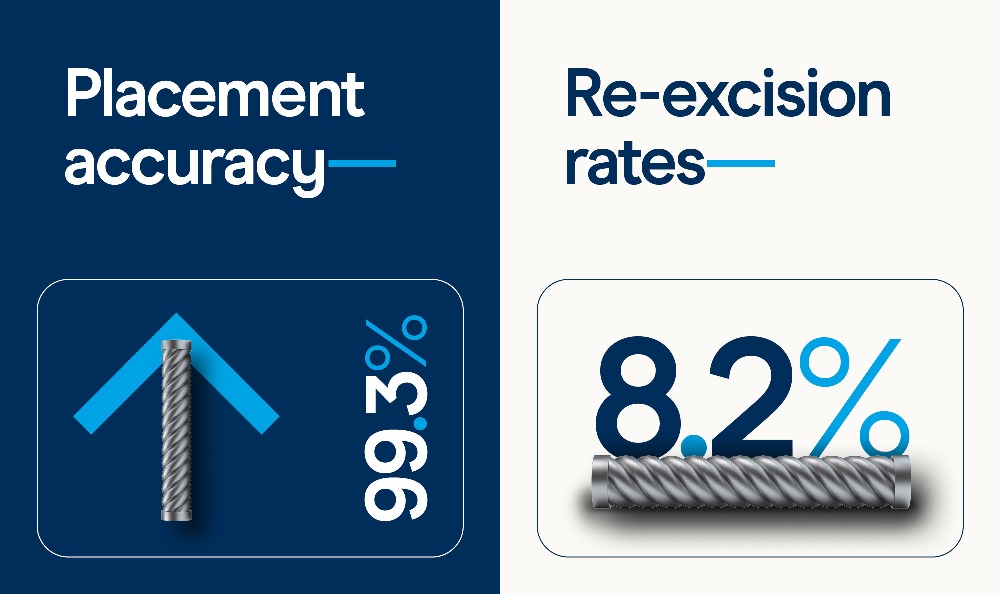
An independent meta-analysis from January 2026, pooling 2,117 patients and 2,176 Magseed marker placements, has reported low re-excision rates (8.2%) and low positive margins (7.6%) when the marker is used to localise non-palpable breast lesions prior to breast‑conserving surgery (BCS).
Al Darwashi et al. (2026) pooled 16 studies to evaluate safety and efficacy outcomes when the Magseed marker was used for preoperative localisation of non-palpable lesions prior to BCS.
The authors reported high placement accuracy, reliable intraoperative retrieval and low rates of positive margins, re-excisions and complications.
In a cohort cited by the review, Moreno‑Palacios et al. (2024) also observed that Magseed marker facilitates less extensive resections compared to guidewires, promising improved cosmetic outcomes while maintaining oncological efficacy.
The key findings
Low re-operation burden: Positive margins occurred in just 7.6% of cases, and only 8.2% required re-excision across the included series.
High placement accuracy: The success rate for Magseed marker placement showed 99.3% positioned within 10 mm of the lesion.
Of note, 96.6% of Magseed markers were placed within an even stricter 5 mm radius.
Reliable retrieval: The pooled intraoperative retrieval success was 99.6% for the Magseed® marker.
“This meta-analysis demonstrated Magseed as a safe and effective preoperative localisation technique for BCS in the management of selected non-palpable breast lesions.” Al Darwashi et al. (2026)
Ready to find out more about the Magseed marker and the Sentimag system?
→ Speak to a Magseed marker expert
Magseed® is a trademark of Hologic, Inc. or its subsidiaries in the United States or other countries. Intended for medical professionals and use in the U.S., UK and the EU only.














Menopause is often absent from women’s electronic health records, a study of nearly 396,000 women has found.
Researchers found menopause appeared almost seven times more often in participant surveys than in electronic health records (EHRs).
The findings suggest important reproductive health information, including age at menopause, may often be missing from health records used for research.

Audrey Hendricks, associate professor of bioinformatics at CU Anschutz and the study’s principal investigator, said: “Ultimately, we cannot study what we do not measure. We cannot treat what we do not know.
“Menopause has enormous implications for women’s health, but if we don’t consistently capture when menopause occurs and other important reproductive health information, we limit our ability to understand how this transition affects disease risk and health outcomes.”
Researchers at the University of Colorado Anschutz analysed data from women taking part in the National Institutes of Health’s All of Us Research Program.
They compared menopause information reported by participants in surveys with menopause diagnoses recorded in their electronic health records.
Around 193,000 menopause observations were identified in survey data, compared with approximately 28,000 diagnoses in EHR data.
Menopause was documented in electronic health records for only about 7 per cent of women in the dataset.
Nearly all participants with a menopause diagnosis recorded in their EHR also reported menopause in survey data. However, substantially fewer women had menopause documented in their health records.
Other important information was also frequently unavailable, including age at menopause, which researchers may use when examining links between menopause and chronic disease risk.
Menopause is a physiological transition that can affect cardiometabolic health and many other aspects of women’s health.
Researchers said relatively little is known about how factors including the timing and type of menopause influence health outcomes across diverse populations.
Large-scale programmes such as All of Us combine participant surveys, electronic health records and genomic data, but menopause-related research depends on relevant reproductive health information being available.
Missing menopause information can make it harder to investigate how the transition relates to health and disease.
The findings may also help researchers using All of Us data define menopause-related study populations, design studies and estimate how many participants are needed.
Hendricks said: “We have an enormous opportunity to use large-scale datasets to understand women’s health across the menopause transition and to identify who may be at greater risk for disease.
“But we need to make sure that the information researchers need is actually being collected.
“We must do a better job of capturing women’s health information, including reproductive health and measures related to menopause.”
Researchers said more complete and consistent collection of menopause and reproductive health information could help future studies examine factors such as age at menopause and their relationship with disease risk and health outcomes.













 Hormonal health2 weeks ago
Major UK study could be a ‘game-changer’ for heavy periods and endometriosis

 Entrepreneur1 week ago
KOVE Medical raises €1.7 million to improve safety of foetal surgery

 Fertility2 weeks ago
One week left to apply: W Accelerate with Merck KGaA and M Ventures

 Pregnancy1 week ago
UK study aims to transform maternity care for high-risk pregnancies

 Mental health2 weeks ago
PMDD after SSRIs or hormones: Why the brain may be the missing treatment target

 Diagnosis2 weeks ago
Ark Surgical secures further institutional backing to accelerate US expansion

 Menopause6 days ago
Menopause hormone treatment may ease brain fog, study suggests

 Events3 days ago
Last chance to save on Women’s Health Week and Women’s Sport Summit: Early Bird pricing ends 11 September