




The world’s largest IUD maker is betting on the next frontier in women’s health, and India is leading the way
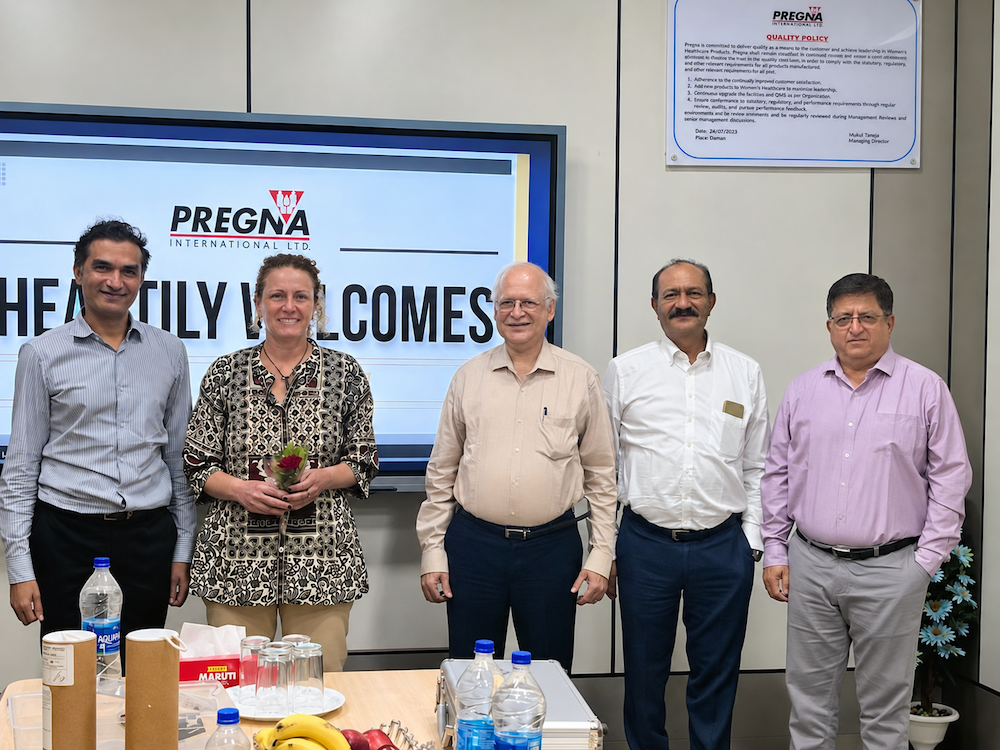
Pregna: The World’s Largest IUD Manufacturer, Built From India
Since 1991, Pregna International has built one of the most significant medical infrastructures in the world for women’s health. Headquartered in Mumbai, the company is the world’s largest manufacturer of IUDs: over 100 million women across more than 140 countries have been served by its products, making it one of the true global backbones of reproductive healthcare..
Pregna holds ISO 9001, CE, WHO GMP, and ISO 13485 certifications, operates its own in-house R&D team, and holds registered patents with ongoing filings each year. Its international partnerships include multinationals, reputed pharma companies, social marketing organizations, through which it builds resilient supply chains for government and international health programs across the developing and developed world alike. In India, where it is a familiar and trusted name across the healthcare sector, and globally, Pregna is among the most significant manufacturing players in women’s health on the planet.
So Why Would a Giant Like This Turn to a Young Medtech Startup?
Over the past year, Pregna has begun expanding beyond its traditional core (IUDs and contraceptives) into an entirely new category: collecting and analyzing menstrual fluid as a source of medical information. Its partner in this effort is Gals Bio, a medtech company that developed a device called TulipOn: a non-absorbent, at-home menstrual collection tool designed to replace the tampon, cup, and pad as the primary means of managing menstrual flow.
Under the agreement between the two companies, Pregna will lead TulipOn’s commercial entry into the Indian market as a hygiene product for women with heavy bleeding, leveraging the manufacturing and distribution infrastructure it has spent over three decades building across the country and beyond. For India specifically, the partnership signals something bigger than a single product launch: a homegrown manufacturing giant positioning itself at the frontier of a category most of the world hasn’t caught up to yet.
For a product category that has barely changed in a century, TulipOn’s specs read like a genuine leap rather than an iteration. Up to 12 hours of continuous wear, day or night, with no absorbent material at all and no leaking. Insertion and removal are designed to be as simple as a tampon’s, but what comes out holds up to 45 milliliters of fluid intact rather than trapped and degraded inside fibers. For millions of women managing heavy bleeding, that is not a marginal upgrade to an existing category; it is the first fundamentally new answer to a problem the industry had quietly stopped trying to solve.
“Pregna and Gals Bio share more than a common vision for women’s health. We share a fundamental belief that for a better world, the gender gap in healthcare can, and must, be closed.”, explains Hilla Shaviv, founder and CEO of Gals Bio, a biomedical engineer with degrees from Caltech and Tel Aviv University, and more than 20 years of experience in R&D in women’s health.
The Team Behind the Technology
Shaviv is not alone in this vision. Alongside her stands a team combining technological, clinical, and regulatory depth that is rare for a company at this stage: Omer Shezifi, VP of Technology with more than 20 years of experience in medical device product development; Dr. Amos Ber, an OB-GYN specialist and published author on women’s reproductive health; and Dr. Helena Grinberg-Rashi, who brings over 15 years of regulatory experience across the pharmaceutical and medical device industries. The company is also supported by an advisory board that includes Prof. Lee Shulman, Head of the Division of Reproductive Genetics at Northwestern University’s Feinberg School of Medicine, and Prof. Rivka Carmi, one of the world’s leading medical geneticists and author of nearly 150 scientific publications.
From Hygiene Product to Diagnostic Infrastructure
But the partnership with Pregna is only the first layer of the story. Beneath the consumer product lies a far more ambitious infrastructure: turning menstrual blood, a fluid regarded for thousands of years as waste and at times as a cultural taboo, into a legitimate source of medical diagnosis.
A groundbreaking proteomic study published back in 2012 in the journal Molecular & Cellular Proteomics identified 385 proteins unique to menstrual fluid, several of them established biomarkers linked to cancer and endometriosis. Since then, a further series of studies (published in outlets including Clinical Chemistry, eBioMedicine, and Reproductive Sciences) has continued to build the case for the diagnostic potential of this fluid.
The challenge was never scientific; it was engineering: how do you collect this fluid in a standardized, contamination-free, lab-compatible way without compromising its biological integrity? Existing collection tools, including tampons, menstrual cups, and pads, were designed for absorption and hygiene, not scientific preservation. TulipDx, the second layer of Gals Bio’s technology, was built to solve exactly that: a preservation and transport system that allows a sample to reach the lab intact for molecular analysis.
Real Proof of Concept, Not Just Vision
Gals Bio has already completed a significant clinical validation process: a study involving 156 women over roughly six menstrual cycles, with an 89% user satisfaction rate and no reported safety incidents. Biochemical markers (TSH, FSH, Vitamin B12, Ferritin, CA125) maintained full integrity, and PCR testing on collected secretions yielded results identical to those obtained through traditional clinical collection methods.
On the regulatory front, the company holds three granted patents in the US and Europe, alongside additional pending patent applications. Gals Bio has also signed a letter of intent with Sola Diagnostics of Austria to explore integrating its technology into the WID®-easy test for early detection of endometrial cancer, and is now expanding its scientific work toward endometriosis diagnostics as well, a condition that affects an estimated 190 million women worldwide and remains chronically underdiagnosed.
Why Now
Something shifted in 2026. Not gradually, but almost all at once, and from three different directions that rarely move in sync.
Venture capital moved first. In the UK, Daye raised millions of dollars from investors including Khosla Ventures and Index Ventures to develop tampon-based diagnostic tools. Culture followed: Daye earned a TIME Best Invention honor, the kind of recognition that signals a category has crossed from niche to mainstream. And then, in mid-2026, medicine caught up too. A comprehensive review published in the Journal of Shanghai Jiao Tong University surveyed the entire state of menstrual blood diagnostics across endometriosis, endometrial cancer, cervical cancer, and lower genital tract infections, and arrived at a conclusion that would have seemed improbable just a few years earlier: the underlying science is largely proven. What has held the field back, the review found, is not biology but engineering, namely the lack of standardized, reliable collection and pre-analytical handling methods, exactly the problem Gals Bio set out to solve. The same review singles out an emerging category of wearable, in-pad diagnostic devices as one of the field’s most promising directions forward, a category TulipOn and TulipDx sit squarely within.
When investors, culture, and peer-reviewed medicine all point to the same conclusion in the same year, that is usually not a coincidence. It is a category reaching its moment. Gals Bio, with a differentiated technological approach (non-absorbent collection) and a complementary clinical focus (endometrial cancer and endometriosis), is entering that moment through one of the largest women’s health manufacturing networks in the developing world.
The science itself has recently reached a new level of institutional recognition. A comprehensive review published in mid-2026 by researchers at Shanghai Jiao Tong University systematically surveyed the current evidence for menstrual blood-based diagnosis across endometriosis, endometrial cancer, cervical cancer, and lower genital tract infections, concluding that menstrual blood represents a credible emerging diagnostic specimen with considerable clinical potential. Notably, the same review identifies the field’s central bottleneck as the lack of standardized, contamination-free collection protocols, precisely the engineering gap TulipOn and TulipDx were built to close.
Market research shows striking consumer readiness for this shift: in one global survey of 2,414 women, 97% expressed willingness to use their menstrual blood for cancer screening.
There is also a quieter, longer-term impact worth noting: for women in remote or underserved areas who have limited or no practical access to a clinic, an at-home kit built on infrastructure already reaching over 100 million women could bring basic diagnostic testing within reach for the first time, while also easing the burden on overstretched local clinics.
A Partnership That Strengthens Both Arms of the Business
What makes the Pregna partnership particularly significant is the strategic duality: the same manufacturing and supply infrastructure bringing TulipOn to market as a hygiene product can also serve as the operational backbone for producing diagnostic-grade TulipDx kits at scale. Controlling a single supply chain that serves both an everyday consumer product and a component of advanced medical diagnostics is a structurally resilient model: not a single bet, but two revenue paths resting on the same technological and operational foundation, anchored in one of the world’s largest and most trusted women’s health manufacturing networks.
A Business Model Built for Durability
Beyond the science, what stands out about this model is its structure. Most diagnostics companies live or die by a single test, a single indication, a single regulatory pathway. Gals Bio’s platform approach, an underlying collection and preservation infrastructure that can support multiple biomarker panels across multiple conditions, means that progress on one front (endometrial cancer, endometriosis, or future indications) strengthens the whole, rather than existing in isolation. Paired with an established manufacturing partner already generating revenue at scale through its hygiene line, the combination gives the diagnostics business a foundation rarely available to early-stage medtech: proven production capacity, global distribution reach, and a revenue stream that does not depend on regulatory approval timelines to exist.


Newsletter
Sign up for free weekly updates
The latest femtech news, research and investment, straight to your inbox.




