



Events
Reimagining women’s health with WHIS 2025


There is an increasing recognition that investing in women’s health is both a moral and an economic imperative.
Women represent half of the global population and are often the primary healthcare decision-makers for their families.
Yet, historically, women’s health has been underfunded and underserved in clinical research and healthcare policies.
This has created gaps in access to care and a lack of representation of women’s health needs in medical advancements.
For the past six years, the Women’s Health Innovation Series has been a leading force in advancing women’s health.
Now, as part of its ongoing mission to increase access and accelerate innovations for the health of women, the series has undergone a transformative rebrand – expanding its scope to offer a more comprehensive, integrated approach to the diverse and complex landscape of women’s health.
By integrating their previous FemTech and Reproductive Health events under one dynamic umbrella, WHIS is reimagining how the industry engages and tackles the most critical conversations and challenges faced in women’s healthcare.
This rebrand signals a shift towards a more holistic approach—one that seeks to address systemic barriers in healthcare delivery, policy, and technology.
The Need for a Holistic Approach to Women’s Health
Historically, women’s health has been viewed primarily through the lens of reproductive and maternal health.
However, today’s healthcare landscape recognises that women face unique health challenges that require a comprehensive approach, one that encompasses physical, emotional, and mental well-being throughout the lifespan.
This holistic approach is at the core of WHIS 2025, with the event emphasising the importance of shifting the focus from isolated health conditions to integrated, patient-centred care.
As women live longer, there is an increasing need to address ageing-related conditions, such as osteoporosis, dementia, and cardiovascular diseases—conditions that affect women differently than men.
Chronic conditions like heart disease, for example, have long been studied from a male-centric perspective but require a more nuanced understanding when it comes to women’s health.
Medtronic’s President of Heart, Nina Goodheart will delve into how existing medical interventions are supporting the health of women against cardiovascular disease.
She will focus on advancements in treatment options, the critical role of early detection, personalised care, and preventative strategies.
By taking a holistic view of women’s health, healthcare systems can ensure that women receive the comprehensive care they need to thrive at every stage of life.
Reducing Barriers to Access
A holistic approach also means tackling the significant barriers women face when trying to access care.
Many women experience additional challenges such as caregiving responsibilities, financial constraints, and inadequate insurance coverage, which contribute to delayed diagnoses, poorer health outcomes, and increased strain on women, particularly in underserved communities.
To address these inequities, there is a growing recognition that a shift toward value-based care is essential.
Unlike the traditional fee-for-service models, which prioritise the volume of services provided, value-based care emphasises the importance of improving patient outcomes.
Dianne Balon, SVP of Government at Blue Cross Alberta, will discuss the importance of conveying the value of preventative care and interventions to payers.
By demonstrating the long-term benefits of investing in women’s health—through improved outcomes and reduced long-term costs—healthcare providers can make a compelling case to insurers for broader access to women’s health services.
Fertility and Maternal Health
Fertility and maternal health continue to be major areas of concern, particularly in the U.S., where access to fertility treatments remains difficult for many due to high costs, limited insurance coverage, and geographical barriers.
These systemic issues prevent many women and families from accessing the reproductive care they need, creating significant disparities in maternal health outcomes.
Neel Shah, Chief Medical Officer at Maven Clinic, will dive into the complexities of the U.S. fertility landscape.
He will address the financial and policy barriers that prevent equitable access to IVF and other fertility treatments, discussing innovative solutions, such as expanding fertility benefits through employer-sponsored insurance, telemedicine, and other models that could help democratize access to fertility services.
Additionally, a woman’s journey to motherhood is far from linear, and providing comprehensive care throughout pregnancy, delivery, and the postpartum period is essential.
This holistic approach includes addressing mental health challenges like postpartum depression and providing access to services such as prenatal education, lactation support, and childcare.
However, traditional reimbursement models often fail to support the long-term, continuous care needed to address the full spectrum of maternal health needs.
As a result, many women are left without the comprehensive support they need during these critical life stages.
Empowering Women Through Data and Technology
As women’s health continues to evolve, the role of consumer and digital health technologies is becoming increasingly important in shaping the future of care.
Wearables, connected health devices, and consumer-driven health solutions are providing women with more control over their well-being, empowering them to monitor a wide range of health metrics.
Dorothy Kilroy, Chief Commercial Officer at OURA will explore the transformative potential of wearable technologies and connected health devices in empowering women to take charge of their health. his empowerment also extends to how women engage with healthcare providers.
By sharing real-time data with clinicians, women can benefit from more personalised care plans, early detection of health issues, and targeted preventative measures.
WHIS 2025 is rethinking how women’s health is perceived and addressed – shifting from a fragmented, isolated approach to one that prioritises holistic, integrated care throughout a women’s lifespan.
By bringing together leaders from across the entire healthcare continuum, the WHIS 2025 will catalyse critical conversations and actions to reshape the healthcare system’s approach to the unique challenges women face.
Registration for WHIS 2025 is now open and you can benefit from an exclusive discount on top of their lowest ticket price (book before May 9).
Use code FTW10 for an additional 10% off.















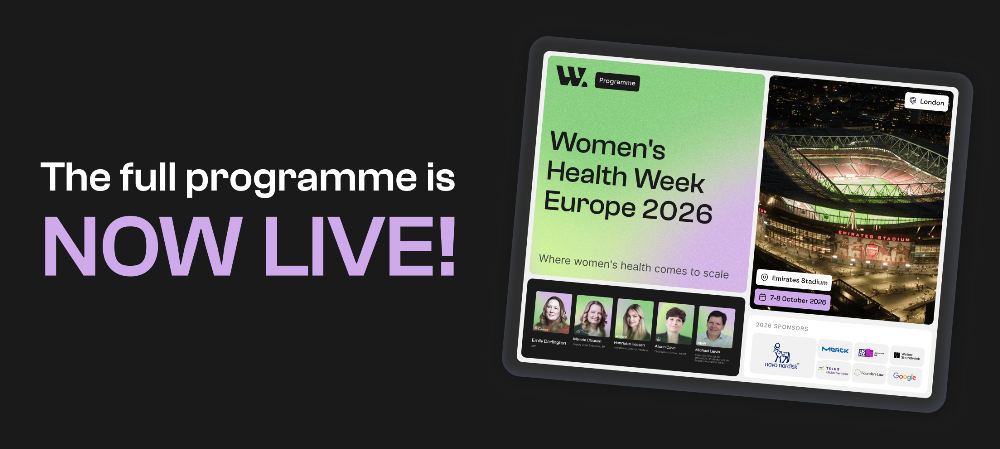
Women’s Health Week Europe 2026 has released its fully populated speaker and session lineup ahead of the event’s return to The Emirates Stadium in London on 7–8 October, with 80+ speakers now confirmed across two dedicated stages.
The programme
The agenda runs across two dedicated stages in parallel, plus two pitch competitions across both days.
The Global Stage opens with a keynote from Merete Clausen (EIF) before moving into sessions on funding trends, AI, the gender data gap, the wearable revolution, and European policy.
Standout sessions include The Age of Digital TransformAItion featuring Nichole Young-Lin (Google), Frida Polli (MIT), and Sapna Shah (Sie Ventures); Lone Wolf or Pack Leader on collaboration versus fragmentation, with Eirini Rapti (Inne), Tatum Getty (Thena Capital), Novo Nordisk, and Jen Roberts-Woods (Borski Fund); and a live debate on whether the women’s health label helps or hinders founders. Day one closes with a keynote from Alison Cave, Chief Safety Officer at the MHRA.
The Scale Stage runs a practical playbook track in parallel, with sessions covering regulatory approval pathways, international expansion, the founder’s legal playbook, PR strategy, and implementing AI into a women’s health business.
The Reverse Pitch flips the usual format: investors and corporates pitch the room on what they are actively looking to fund, acquire, or partner on right now.
View the full agenda and speaker lineup
Pitch competitions
The WHW Europe pitch competitions are back, taking place in front of the audience across both days on the mainstage. 16 finalists will compete across two categories: Consumer & Tech on day 1 and Medical Devices & Therapeutics on day 2.
Any company treating a condition that affects women exclusively, differently, or disproportionately is eligible to apply.
Applications and close 28 August 2026.
Previous alumni include Circe, who secured £100k from Innovate UK, BoobyBiome, who closed a £2.5M seed round post-WHW Europe, and Amilis, who secured £1M at London Tech Week after winning at WHW USA 2026.


An endometriosis musical by two US writers will debut at the Edinburgh Festival Fringe in August.
“Endometriosis: The Musical” follows Jane, a woman trying to discover why she is living with chronic pain.

Maria Bartholdi and Kristin Stowell first developed the production for the 2022 Minnesota Fringe Festival.
The full show premiered at Theater in the Round in Minneapolis in 2025.
Stowell said the play drew on personal experience, although neither writer realised it at the time.
“So it’s like my goal to let women see themselves in this who are dealing with this and have a question they can bring back to their doctor,” she said.
“Like, could it be endometriosis?”
Bartholdi said she did not realise she might have the condition herself until after the play premiered.
“This show helped diagnose me, which I think is just one of the miraculous things that we hope this the show does for other people as well,” Bartholdi said.
Dr Wendy VanBuren, a radiologist at Mayo Clinic in Rochester, said she was a fan of the musical and its role in raising awareness of a common but underdiagnosed disease.
“Cells that are similar to but not identical to the cells that comprise the lining of the uterus, the inside of the uterus, are located outside the uterus,” said VanBuren.
“When they’re outside the uterus, there isn’t the right environment to deal with that. So basically, what you get is bleeding, and then you get inflammation.”
Roughly one in seven women live with the disease, and receiving a diagnosis can take nearly a decade.
Hosted by Amanda Ducach, CEO, and Morgan Rose, chief science officer, EmaEQ
Healthcare companies have spent the last two years hearing the same advice: get AI into your product. Few have been told what that actually takes.
Most default to the fastest option. Plug in a general-purpose model, wrap it in a chat window, and call the box checked. It looks like progress on a roadmap slide. It rarely holds up once a real patient is on the other end of it.
We’ve spent years building AI specifically for healthcare, and the lesson that keeps repeating itself is simple: accuracy is not the same thing as trust, and trust isn’t something you bolt on after launch. It has to be part of how the system is built from the first line of code, not a feature added once regulators or users start asking questions.
That distinction is the whole reason clinical accuracy gets treated as a checkbox instead of a discipline. A model can sound confident and still be wrong in ways that matter enormously in a health context.
Knowing the difference, and building for it deliberately, is what separates AI that’s genuinely safe for care from AI that’s simply fast to ship.
On July 20th, we’re hosting a live conversation about exactly this: what companies should be paying attention to before they choose an AI to build with, what clinical accuracy really requires, and the pillars we hold every AI system to before it gets anywhere near a patient’s care.
The Healthcare AI Playbook Webinar: July 20th, 1:30-2pm EST, live on LinkedIn.
Register here: https://www.linkedin.com/events/7482643171823509504?viewAsMember=true
If your team is building anywhere near healthcare, or evaluating what’s already in your product, this is the conversation we think the industry needs right now.











 News5 days ago
UK femtech investment surges 194% in a decade, research finds

 Fertility2 weeks ago
Natural Cycles receives sixth FDA clearance for fertility algorithm

 Wellness1 week ago
Cancer patient receives ‘landmark’ treatment in world-first

 Insight2 weeks ago
Experimental treatment significantly slows progression of fatal brain disease in women, study finds

 Diagnosis6 days ago
TidalSense raises £14m to expand five-minute COPD test across NHS

 Sponsored Content2 weeks ago
The room is filling up at WHW Europe 2026 with super early bird pricing ending this Friday

 News5 days ago
Cross-Border Impact Ventures raises US$58m for women and children’s health

 Insight2 weeks ago
Johnson & Johnson offers to pay US$5.5bn to settle talc cancer lawsuits