




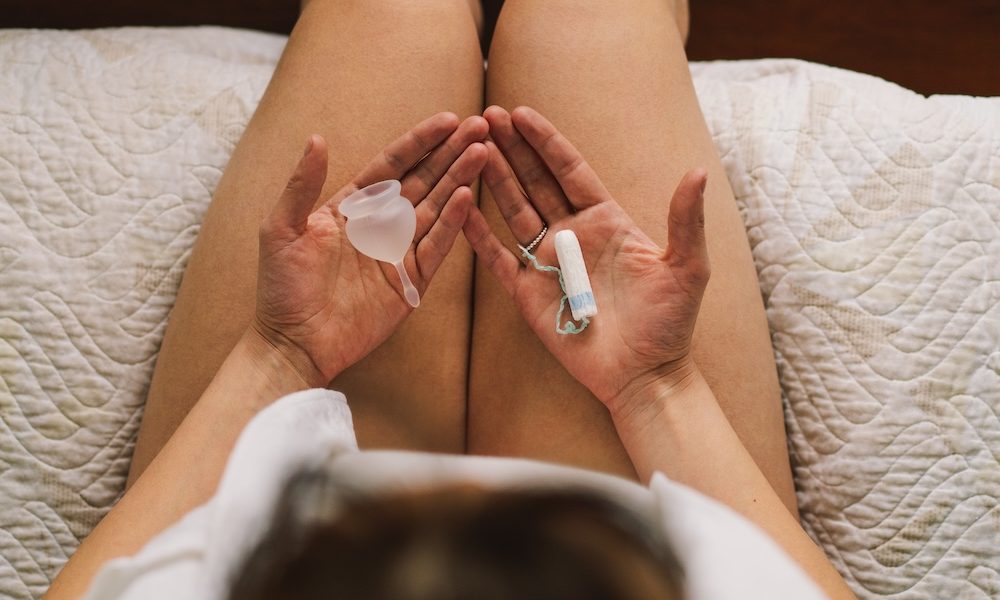
A team of US researchers has developed a biomaterial designed to improve the performance of current period products by making the blood harder to spill out.
Researchers at the Virginia Polytechnic Institute and State University developed the blood absorbent biomaterial with the aim of improving the performance of menstrual products by minimising blood leakage and spilling.
The innovation, the team says, should help prevent infection, while also being environmentally friendly.
Lab leader Bryan Hsu, assistant professor of biological sciences, wanted his next project to focus on an area of research that had long been neglected and that’s when he landed on menstruation.


“It’s something that people don’t feel comfortable talking about, and that’s maybe an indication of why it hasn’t gotten enough attention,” he explained.
Menstrual products have evolved little during the last century. The primary products available today were developed nearly 100 years ago: the disposable menstrual pad in 1888, the tampon in 1933, and the menstrual cup in 1937.
Postdoctoral associate Harsimran Kaur, who led the project, said: “There is very little awareness about the importance of good menstrual care, and poor practices can negatively affect women’s health. This is an area that impacts women but isn’t often given attention.”

Harsimran Kaur, Bryan Hsu, and Rogerio Bataglioli / Photo by Jenise Jacques for Virginia Tech
Hsu and the team used an alginate-glycerol powder formula that, when added to a traditional menstrual pad, allows the accumulated blood to turn into a gel. The pad can then absorb more blood and leak less than a traditional pad.
“A pad with the powder formula absorbs the blood, and if you squeeze it, it doesn’t come back out. But in a normal menstrual pad, if you do the same experiment, it comes right back out,” he explained.
When the powder formula is added to a cotton coil and inserted into a menstrual cup or disc, the blood collected there also turns into a gel, eliminating the mess when removing or changing the cup or disc.
Carrie Champine, board-certified obstetrician and gynaecologist who collaborated with the team, said: “Leakage is a fear for all users of menstrual hygiene products. All of us have experienced it, leading to embarrassment and missed school days and workdays.
“Users of menstrual products are always looking for products that are comfortable and tailored to their body and flow patterns, with minimal risk of leakage or menstrual product failure.”
Findings have shown the powder formulation, which is derived from natural sources, seaweed, and sugar alcohol, is biodegradable and safe to use.
“It’s found everywhere in foods and it’s approved by the Food and Drug Administration (FDA), so it’s considered safe,” said Hsu. “It is in the boba tea or the cheap sushi you get in restaurants.”
Unlike most used period products, which take over 500 years to biodegrade, this method is also environmentally friendly, the researcher noted.
Women’s health progress
According Hsu, as of 2020, 46 per cent of women in Virginia are of menstrual age, which is 26 per cent of all Virginians, and roughly a fourth of the state’s total population. While menstruation is not a disease, it does impact absenteeism in the workplace and in school.
“A woman will have a period for approximately five days every 30 days throughout her lifetime, which is roughly 2,200 days, or 6.2 years of her life,” he explained. “For comparison, the average American spends 8.3 years watching television and 4.5 years eating.
“Women are half the population and go through menstruation every month. It’s a natural process that dramatically affects quality of life. For some, it can be debilitating,” he added.
Hsu sees this as just the beginning of his venture into promoting women’s health issues.
“I think women’s health is becoming more and more something people want to research. This is kind of my first step in a series of things to take care of women.”
His colleague, postdoctoral associate Rogerio Bataglioli, who led the project, is hopeful for new opportunities in the design of menstrual products.
“Using biomaterials can expand the potential functionality of these menstrual products,” Bataglioli said.
“Women face an array of challenges related to menstrual health, and we think using advanced functional materials can help us come up with innovative solutions.”
To receive the Femtech World newsletter, sign up here.


Newsletter
Sign up for free weekly updates
The latest femtech news, research and investment, straight to your inbox.




