




Cancer
Therapeutic HPV vaccine could eliminate precancerous cervical lesions


A therapeutic vaccine targeting human papillomavirus type 16 (HPV16) induced regression in high-grade precancerous cervical lesions, according to the results from a Phase 2 clinical trial.
In those with grade 3 cervical intraepithelial neoplasia (CIN3), cells are already on the path toward malignancy. If left untreated, approximately one-third of these cases progress to cervical cancer within 10 years and roughly half within 30 years.
The Vvax001 vaccine is a modified version of the Semliki Forest virus that cannot replicate and produces the oncogenic E6 and E7 proteins that are expressed exclusively by HPV16-infected cells.
In the Phase 2 trial, 18 patients with HPV16-positive CIN3 received three doses of Vvax001 three weeks apart, and then were routinely monitored via colposcopy before a final colposcopy-guided biopsy at 19 weeks post-immunisation.
“Nearly all premalignant cervical lesions and cervical cancers are caused by HPV infection, with HPV16 implicated in the majority of cases,” said Refika Yigit, principal investigator and oncological gynaecologist at University Medical Centre Groningen in the Netherlands.
“The main purpose of our trial was to investigate whether our therapeutic vaccine—Vvax001— could offer a potential alternative treatment to the standard-of-care loop excision, which is frequently associated with complications.”
Nine of the 18 patients experienced regression—six to low-grade dysplasia and three with complete regressions and no signs of dysplasia.
Lesion size was significantly reduced in all but one of the patients, and these reductions were evident within a month of finishing vaccination.
The nine patients whose disease did not regress received loop excision surgery, though no residual disease was found in four of these patients, suggesting the additional time to surgery might have allowed for full lesion eradication, according to the authors.
“To the best of our knowledge, this response rate makes Vvax001 one of the most effective therapeutic vaccines for HPV16-associated CIN3 lesions reported to date,” said Yigit.
“If confirmed in a larger trial, our results could mean that at least half of the patients with CIN3 might be able to omit surgery and avoid all its possible side effects and complications.”
In the standard-of-care setting, HPV clearance is linked to lower risk of recurrence, and Yigit said her team expects the same here. Ten of the 16 patients evaluated cleared HPV16, including all nine of those whose disease regressed. Two patients whose disease did not regress also cleared HPV16; however, their lesions harboured other HPV strains.
After a median follow-up of 20 months, none of the patients had recurrences.
Limitations of the study include limited follow-up time, small sample size, and lack of a control group for spontaneous regression due to ethical concerns.





Diagnosis
New meta-analysis further supports low re-excisions and high placement accuracy with the Magseed marker

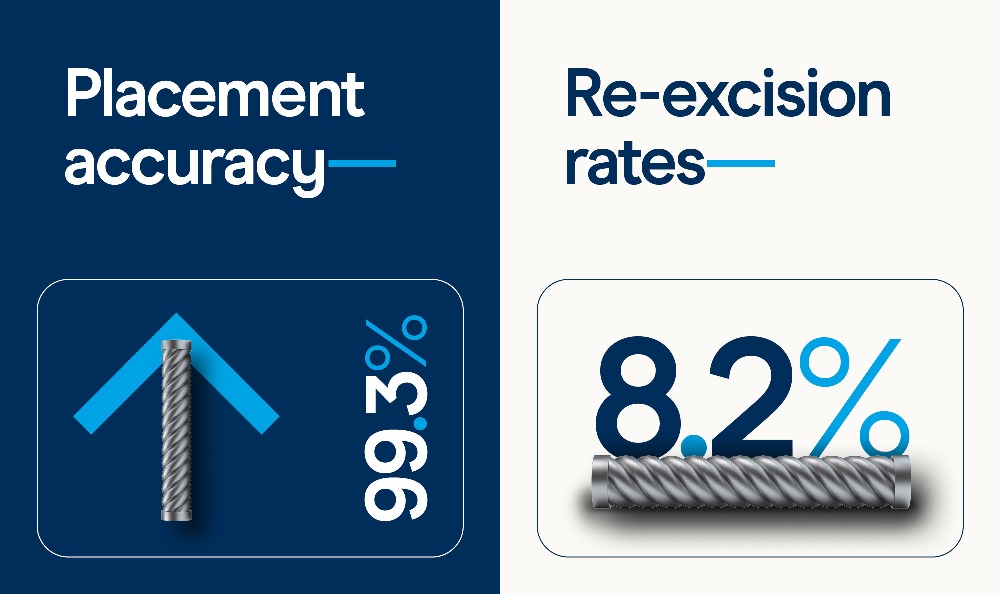
An independent meta-analysis from January 2026, pooling 2,117 patients and 2,176 Magseed marker placements, has reported low re-excision rates (8.2%) and low positive margins (7.6%) when the marker is used to localise non-palpable breast lesions prior to breast‑conserving surgery (BCS).
Al Darwashi et al. (2026) pooled 16 studies to evaluate safety and efficacy outcomes when the Magseed marker was used for preoperative localisation of non-palpable lesions prior to BCS.
The authors reported high placement accuracy, reliable intraoperative retrieval and low rates of positive margins, re-excisions and complications.
In a cohort cited by the review, Moreno‑Palacios et al. (2024) also observed that Magseed marker facilitates less extensive resections compared to guidewires, promising improved cosmetic outcomes while maintaining oncological efficacy.
The key findings
Low re-operation burden: Positive margins occurred in just 7.6% of cases, and only 8.2% required re-excision across the included series.
High placement accuracy: The success rate for Magseed marker placement showed 99.3% positioned within 10 mm of the lesion.
Of note, 96.6% of Magseed markers were placed within an even stricter 5 mm radius.
Reliable retrieval: The pooled intraoperative retrieval success was 99.6% for the Magseed® marker.
“This meta-analysis demonstrated Magseed as a safe and effective preoperative localisation technique for BCS in the management of selected non-palpable breast lesions.” Al Darwashi et al. (2026)
Ready to find out more about the Magseed marker and the Sentimag system?
→ Speak to a Magseed marker expert
Magseed® is a trademark of Hologic, Inc. or its subsidiaries in the United States or other countries. Intended for medical professionals and use in the U.S., UK and the EU only.

Wellness
Poor mental health, poverty and pollution significantly raise women’s heart failure risk – study


GSK said its ovarian cancer drug shrank or cleared tumours in more than 60 per cent of patients in an early trial as CCO Luke Miels pushes faster development.
The company said that in an early-stage trial, Mocertatug Rezetecan, known as Mo-Rez, shrank or eliminated tumours in 62 per cent of patients with ovarian cancer after chemotherapy had failed, and in 67 per cent of those with endometrial cancer.

Hesham Abdullah, GSK’s global head of cancer research and development, said: “Treatment of gynaecological cancers remains a major challenge, with a pressing need for new therapies that offer improved response rates.
“With Mo-Rez we now have compelling evidence of a promising clinical profile.”
GSK acquired the Mo-Rez treatment, an antibody-drug conjugate, from China’s Hansoh Pharma in late 2023 and has trialled it in 224 patients around the world, including the UK, over the past year.
Only a few patients needed to stop treatment because of side effects, the most common being nausea.
It is given every three weeks by intravenous infusion, meaning directly into a vein.
Combined with data from a separate intermediate trial in China, the results have given the British drugmaker the confidence to go straight to late-stage trials, with five clinical studies planned globally in the next few months, including on patients in the UK.
Speaking to journalists before the conference, Abdullah described Mo-Rez as a “key asset” in the company’s growing cancer portfolio.
It is expected to be a blockbuster drug, with peak annual sales of more than £2bn, which GSK hopes will help it achieve its 2031 sales target of £40bn.
A few years ago GSK did not have any cancer drugs on the market, but it now has four approved medicines and 13 in clinical development.
Last year, oncology generated nearly £2bn in sales, up 43 per cent from 2024, with sales of its endometrial cancer drug Jemperli rising 89 per cent.











 Entrepreneur3 weeks ago
Three sessions that show exactly where women’s health is heading in 2026

 Pregnancy3 weeks ago
How NIPT has evolved and what AI NIPT means in 2026

 Menopause4 weeks ago
Watchdog bans five ads for women’s heath claims

 Events4 weeks ago
WHIS USA 2026 announces first ticket release for landmark Women’s Health Innovation Summit

 Menopause4 weeks ago
Menopause has no lasting impact on cognition, research finds

 News3 weeks ago
Two weeks left to make your mark in women’s cardiovascular health

 Opinion3 weeks ago
Q1 momentum: Female founders are advancing, but the system still hasn’t caught up

 News4 weeks ago
Endometriosis firm wins NIH prize